Prairie Rose Chapter

Deep Dive: Mexican Hat courtesy Lady Bird Johnson Wildflower Center

**ARCHIVED POST **

Deep Dive: Mexican Hat

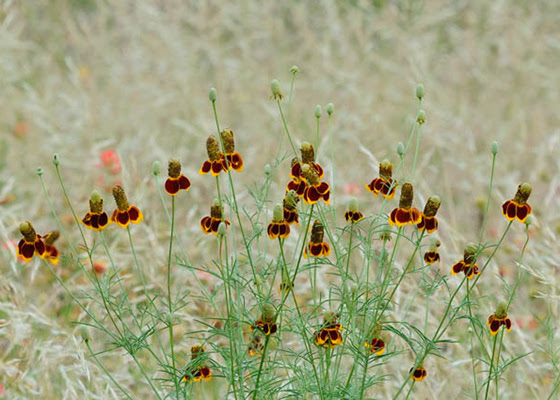
Bunch of Mexican hats in the field
Zooming past wildflowers along roadsides or glimpsing them on a bike ride or jog is pleasant enough. But there’s a wealth of plant intel — and some pretty otherworldly eye candy — available if you stop and take a closer look, which is what we did with Mexican hat (Ratibida columnifera) as our model.

An unfussy, drought-hardy perennial, Mexican hats vary from entirely yellow to deep, rusty orange (with many combinations therein), all of which pop atop feathery green foliage. These plants are members of the aster family, but unlike many of their relatives (such as asters, daisies and sunflowers), Mexican hats’ disk florets (the ones in the center) adorn tall columns rather than flat faces.

On that note, let’s take a journey down the Ratibida rabbit hole and learn some plant anatomy.
 

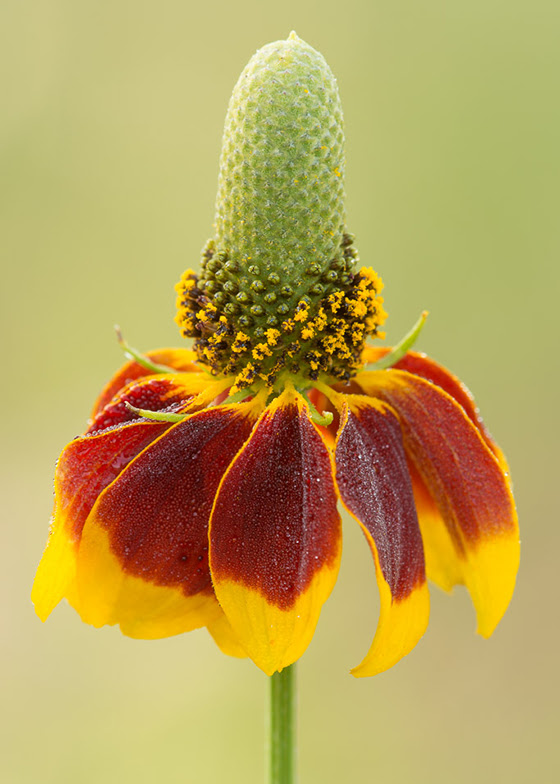
Mexican hat showing two types of inflorescence
This image clearly shows the two types of flowers present on a Mexican hat inflorescence (or head): small disk florets on the central column (yes, those little things are flowers!) and ray flowers — the colorful drooping petals — around the base. Disk florets bloom from the bottom of the column to the top over a period of days.
 
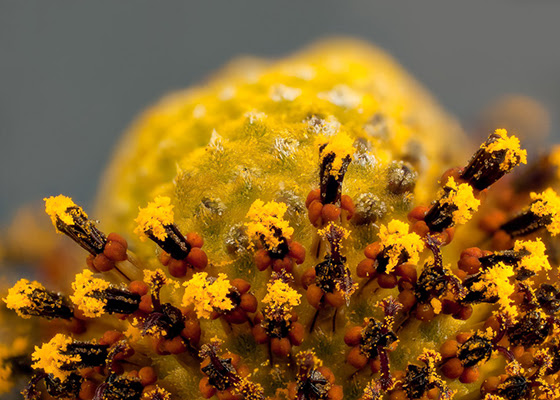
Close-up of disk florets with corolla petals, anther tubes and pollen
Zeroing in on a collection of disk florets, we see brownish-orange corolla petals, chocolate-colored anther tubes and golden grains of pollen. Some anthers are closed, while others show exposed female stigmas curling out the ends.  
 
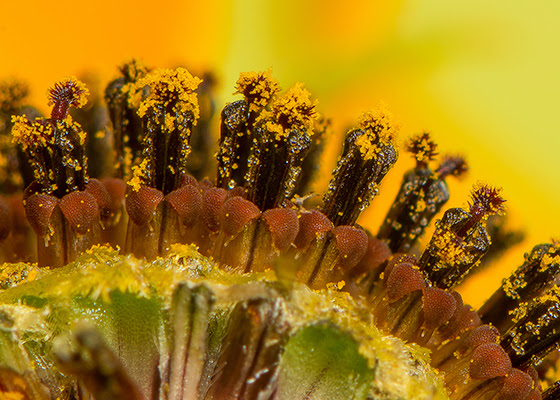
Close-up showing both make and female flower structures
Each disk floret contains both male and female flower structures. As the female style elongates within the male anther tube, pollen sacs rupture, and pollen is pushed out on stigmas with specialized fleshy bristles (most conspicuous on the far right and left of this image). This process is termed “plunger pollination” and is the main system of pollination within Asteraceae (the aster family).

One distinguishing feature of this process is that the female parts help present male pollen to pollinators, facilitating outcrossing (pollination with pollen from a different plant of the same species) and avoiding self-pollination. Once pollen is carried to the mature stigma of a different flower via wind or insects, fertilization begins. Eventually, a seed will be produced at the base of each fertilized floret.

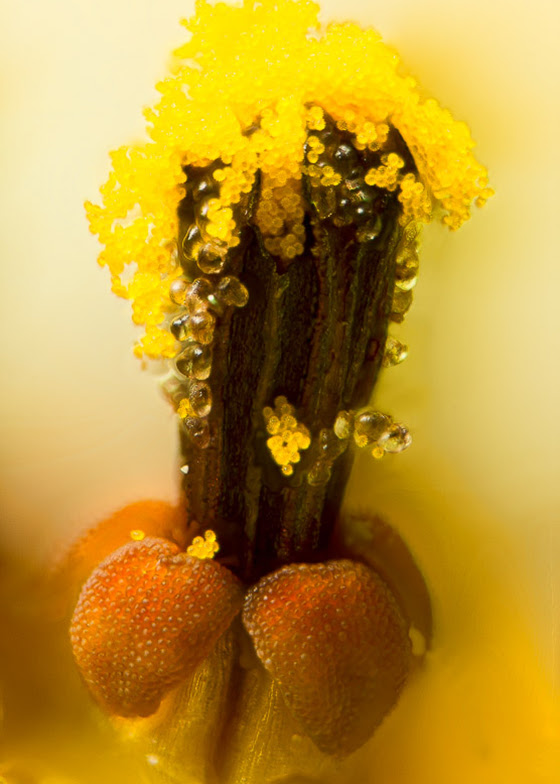
Macro view of a single disk floret showing corolla petals, anther tube and yellow pollen
This macro view of a single disk floret shows corolla petals, an anther tube and plenty of bright yellow pollen. The clear-colored sacs along the anther are trichomes that secrete insect-repelling chemicals (which protect immature pollen from insect raiders).

Multiply that by several hundred ray florets per flower head and more than a dozen flower heads per plant, and it’s clear nature has a lot going on in plain sight — if we look closely (and a macro lens doesn’t hurt).

**ARCHIVED POST**

**ARCHIVED POST LINKS & PICTURES MAY NOT WORK**

**ARCHIVED POST AUTHOR: prairierose

About the Region

Fall Symposium 2025 Logo - Teach for the Future

Salado, the location of our Fall 2025 Symposium, lies at the intersection of two ecoregions: the Edwards Plateau (Limestone Cut Plain) and Blackland Prairie (Northern Blackland Prairie).

The Edwards Plateau area is also called the Hill Country; however, this general term covers a much larger area extending farther north. Spring-fed creeks are found throughout the region; deep limestone canyons, rivers, and lakes (reservoirs) are common. Ashe juniper is perhaps the most common woody species found throughout the region. Additional woody species include various species of oak, with live oak (Quercus fusiformis) being the most common. Sycamores (Platanus occidentalis) and bald cypress (Taxodium distichum) border waterways. This area is well known for its spring wildflower displays, though they may be viewed in spring, late summer, and fall, as well. According to Texas Parks and Wildlife, average annual rainfall in the Edwards Plateau ranges from 15 to 34 inches.

The Blackland Prairie extends from the Red River south to San Antonio, bordered on the west by the Edwards Plateau and the Cross Timbers, and on the east by the Post Oak Savannah. Annual rainfall averages 30 to 40 inches, with higher averages to the east. This region is dominated by prairie species. The most common grass species include little bluestem (Schizachyrium scoparium) and Indian grass (Sorghastrum nutans) in the uplands and switchgrass (Panicum virgatum) in the riparian areas and drainages. Common herbaceous flowering plants include salvias, penstemons, and silphiums. This area has suffered greatly from overgrazing and agricultural use. Few intact areas remain, though many of the plants can be found along county roadsides throughout the region.

Our fall Symposium host chapter, the Tonkawa Chapter, includes both of these ecoregions.

Source: Wildflowers of Texas by Michael Eason