Guadalupe Chapter

Guadalupe Chapter General Information

Chapter Monthly Meeting Schedule & Directions

Guadalupe Chapter Monthly Meetings include a Social at 6:30 PM, a Presentation at 7PM, followed by a Business Meeting.

There are nine Monthly Chapter Meetings and generally a December Social.

The January, March, May, September and November meetings are held in Seguin at the First Presbyterian Church; 1121 East Walnut St., Seguin, Texas

The February, April, June and October meetings are held in Marion at St. John Lutheran Church; 600 South Center Street (FM 465), Marion, Texas

December Socials will be announced separately.

The Guadalupe Chapter usually doesn’t meet in July and August

Directions to St. John Lutheran Church in Marion Texas

Address:  600 South Center Street (FM 465), Marion, Texas
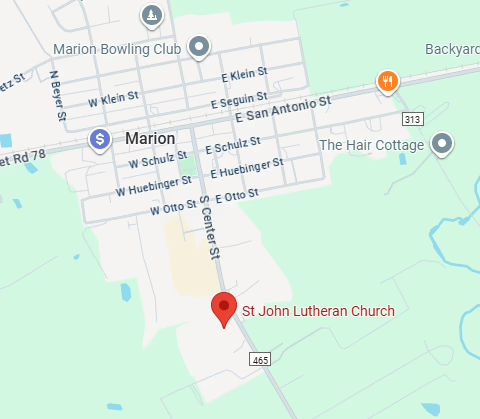
 

 FM 78 passes East/West through the middle of Marion. At the stop light in the middle of town at Center Street (Route 465), turn South onto Center Street. Proceed 1/2 mile and St. John Lutheran Church will be on the Right side of the road.

If coming from Interstate 10, at Exit 599, turn North on FM 465 towards Marion. Proceed about 3.4 miles and St. John Lutheran Church will be on the Left just as you arrive in Marion.

Directions to First Presbyterian Church in Seguin

There are numerous paths to First Presbyterian Church which is on the east side of Seguin.
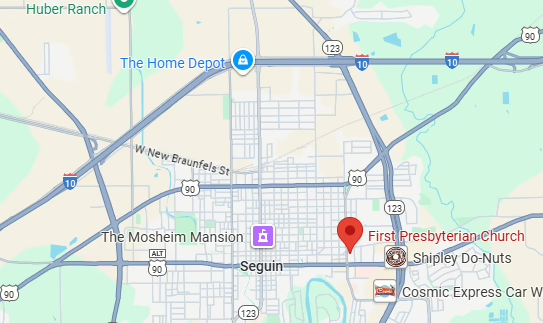
Parking for First Presbyterian is behind the church and is only accessible from Moss Street.
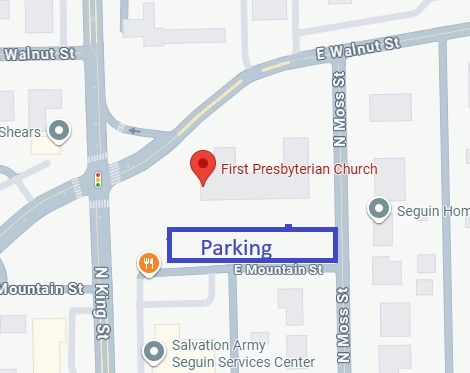
From outside Seguin, I suggest you take the most direct route to Route 90 or Alternate 90. Turn towards the church on North King Street. Turn on East Walnut Street. Pass First Presbyterian and turn right on Moss Street.

About the Region

Fall Symposium 2025 Logo - Teach for the Future

Salado, the location of our Fall 2025 Symposium, lies at the intersection of two ecoregions: the Edwards Plateau (Limestone Cut Plain) and Blackland Prairie (Northern Blackland Prairie).

The Edwards Plateau area is also called the Hill Country; however, this general term covers a much larger area extending farther north. Spring-fed creeks are found throughout the region; deep limestone canyons, rivers, and lakes (reservoirs) are common. Ashe juniper is perhaps the most common woody species found throughout the region. Additional woody species include various species of oak, with live oak (Quercus fusiformis) being the most common. Sycamores (Platanus occidentalis) and bald cypress (Taxodium distichum) border waterways. This area is well known for its spring wildflower displays, though they may be viewed in spring, late summer, and fall, as well. According to Texas Parks and Wildlife, average annual rainfall in the Edwards Plateau ranges from 15 to 34 inches.

The Blackland Prairie extends from the Red River south to San Antonio, bordered on the west by the Edwards Plateau and the Cross Timbers, and on the east by the Post Oak Savannah. Annual rainfall averages 30 to 40 inches, with higher averages to the east. This region is dominated by prairie species. The most common grass species include little bluestem (Schizachyrium scoparium) and Indian grass (Sorghastrum nutans) in the uplands and switchgrass (Panicum virgatum) in the riparian areas and drainages. Common herbaceous flowering plants include salvias, penstemons, and silphiums. This area has suffered greatly from overgrazing and agricultural use. Few intact areas remain, though many of the plants can be found along county roadsides throughout the region.

Our fall Symposium host chapter, the Tonkawa Chapter, includes both of these ecoregions.

Source: Wildflowers of Texas by Michael Eason