NICE! Plant of the Month
(Ilex vomitoria)
Description:
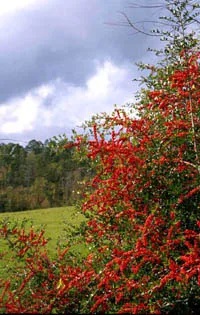
Yaupon Holly may be grown as a multitrunked shrubby or single trunked small tree. It is native across the entire Southeastern US with its western range extending into central Texas. In the Hill Country it seldom reaches its potential height of 25 ft. being seen more often at maturity at approximately 15 ft. Yaupon is dioecious, with inconspicuous male and female flowers appearing on different trees in spring. Small ¼ inch drupes cluster tightly along stems of female trees and turn bright red in early winter. The fruit persist throughout the cold season. The glossy evergreen leaves are simple, alternate, oval to oblong, ½ to 2 inches long, and leathery to the touch with small rounded toothed margins. Relatively free of disease and insects. The fruits are poisonous to humans, but are consumed in late winter by birds. Cultivars include both fruitless dwarfs and yellow-fruited standard varieties. Most commercially available specimens are vegetatively reproduced females selected for abundant or vibrant colored fruit.
Deer Resistance:
Deer-resistant, but all trees need to be caged while small.
Planting Sites:
Yaupon is adaptable to all Hill Country soil types including caliche with poor to good drainage. It grows well in full sun, part shade or full shade of tall trees. Cold hardy. Yaupon is moderately drought tolerant once established, surviving on 24 inches or more of precipitation.
Planting Instructions:
Dig hole 2-5 times wider than, but the same depth as the root ball in the nursery container. Carefully remove plant from container, taking care not to break the root ball. Loosen exterior roots, if root bound. Refill the hole using removed dirt amended with no more than ¼ volume of compost. Do not add any soil to the top of root ball, but do apply 2-3 inches of mulch over the disturbed soil area and root ball up to within 1-2 inches of trunk.
Watering Instructions:
Water in well during planting. An organic-based root stimulator, used according to product directions, may be applied. Repeat watering a few days after planting. Thereafter, water deeply every 7-10 days, after checking an inch or two into soil at edge of root ball to determine soil moisture. Skip a watering after a rain of ½ to 1 inch. Maintain this watering schedule until the first fall after planting. Reduce water during fall and winter. In a “normal” year, no watering may be necessary in fall and winter, but during a dry period, monthly watering may be desirable.
NICE! Tip:
The caffeine-rich leaves may be heat dried and used to make tea. Evergreen Yaupon Holly has a dense branching structure that makes it ideal for screens or as specimen plants. It responds well to training into any shape.
Look for the NICE! Plant of the Month signs and information sheets on your next visit to a participating Boerne nursery. And thank you for supporting native plants by using them in your landscapes.