NICE! Plant of the Month
(Yucca rupicola)
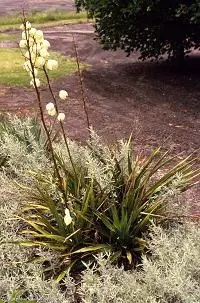
Description:
Endemic to the Edwards Plateau, Twist-leaf yucca gets its name from its wonderful twisting leaves. It is a low-growing yucca without a visible stem with single or clustered heads of twisted, arching blue-green leaves 8-24 inches long. Flowers are held on stalks as long as 9 feet and bloom mostly in spring (April/May) or early summer (June/July).
Deer Resistance:
Deer are fond of browsing the stalks, buds and flowers of the yucca.
Planting Sites:
Twist-leaf yucca is native to rocky limestone hills or woodlands in the Edwards Plateau. It will grow in full sun (where it blooms best), or as an under story plant. It is very difficult to transplant from the wild, but is sold as a container plant by several nurseries.
Planting Instructions:
Dig a hole at least two times wider than, but the same depth as the root ball in the nursery container. The sides of the hole should be irregular, not smooth. Remove plant from container, taking care to support the root ball. Loosen exterior roots gently with fingers. If the plant is root-bound, the outer roots may be cut in several places if they cannot be loosened by hand. Lift the plant by the root ball and place it in the hole. Backfill using soil that was dug from the hole. Do not add any soil to the top of the root ball, but a thin layer of compost may be spread over the surface. Gently firm the soil. but do not tamp. Place 3-4 inches of mulch over the bare soil and root ball around the plan, but not touching the base of the plant.
Watering Instructions:
Water in well after planting to settle soil around roots. Water deeply a couple of times a week for 2-4 weeks after planting, then every 7-10 days, as needed, during the first growing season. Check moisture an inch or two into soil at the edge of the root ball to determine soil moisture. Skip a watering after a rainfall of ½ to 1 inch. Maintain this watering schedule until the first fall. Reduce watering during fall and winter. In a “normal” year, no watering may be necessary during fall and winter, but during a dry period, monthly watering may be needed. From the second spring and throughout the second summer, water monthly only in periods of drought. Watering should be unnecessary after the plant is thoroughly established.
NICE! Tip:
Twistleaf yucca is very effective on difficult-to-landscape sites such as rocky slopes or escarpments, in shallow soils in groupings with Bear Grass, Cedar Sage, Turk’s Cap and Fragrant Mist Flower.
Look for the NICE! Plant of the Month signs and information sheets on your next visit to a participating Boerne nursery. And thank you for supporting native plants by using them in your landscapes.