NICE! Plant of the Month
(Stachys coccinea)
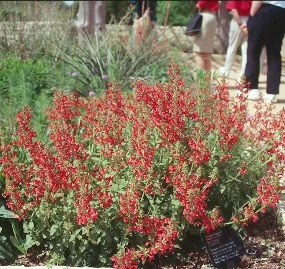
Description:
Texas Betony, is a flowering and evergreen perennial, 12 to 18 inches tall or more. It naturally grows in moist crevices of the mountains of West Texas, west to Arizona, and northern Mexico. It produces red or pink tubular flowers and has a long bloom season, from spring until fall. The grey-green leaves are opposite, fuzzy, toothed, triangular, and up to 3 inches long. Texas Betony is a favorite nectar plant for hummingbirds, honeybees and the Pipevine Swallowtail butterflies.
Deer Resistance:
Deer resistant due to the very pungent leaves.
Planting Sites:
Texas Betony prefers well-drained soil and partial shade. It is very drought tolerant after established. It is an excellent border plant for the shade. Propagate by division, cuttings or seeds. Do not plant too close to the edge of the flower bed or the flowers will spill over into the yard.
Planting Instructions:
Dig a hole at least two times wider than, but the same depth as the root ball in the nursery container. Remove plant from container, taking care to support the root ball. Gently loosen exterior roots gently with fingers. Plant at the same depth as the soil in the container. Backfill using soil that was dug from the hole. Add 3-4 inches of mulch. Space plants 12″ apart.
Watering Instructions:
Moderate water use. Give extra water if placed in full sun. After planting, water deeply in order to settle soil around roots. Water deeply the first two weeks and then every 7-10 days, as needed, during the first growing season. Check moisture an inch or two into soil at the edge of the root ball to determine soil moisture. Skip a watering after a rainfall of ½ to 1 inch. Maintain this watering schedule until the first fall. Reduce watering during fall and winter. In a “normal” year, no watering may be necessary during fall and winter, but during a dry period, monthly watering may be needed. From the second spring and throughout the second summer, water monthly only in periods of drought. Watering should be unnecessary after the plant is thoroughly established.
NICE! Tip:
Texas Betony can be used in flower pots or as a ground cover. Foliage hardy to 32°F (0°C). Remove spent blooms or allow to mature and start new plants. Plant Texas Betony instead of Vinca minor or Liriope.
Look for the NICE! Plant of the Month signs and information sheets on your next visit to a participating Boerne nursery. And thank you for supporting native plants by using them in your landscapes.