Hans Hofmeister 8-3-23
As a new homeowner in 2005, I had many exciting plans for a native plant type yard. In the 18 years since, numerous results have manifested, some unexpected.
Since we had a native Texas grape talk at the recent chapter meeting I thought my experiences with the muscadines might be helpful.
I bought 8 vines from Ison’s Nursery about 15 years ago. I don’t remember the types but half were the maroon color muscadines and the others were the bronze color. I planted them in my dark gray gumbo soil with lots of MicroLife and that seemed to work fine.
For the first year or two, I fastidiously grew them onto a structure of poles with a heavy steel wire running across the top. Watching them climb and spread was entertaining. In fact, the other day I saw one running across a wire, and the uncurling end of the vine looked like a head. The two tendrils were reaching far in a Y shape on either side of the head like arms. It looked alive. The arms grabbed the wire after a day or two and then it continued on.
I also liked how thick the leaves were when it was trained on the wire. In the right location it could make an excellent awning.
In the long awaited first harvest years ago, the maroon and gold/green grapes looked delicious. They had a great flavor. The maroon ones in particular were good, grapelike but with a tanginess and something like a watermelon flavor. Really refreshing.
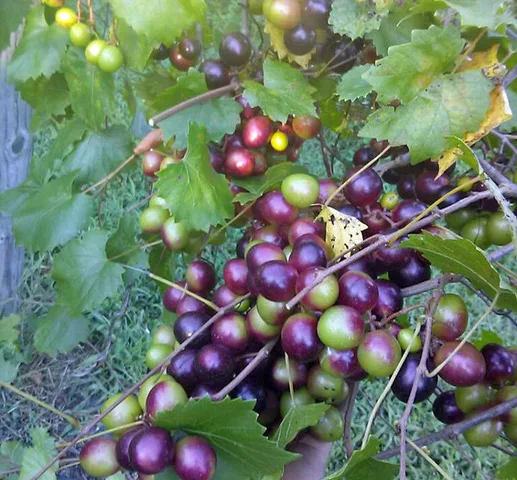
The big seeds inside were a problem, like 8 or 9 chunks of grape nuts cereal. Also the skin was between 1/8 and 1/4 inch thick, and very rubbery. So it was kind of a lot of work to get the edible pulp out.
I tried making preserves or jelly. Unfortunately the skin persisted through the canning process. So the “bronze” ones especially, looked like a jar of very sweet olives! Eck. Chewy.
I moved on to other projects and the carefully cultivated vineyard plants “escaped.” They grew away and also many grapes spawned new plants.
Now, 15 years later, the vines are everywhere in the trees, thickets, and on top of many areas of the forest. It is not shading the pine trees, etc. too much. But it seems to have a hidden benefit.
In hurricane Rita, I did a lot of prep work, like boarding up the windows, for nothing. So I was more blasé about Ike. Then it came up Galveston bay and that is only 20 miles from me. I had 100 mph winds from two different directions for many hours. The ground was shaking.
The next morning, I went out and tree leaves were shredded to the size of quarters and nickels. They were stuck all over the sides of the barn and house like thousands of pieces of green tape. Then the sun came up. The pieces all dried and fell off.
However on the ground level, in between the thickets and trees with their muscadine nets, the wind must have been a lot slower. Lawn chairs I hadn’t bothered to put away were still in the same place. So it seems to me that a healthy net of muscadines can protect from hurricanes. Also I can imagine that thickets and vines would help in a flood. They might stop boards, cars, cows, etc. from floating into your yard.
Meanwhile, now the muscadines are landing everywhere in my yard from high above, even with this drought I didn’t realize the vines were so extensive up there. About half the grapes look eaten when they land. I would think the big seeds have a lot of nutrition.
I also have a pipe which puts the A/C condensation into a bird bath on the ground. I think this and the muscadines are why squirrels etc. have never bothered my tomatoes.
If you try this adventure you can see it has many ways to be successful. And supposedly muscadines can live for 400 years.
Even in the beginning I was using Native Plant Society – Houston’s many-page native plant guide to help me pick plants. Thank you everyone who worked so hard to put that together. It was a huge help.