Meadow Garlic

Allium canadense

Other common name(s):

Wild Garlic, Wild Onion

Family:

Amaryllidaceae (Daffodil Family)

Plant Ecoregion Distribution Map

This map uses data from the US EPA. EPA  servers have been offline frequently so maps may not display. We are working on a solution.

Central Great Plains, Cross Timbers, East Central Texas Plains, Edwards Plateau, Gulf Coast Prairies and Marshes, Texas Blackland Prairies, Western Gulf Coastal Plain
Broken Red Plains, Limestone Plains, Red Prairie
Carbonate Cross Timbers, Eastern Cross Timbers, Grand Prairie, Limestone Cut Plain, Western Cross Timbers
Bastrop Lost Pines, Floodplains and Low Terraces2, Northern Post Oak Savanna, Northern Prairie Outliers, San Antonio Prairie, Southern Post Oak Savanna
Balcones Canyonlands, Edwards Plateau Woodland, Llano Uplift, Semiarid Edwards Plateau
Coastal Sand Plain, Floodplains and Low Terraces4, Laguna Madre Barrier Island and Coastal Marshes, Lower Rio Grande Alluvial Floodplain, Lower Rio Grande Valley, Mid-Coast Barrier Islands and Coastal Marshes, Northern Humid Gulf Coastal Prairies, Southern Subhumid Gulf Coastal Prairies, Texas-Louisiana Coastal Marshes
Floodplains and Low Terraces1, Northern Blackland Prairie, Southern Blackland Prairie
Flatwoods, Floodplains and Low Terraces3, Pleistocene Fluvial Terraces, Red River Bottomlands, Southern Tertiary Uplands, Tertiary Uplands

Plant Characteristics

Growth Form

Herbaceous

Height

.25
to
1
ft.

Spread

.25
to
1
ft.

Leaf Retention

Deciduous

Lifespan

Perennial

Habitat and Care Requirements

Soil Type(s)

Sand, Loam, Clay, Rich, Well Drained, Moist

Light Requirement

Sun, Part Shade

Water Requirement

Medium

Native Habitat

Grassland

Bloom and Attraction

Bloom Color

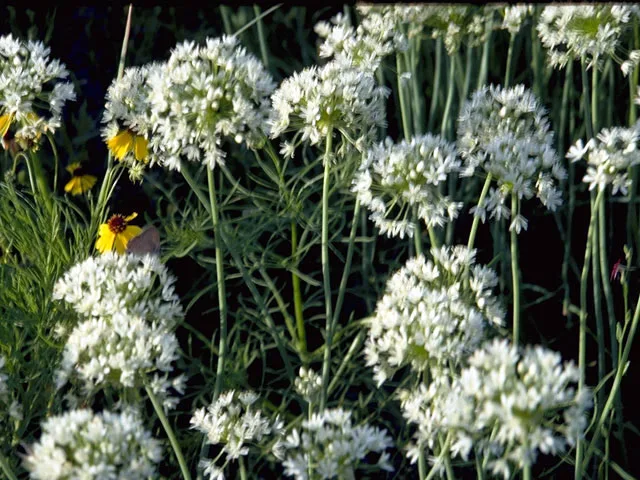
White

Bloom Season

Spring, Summer

Seasonal Interest

Seeds, Forage, Nectar, Pollen

Wildlife Benefit

Butterflies, Birds, Nectar Insects, Bees

Maintenance

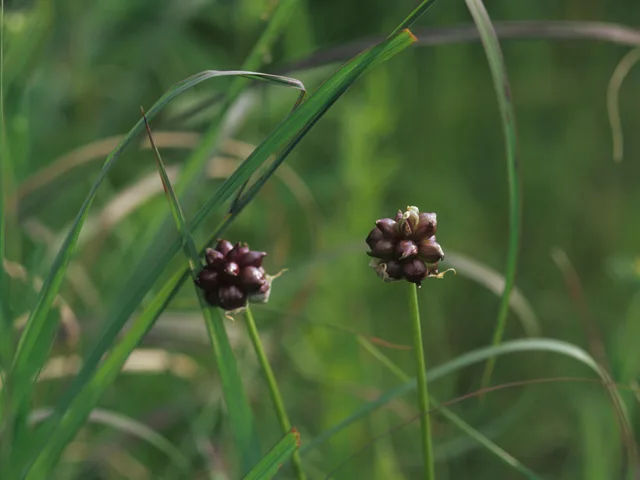
This is a very versatile plant, able to adapt to all but very wet conditions. Make sure soil is well-drained, plants will rot in standing water. It does not flower in deep shade, but will still form aerial bulblets. Can spread profusely in warmer climates. Wild garlic makes a good woodland ground cover in the Texas Blackland Prairie ecoregion. Generally free of pests and disease, although there can be problems with slugs. Propagation: seed, root division.

Comments

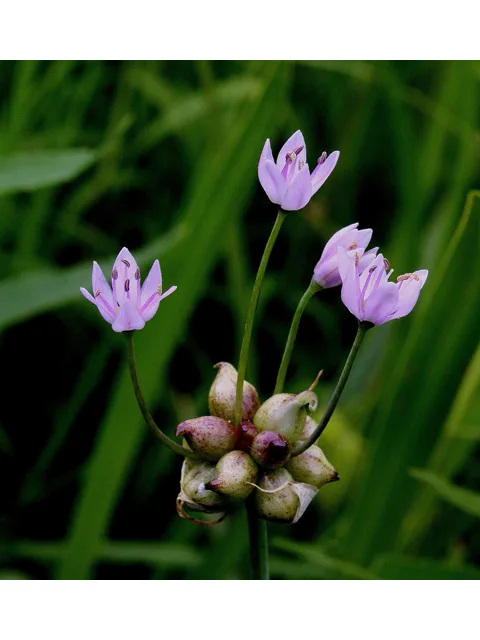
Blooms March-July. It has grass-like basal leaves and an 8-12 in. flowering stalk that grows from a bulb. Star-shaped flowers form a dome-like cluster. Native habitat is open woods and prairies. The fruit is a capsule. The plant has a strong, onion-like odor. Bulbs and leaves may be eaten by wild turkeys. Rabbits and deer tend to avoid eating any Allium species.
Material Treatment Method Collection References
Clump Division If there are multiple plants growing, dig up the plant and gently tug the plants apart, being careful not to disturb too many of the roots. They may be connected by large root segments which you may need to break to free the plantlet. Pot up the new plant in well-draining soil. Repot the parent plant back into its original location. Some alliums (Allium roseum, A. sphaerocephalon and A. vineale) produce aerial bulbils (small young bulbs produced instead of flowers) in the flower head. These bulbils can be carefully removed and separated. The bulbils can be planted in moist free-draining Can refer to either home-made garden compost or seed/potting compost: • Garden compost is a soil improver made from decomposed plant waste, usually in a compost bin or heap. It is added to soil to improve its fertility, structure and water-holding capacity. Seed or potting composts are used for growing seedlings or plants in containers - a wide range of commercially produced peat-free composts are available, made from a mix of various ingredients, such as loam, composted bark, coir and sand, although you can mix your own. compost about 2.5cm (1in) apart and covered with 1cm (3/8in) layer of compost. It will take several years for them to reach flowering size. Check to see if there is more than one plant. In some cases they may still be beneath the soil surface. If you feel confident, you may remove the soil to check for baby plantlets below! 1) https://greg.app/plant-care/allium-canadense 2) https://www.rhs.org.uk/plants/allium/growing-guide
Seed No Treatment It is best to sow ripe ripe seeds as soon as possible. Sow into trays of gritty compost and and cover them with 5mm of grit. Place the containers outside in a shady spot. Alternatively store seeds in a fridge and sow in spring at about 13°C (55°F). Most should germinate within 12 weeks. It will take several years to reach the flowering size. Seeds are hard, usually yellow, brown or black, and contained in a seedpod that can be buff colored, white or brown and dry. Ripe seeds usually eject the seedpod easily and naturally. https://www.rhs.org.uk/plants/allium/growing-guide
Bulb Division Starting plants from bulblets is a convenient method of propagation. Larger bulblets germinate better than smaller ones and retain their viability longer (Krochmal, 1960). Bulblets held in cold storage at 40 degrees F broke dormancy while those stored at room temperature had lower germination percentages. Germination temperature was 69 degrees F. Bulblets held for 3 years at room temperature could not be germinated (Andersen 1968). Allium canadense is easily started from seed in the greenhouse during late winter or early spring. Bulbs can be divided in fall. https://warcapps.usgs.gov/PlantID/Species/Details/2043#:~:text=Starting%20plants%20from%20bulblets%20is,can%20be%20divided%20in%20fall.

About the Region

Fall Symposium 2025 Logo - Teach for the Future

Salado, the location of our Fall 2025 Symposium, lies at the intersection of two ecoregions: the Edwards Plateau (Limestone Cut Plain) and Blackland Prairie (Northern Blackland Prairie).

The Edwards Plateau area is also called the Hill Country; however, this general term covers a much larger area extending farther north. Spring-fed creeks are found throughout the region; deep limestone canyons, rivers, and lakes (reservoirs) are common. Ashe juniper is perhaps the most common woody species found throughout the region. Additional woody species include various species of oak, with live oak (Quercus fusiformis) being the most common. Sycamores (Platanus occidentalis) and bald cypress (Taxodium distichum) border waterways. This area is well known for its spring wildflower displays, though they may be viewed in spring, late summer, and fall, as well. According to Texas Parks and Wildlife, average annual rainfall in the Edwards Plateau ranges from 15 to 34 inches.

The Blackland Prairie extends from the Red River south to San Antonio, bordered on the west by the Edwards Plateau and the Cross Timbers, and on the east by the Post Oak Savannah. Annual rainfall averages 30 to 40 inches, with higher averages to the east. This region is dominated by prairie species. The most common grass species include little bluestem (Schizachyrium scoparium) and Indian grass (Sorghastrum nutans) in the uplands and switchgrass (Panicum virgatum) in the riparian areas and drainages. Common herbaceous flowering plants include salvias, penstemons, and silphiums. This area has suffered greatly from overgrazing and agricultural use. Few intact areas remain, though many of the plants can be found along county roadsides throughout the region.

Our fall Symposium host chapter, the Tonkawa Chapter, includes both of these ecoregions.

Source: Wildflowers of Texas by Michael Eason