
Pawpaw

Asimina triloba

Other common name(s):

Common Pawpaw, Custard Apple, Indian Banana, Wild Banana

Family:

Annonaceae (Custard-Apple Family)

Plant Ecoregion Distribution Map

This map uses data from the US EPA. EPA  servers have been offline frequently so maps may not display. We are working on a solution.

Western Gulf Coastal Plain
Flatwoods, Floodplains and Low Terraces3, Pleistocene Fluvial Terraces, Red River Bottomlands, Southern Tertiary Uplands, Tertiary Uplands

Plant Characteristics

Growth Form

Tree

Height

10
to
40
ft.

Spread

10
to
40
ft.

Leaf Retention

Deciduous

Lifespan

Perennial

Habitat and Care Requirements

Soil Type(s)

Sand, Loam, Clay, Rich, Moist

Light Requirement

Sun, Part Shade, Shade

Water Requirement

Medium

Native Habitat

Wetland or Riparian

Bloom and Attraction

Bloom Color

Red, Purple

Bloom Season

Spring

Seasonal Interest

Fruit, Fall Color, Larval Host

Wildlife Benefit

Butterflies, Birds, Small Mammals

Maintenance

A good understory tree. Sometimes forms colonies, spreading by root shoots. Provides yellow-green fall color and attractive flowers. Plant away from patios where fruit can stain walkways. Native Habitat: ditches, ravines, flood plains, rich damp woods. WARNING: causes skin irritation when handling fruit, fruit edible but some symptoms might include severe stomach and intestinal pain for some people. Propagation: seed, root cutting, layering.

Comments

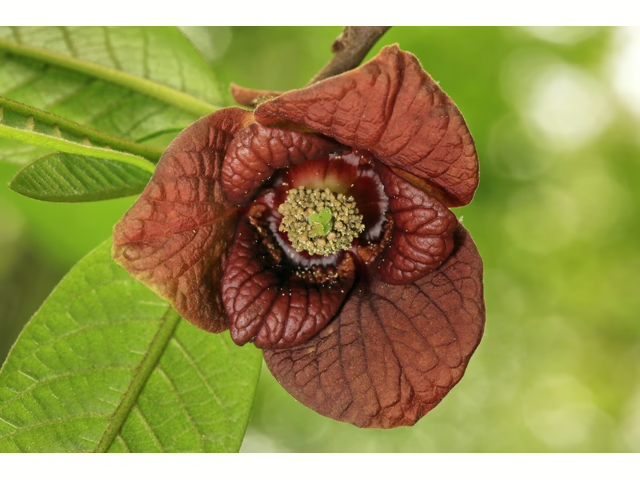
Blooms: April-May. Forms a small, short-trunked tree or large, multi-stemmed shrub, with large, thick oblong leaves. Foliage smells like motor oil when crushed. The bark is shallowly furrowed in larger trees. New shoots are covered with dense, brown hairs. Solitary, six-petaled flowers are borne in leaf axils before leaves emerge. They have a fetid smell. The fruit is an elongated, dark green to yellow berry, up to 6 inches, turning dark when ripe. Larval Host: Zebra Swallowtail Butterfly, Pawpaw Sphinx Month.
Previous Scientific Name(s): Annona triloba L., Orchidocarpum arietinum
Material Treatment Method Collection References
Seed Stratification PawPaw seeds need a cold stratification period of 70-100 days at 35 to 50 degrees Fahrenheit. To fulfill this requirement Keep seeds in slightly moist sand or other sterile substrate in the refrigerator after collection. After stratification plant seeds 1 inch deep in tree pots at temperatures of 70-85 degrees Fahrenheit. PawPaw can be slow to germinate and take several months to emerge. Using bottom heat under the tree pots can speed germination and seedling growth. Use at least 14 inch tree pot to accommodate deep roots. Keep seedlings moist, in a partially shaded area after they emerge. It is also possible to plant stratified seed directly in its final growing bed. though germination will be less reliable. Remove seeds from the fruit and wash off the pulp before bagging in slightly moist, refrigerated media such as sand. https://www.aces.edu/blog/topics/crop-production/pawpaw-production-guide/#:~:text=Pawpaw%20can%20be%20propagated%20by,germination%2C%20which%20is%20largely%20impractical.
Seed No Treatment The entire pawpaw fruit can be planted in the ground the autumn, with very good likelihood that it will put up shoots in the spring. https://www.gardeningknowhow.com/edible/fruits/pawpaw/propagating-pawpaw-trees.htm
Seed Scarification Let the fruit ripen to maturity first, as it tends to drop from the tree while still green. Let the fruit sit in an airy spot until the flesh softens, then remove the seeds. Allow the seeds to dry, scarify them, and then store them in a cold spot for two to three months. https://www.gardeningknowhow.com/edible/fruits/pawpaw/propagating-pawpaw-trees.htm
Softwood Cutting Dip the cuttings in rooting hormone and sink them in rich, moist growing medium. It’s best to take several cuttings, as the success rate of rooting is usually very low. take softwood cuttings of 6 to 8 inches (15-20 cm.) in late summer. https://www.gardeningknowhow.com/edible/fruits/pawpaw/propagating-pawpaw-trees.htm

About the Region

Fall Symposium 2025 Logo - Teach for the Future

Salado, the location of our Fall 2025 Symposium, lies at the intersection of two ecoregions: the Edwards Plateau (Limestone Cut Plain) and Blackland Prairie (Northern Blackland Prairie).

The Edwards Plateau area is also called the Hill Country; however, this general term covers a much larger area extending farther north. Spring-fed creeks are found throughout the region; deep limestone canyons, rivers, and lakes (reservoirs) are common. Ashe juniper is perhaps the most common woody species found throughout the region. Additional woody species include various species of oak, with live oak (Quercus fusiformis) being the most common. Sycamores (Platanus occidentalis) and bald cypress (Taxodium distichum) border waterways. This area is well known for its spring wildflower displays, though they may be viewed in spring, late summer, and fall, as well. According to Texas Parks and Wildlife, average annual rainfall in the Edwards Plateau ranges from 15 to 34 inches.

The Blackland Prairie extends from the Red River south to San Antonio, bordered on the west by the Edwards Plateau and the Cross Timbers, and on the east by the Post Oak Savannah. Annual rainfall averages 30 to 40 inches, with higher averages to the east. This region is dominated by prairie species. The most common grass species include little bluestem (Schizachyrium scoparium) and Indian grass (Sorghastrum nutans) in the uplands and switchgrass (Panicum virgatum) in the riparian areas and drainages. Common herbaceous flowering plants include salvias, penstemons, and silphiums. This area has suffered greatly from overgrazing and agricultural use. Few intact areas remain, though many of the plants can be found along county roadsides throughout the region.

Our fall Symposium host chapter, the Tonkawa Chapter, includes both of these ecoregions.

Source: Wildflowers of Texas by Michael Eason