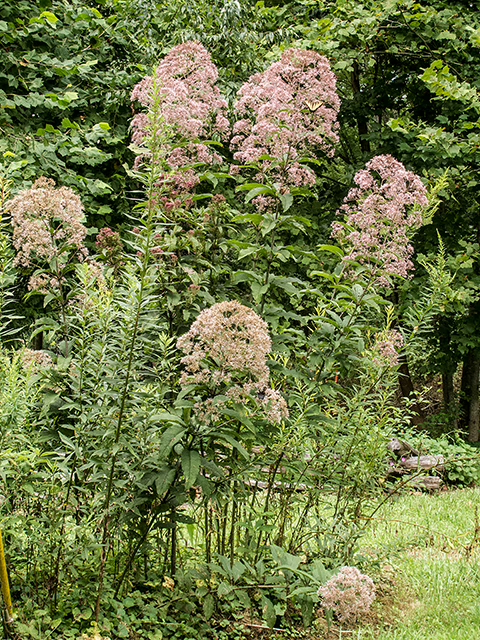


Joe Pye Weed

Eutrochium fistulosum

Other common name(s):

Trumpetweed, Queen Of The Meadow, Hollow Joe-pye Weed

Family:

Asteraceae (Aster Family)

Plant Ecoregion Distribution Map

This map uses data from the US EPA. EPA  servers have been offline frequently so maps may not display. We are working on a solution.

Western Gulf Coastal Plain
Flatwoods, Southern Tertiary Uplands

Plant Characteristics

Growth Form

Herbaceous

Height

5
to
7
ft.

Spread

2
to
4
ft.

Leaf Retention

Deciduous

Lifespan

Perennial

Habitat and Care Requirements

Soil Type(s)

Sand, Loam, Clay, Rocky, Shallow, Moist, Dry

Light Requirement

Sun

Water Requirement

Medium, High

Native Habitat

Woodland, Wetland or Riparian

Bloom and Attraction

Bloom Color

Pink, Purple

Bloom Season

Summer

Seasonal Interest

Seeds, Nectar, Pollen

Wildlife Benefit

Butterflies, Birds, Bees

Maintenance

Landscape locations include meadows, naturalized areas, ponds, woodland, butterfly garden, pollinator garden, rain garden, mass planting. Native habitat: alluvial woods, meadows, bogs, marshes, stream banks. Its height makes this a dramatic accent in the back of a garden.

Comments

Blooms July-September. An erect, clump-forming plant. characterized by the hollow central cavity of the stem. The stem is also covered with a whitish bloom, and is usually purplish. Dark green leaves are lance-shaped, serrated and whorled on the stem. The flowers have a vanilla scent, and occur in rounded clusters of 5 to 7 florets per head that are up to 12-18 inches across. Larval host: Pearl Crescent (Phyciodes tharos). Fruit: small dry seeds with hair-like bristles are dispersed by the wind.
Previous Scientific Name(s): Eupatoriadelphus fistulosus, Eupatorium fistulosum
Material Treatment Method Collection References
Seed Stratification Mix seeds with damp, but not wet, soil, Place mixture in a sealed plastic bag and store in a refrigerator (33-38 F). Leave for 60 days. Some seeds may sprout in the bag. Plant them immmediately. The nutlets mature to shiny black 4-5 weeks after the flower has faded. Only a small percentage viable; these will be plump and swollen. To collect, either take the entire top of the plant or shake it into a paper bag. Seeds can be allowed to dry out before sowing and do not have to be perfectly cleaned. Store in a sealed refrigerated container. 1) https://www.prairiemoon.com/eutrochium-fistulosum-hollow-joe-pye-weed#panel-planting 2) https://growitbuildit.com/joe-pye-weed-eutrochium-eupatorium/#germinate
Seed No Treatment A less complicated approach is to let nature handle the stratifying through a dormant seeding, sowing seeds on the surface of a weed-free site in late fall or winter. Seeds will be conditioned by weathering to make germination possible in subsequent growing seasons. The nutlets mature to shiny black 4-5 weeks after the flower has faded. Only a small percentage viable; these will be plump and swollen. To collect, either take the entire top of the plant or shake it into a paper bag. Seeds can be allowed to dry out before sowing and do not have to be perfectly cleaned. Store in a sealed refrigerated container. 1) https://www.prairiemoon.com/eutrochium-fistulosum-hollow-joe-pye-weed#panel-planting 2) https://growitbuildit.com/joe-pye-weed-eutrochium-eupatorium/#germinate
Clump Division Use a spade to dig out the plant. Make a perimeter about 2″ beyond the edge of the plant. Place the spade at a 45-60 degree angle from horizontal, and dig toward the center of the plant. Do this all around the circumference. Lift out the root mass. Use a pruning or camping saw to cut up the root mass in 2-4 pieces, depending on the size. Replant the pieces immediately to the same depth in new areas. Or, you can store them for a few hours in a moist towel. If clump widens too much, divide it in fall or early spring. 1) https://www.wildflower.org/plants/result.php?id_plant=eufi14#:~:text=Propagation%20Material:%20Root%20Division%20%2C%20Seeds,in%20a%20sealed%20refrigerated%20container. 2) https://growitbuildit.com/joe-pye-weed-eutrochium-eupatorium/#germinate 3) https://earthone.io/plant/eutrochium%20fistulosum?srsltid=AfmBOoqsMvXIuGyM_JCCHnB0Z8MfKpuYT8sh0ikZGV1qswwQ4EpHHhHD

About the Region

Fall Symposium 2025 Logo - Teach for the Future

Salado, the location of our Fall 2025 Symposium, lies at the intersection of two ecoregions: the Edwards Plateau (Limestone Cut Plain) and Blackland Prairie (Northern Blackland Prairie).

The Edwards Plateau area is also called the Hill Country; however, this general term covers a much larger area extending farther north. Spring-fed creeks are found throughout the region; deep limestone canyons, rivers, and lakes (reservoirs) are common. Ashe juniper is perhaps the most common woody species found throughout the region. Additional woody species include various species of oak, with live oak (Quercus fusiformis) being the most common. Sycamores (Platanus occidentalis) and bald cypress (Taxodium distichum) border waterways. This area is well known for its spring wildflower displays, though they may be viewed in spring, late summer, and fall, as well. According to Texas Parks and Wildlife, average annual rainfall in the Edwards Plateau ranges from 15 to 34 inches.

The Blackland Prairie extends from the Red River south to San Antonio, bordered on the west by the Edwards Plateau and the Cross Timbers, and on the east by the Post Oak Savannah. Annual rainfall averages 30 to 40 inches, with higher averages to the east. This region is dominated by prairie species. The most common grass species include little bluestem (Schizachyrium scoparium) and Indian grass (Sorghastrum nutans) in the uplands and switchgrass (Panicum virgatum) in the riparian areas and drainages. Common herbaceous flowering plants include salvias, penstemons, and silphiums. This area has suffered greatly from overgrazing and agricultural use. Few intact areas remain, though many of the plants can be found along county roadsides throughout the region.

Our fall Symposium host chapter, the Tonkawa Chapter, includes both of these ecoregions.

Source: Wildflowers of Texas by Michael Eason