
Wild Woodland Strawberries

Fragaria vesca

Other common name(s):

California Strawberry, Wood Strawberry

Family:

Rosaceae (Rose Family)

Plant Ecoregion Distribution Map

This map uses data from the US EPA. EPA  servers have been offline frequently so maps may not display. We are working on a solution.

Chihuahuan Deserts
Chihuahuan Basins and Playas

Plant Characteristics

Growth Form

Herbaceous

Height

.5
to
.75
ft.

Spread

.5
to
1
ft.

Leaf Retention

Deciduous

Lifespan

Perennial

Habitat and Care Requirements

Soil Type(s)

Sand, Loam, Moist

Light Requirement

Part Shade, Shade

Water Requirement

Medium, High

Native Habitat

Woodland

Bloom and Attraction

Bloom Color

White

Bloom Season

Spring, Summer

Seasonal Interest

Berry

Wildlife Benefit

Birds, Small Mammals

Maintenance

Rare in the wild but grown commercially. May need extra care when grown outside its native range. Spreads by stolons. The woodland strawberry can be used as a ground cover, to suppress invasive species, and help with erosion control. Will tolerant some foot traffic. Give lots of space for this fast spreading plant. Propagation: root division, seed

Comments

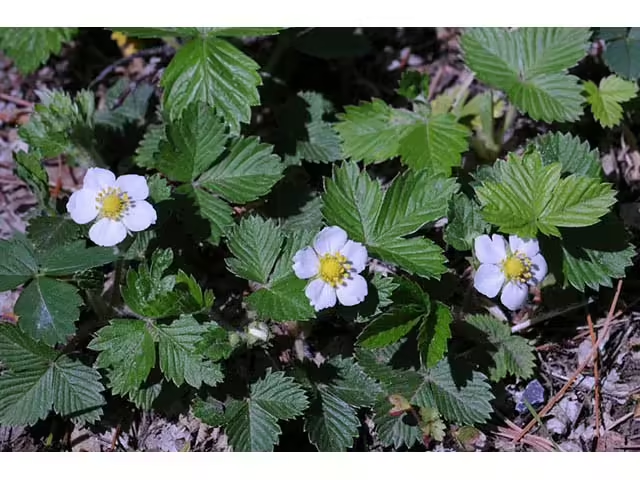
Blooms March-August. A prostrate herb that can carpet the middle elevation forest floor. The leaves are hairy and trifoliate. It bears white, five-petalled flowers. The fruit is a tiny red strawberry with seeds on the surface.
Material Treatment Method Collection References
Stem Cutting The quickest way to propagate wild strawberries is to use established runners as cuttings. Often these offshoots will have already formed roots, allowing them to grow quickly after transplanting. https://plantura.garden/uk/fruits/strawberries/wild-strawberry#:~:text=You%20can%20propagate%20wild%20strawberries,is%20time%20to%20sow%20them.
Seed No Treatment Sow directly in the ground. To obtain seeds for sowing, harvest ripe wild strawberry fruits, cut them into quarters and dry gently in the sun or at 50 °C in the oven. When the flesh is completely dry, the seeds can be rubbed off of the surfaces. Lay the seeds out in an airy place and leave them to dry for a few more days. Store the wild strawberry seeds in a cool, dark and dry place until it is time to sow them. https://plantura.garden/uk/fruits/strawberries/wild-strawberry#:~:text=You%20can%20propagate%20wild%20strawberries,is%20time%20to%20sow%20them.
Offshoots Lift the baby wild strawberry plant out of the ground and transfer it into a 4-inch (10 cm) pot. Fill around the plant in the pot with a mixture of garden soil and acidic compost, like peat moss. Don’t forget to fill in the hole you left in the ground with dirt. Moisten the peat moss and garden soil around the transplant, and then put it out in a weed-free, lightly shaded area under shade cloth or a tree. Let it grow in this location for three or four weeks to give it an opportunity to develop a strong root system. When your transplant looks healthy and vigorous, transplant it one more time to the semi-shaded location you want to make its permanent home. It should get four to six hours of sun in the summer months, preferably with afternoon shade. Look around its base for a baby wild strawberry formed where its stem touched the ground. Cut the stem connecting the parent plant and the baby wild strawberry with clean, sharp shears or scissors. Measure a circle 3 inches (75 mm) wide around the base of the plantlet. Use a garden trowel to dig to a depth of 5 inches (12.5 cm) all around the circle https://strawberryplants.org/grow-wild-strawberries/#how-to-propagate-wild-strawberries

About the Region

Fall Symposium 2025 Logo - Teach for the Future

Salado, the location of our Fall 2025 Symposium, lies at the intersection of two ecoregions: the Edwards Plateau (Limestone Cut Plain) and Blackland Prairie (Northern Blackland Prairie).

The Edwards Plateau area is also called the Hill Country; however, this general term covers a much larger area extending farther north. Spring-fed creeks are found throughout the region; deep limestone canyons, rivers, and lakes (reservoirs) are common. Ashe juniper is perhaps the most common woody species found throughout the region. Additional woody species include various species of oak, with live oak (Quercus fusiformis) being the most common. Sycamores (Platanus occidentalis) and bald cypress (Taxodium distichum) border waterways. This area is well known for its spring wildflower displays, though they may be viewed in spring, late summer, and fall, as well. According to Texas Parks and Wildlife, average annual rainfall in the Edwards Plateau ranges from 15 to 34 inches.

The Blackland Prairie extends from the Red River south to San Antonio, bordered on the west by the Edwards Plateau and the Cross Timbers, and on the east by the Post Oak Savannah. Annual rainfall averages 30 to 40 inches, with higher averages to the east. This region is dominated by prairie species. The most common grass species include little bluestem (Schizachyrium scoparium) and Indian grass (Sorghastrum nutans) in the uplands and switchgrass (Panicum virgatum) in the riparian areas and drainages. Common herbaceous flowering plants include salvias, penstemons, and silphiums. This area has suffered greatly from overgrazing and agricultural use. Few intact areas remain, though many of the plants can be found along county roadsides throughout the region.

Our fall Symposium host chapter, the Tonkawa Chapter, includes both of these ecoregions.

Source: Wildflowers of Texas by Michael Eason