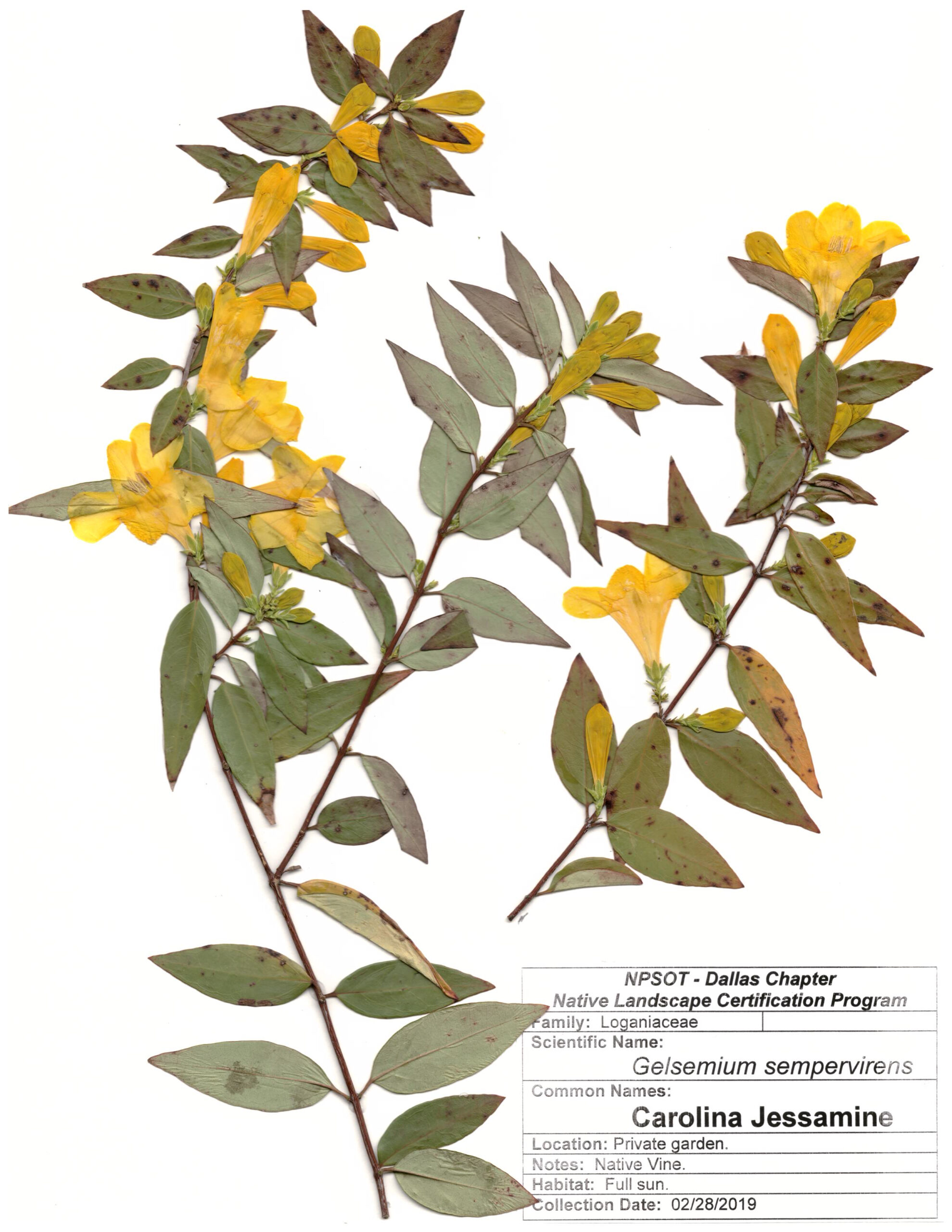
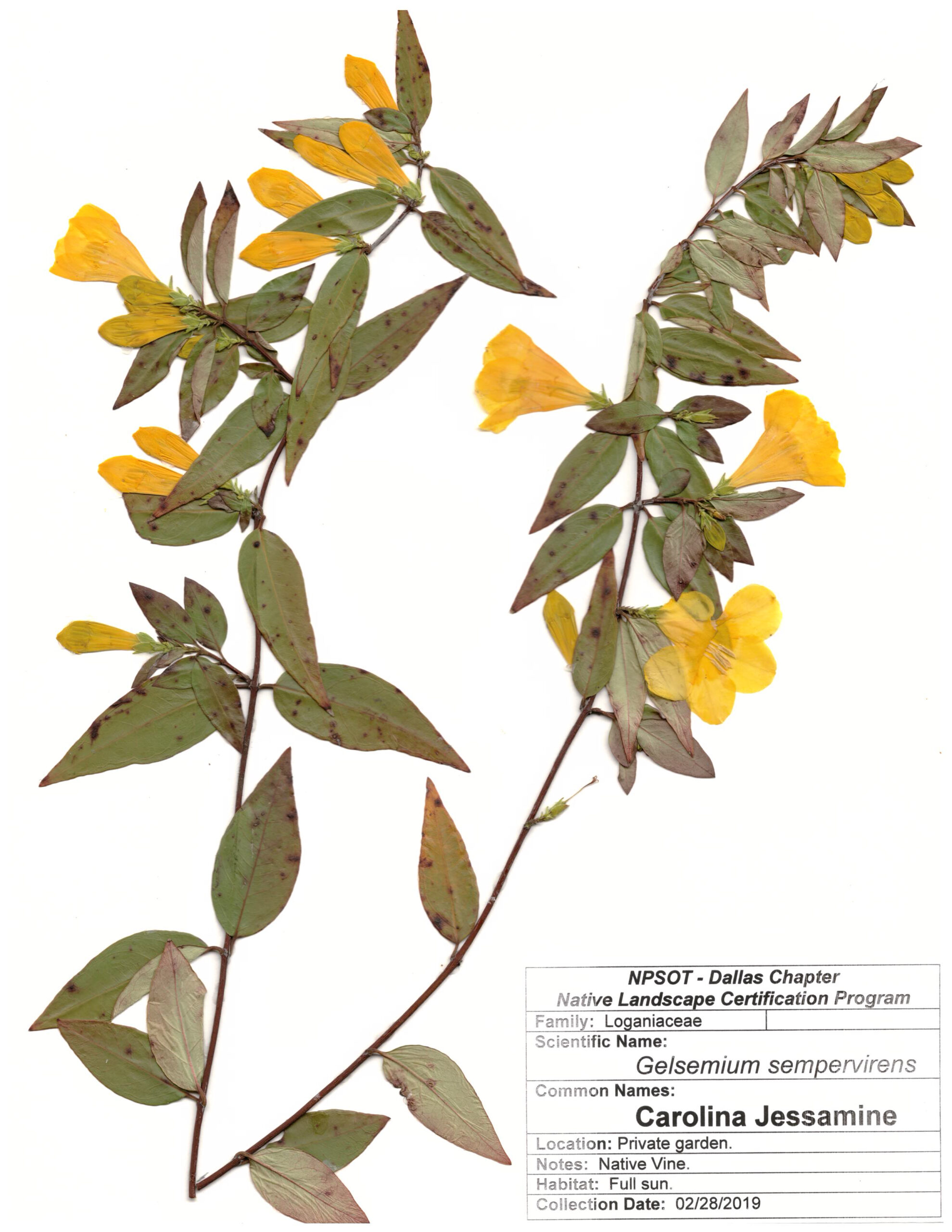

Carolina Jessamine

Gelsemium sempervirens

Other common name(s):

Yellow Jessamine, Evening Trumpetflower, Poor Man's Rope

Family:

Gelsemiaceae (Jessamine Family)

Plant Ecoregion Distribution Map

This map uses data from the US EPA. EPA  servers have been offline frequently so maps may not display. We are working on a solution.

East Central Texas Plains, Texas Blackland Prairies, Western Gulf Coastal Plain
Northern Post Oak Savanna, Northern Prairie Outliers
Northern Blackland Prairie
Flatwoods, Southern Tertiary Uplands

Plant Characteristics

Growth Form

Vine

Height

15
to
20
ft.

Spread

7
to
8
ft.

Leaf Retention

Evergreen

Lifespan

Perennial

Habitat and Care Requirements

Soil Type(s)

Clay, Loam, Moist, Sand, Well Drained

Light Requirement

Sun, Part Shade

Water Requirement

Low

Native Habitat

Shrubland, Woodland

Bloom and Attraction

Bloom Color

Yellow

Bloom Season

Spring

Seasonal Interest

Nectar, Pollen

Wildlife Benefit

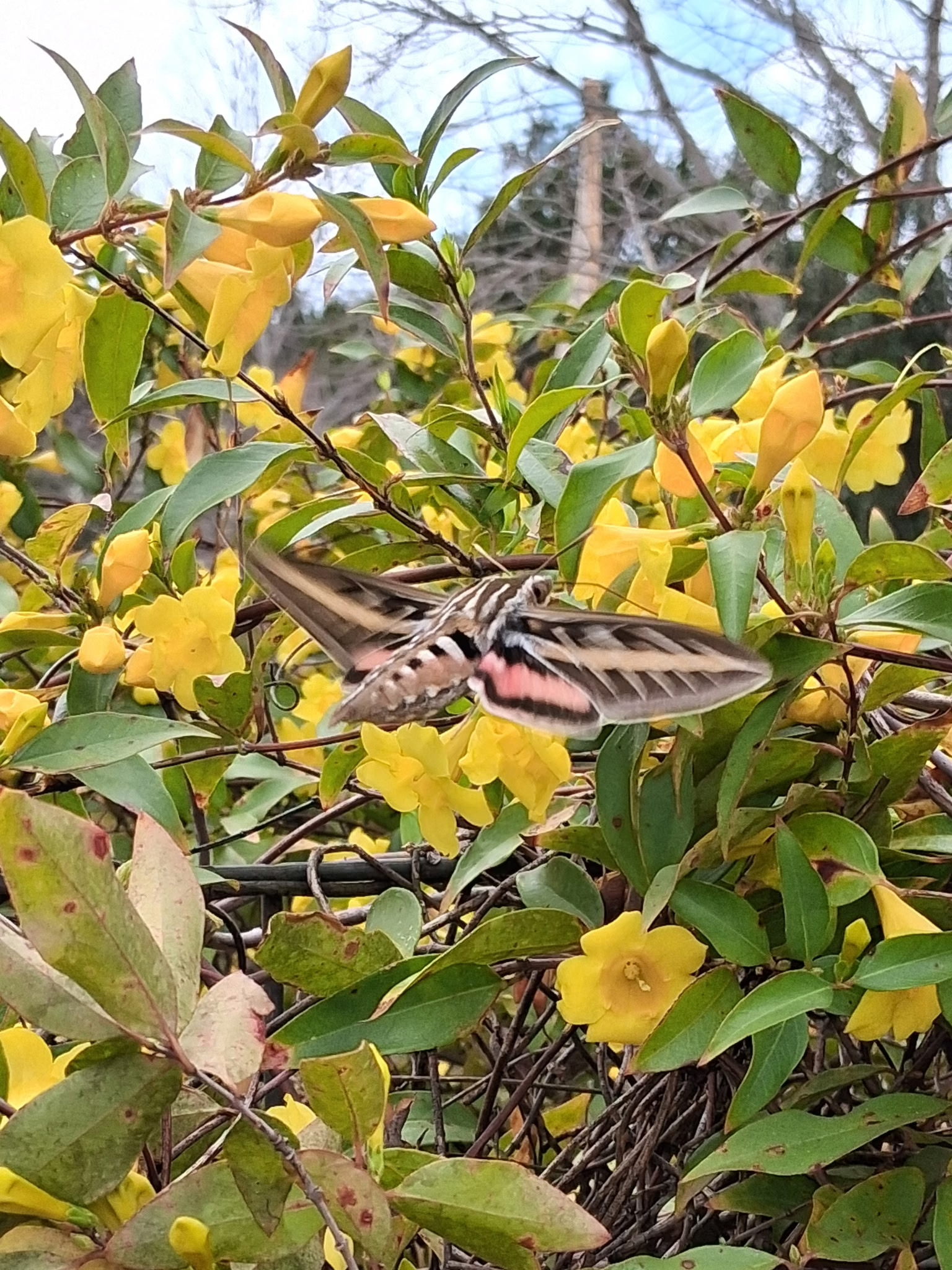
Bees, Butterflies, Hummingbirds, Moths

Maintenance

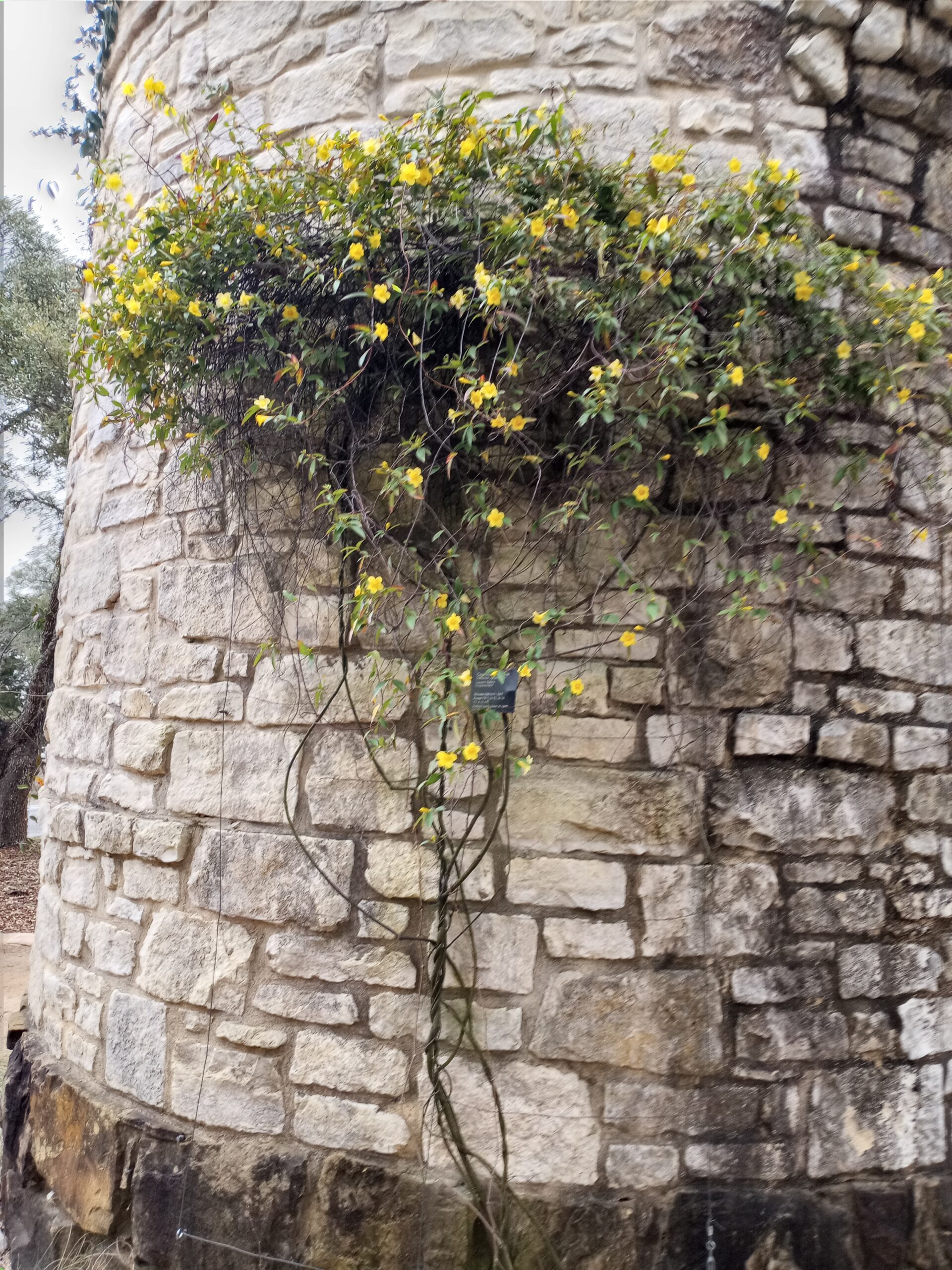
Train on trellis, arbor, wall, fence, or small trees. Flowers best in full sun. Is disease and insect resistant. WARNING: flowers, leaves, & roots are toxic to humans and may be lethal if consumed. Good replacement for non-native Catclaw Vine (Dolichandra unguis-cati). Native habitat: dry to wet thickets, woods, fence rows or hammocks.

Description

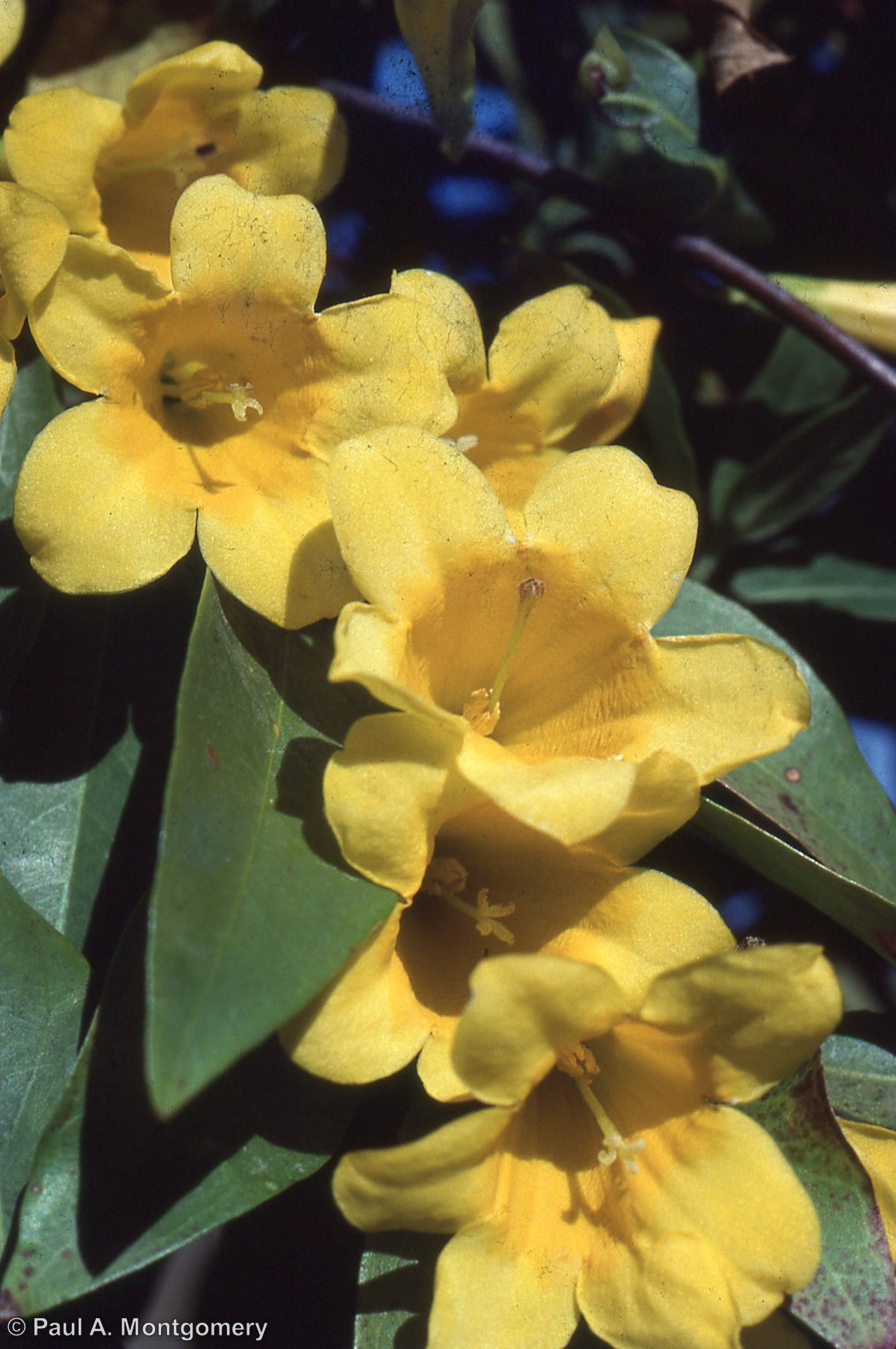
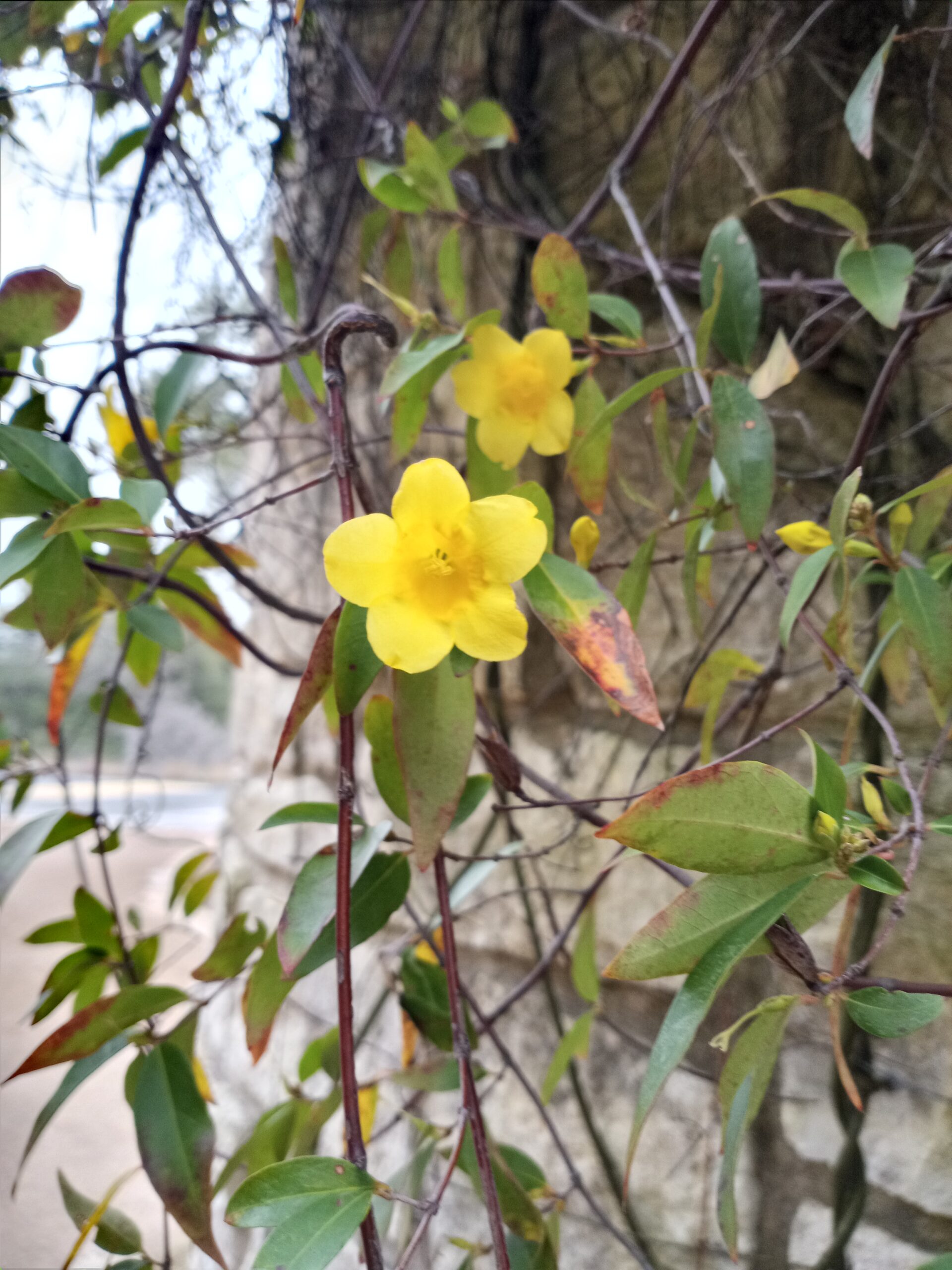
Blooms February-May. May bloom again in the fall depending on the weather. Can grow as groundcover or high-climbing, twining vine. Dark-green, lance-shaped leaves will turn slight yellow or purple in winter. Fragrant yellow, trumpet-shaped flowers. The fruit is a 1 1/2 in. long capsule.
Previous Scientific Name(s): Bignonia sempervirens, Bigonia sempervirens

References

1) Griffith, Bryce, Omernick & Rodgers (2007). Ecoregions of Texas. 2) Miller, George O., Landscaping with Native Plants of Texas 2nd Ed., 2013, pg 48. 3) Wasowski and Wasowski, Native Texas Plants Landscaping Region by Region, 1991, pg. 359. 4) https://www.wildflower.org/plants/result.php?id_plant=GESE. 5) https://portal.torcherbaria.org/portal/taxa/index.php?taxon=Gelsemium+sempervirens&formsubmit=Search+Terms. 6) http://bonap.net/TDC/Image/Map?taxonType=Species&taxonId=12221&locationType=County&mapType=Normal. 7) https://www.itis.gov/servlet/SingleRpt/SingleRpt?search_topic=TSN&search_value=29932#null, 8) Native and Adapted Landscape Plants, City of Austin and Texas A&M, 2014.
Material Treatment Method Collection References
Stem Layering Carolina jasmine roots fairly readily. An easy method is to layer one of the long runners while it is attached to the mother plant. You can actually almost weave it in and out of the soil, so that one long sprout could give you 3-5 new plants. Place a rock or brick over the part under the soil to keep it from bouncing up, and you should have rooted plants within a month or two. Once rooted, cut them apart and transplant. 1) https://www.uaex.uada.edu/yard-garden/in-the-garden/reference-desk/vines/carolina-jessamine.aspx#:~:text=Carolina%20jasmine%20roots%20fairly%20readily,cuttings%20to%20be%20semi%2Dhardwood. 2) https://gardenerspath.com/plants/vines/grow-carolina-jessamine/ 3) https://hort.ifas.ufl.edu/database/lppi/sp170.shtml#:~:text=Common%20name(s):%20Carolina,1/2%20way%20through%20stem
Rhizome Division Remove the excess soil from the rhizomes, and then cut them into pieces, making sure that each rhizome has at least one bud on it. Bury the rhizomes in the ground to about the same depth they were planted when you dug them up, and water well. Continue to water twice a week throughout winter. In spring, you should see some above-ground activity. Start by digging up your jessamine in September or October. https://gardenerspath.com/plants/vines/grow-carolina-jessamine/
Seed No Treatment Start indoors in late winter, or outdoors in late spring when the soil is warm. If you want to collect a few seeds to start new plants, pick in fall after the seeds have turned brown. Air-dry for three or four days. https://www.gardeningknowhow.com/ornamental/vines/carolina-jessamine/growing-carolina-jessamine.htm#:~:text=Carolina%20Jessamine%20propagation%20can%20occur,%2D3.6m)%20at%20maturity.
Stem Cutting Cutting type: stem tip Time of year to take cuttings: Summer Cutting maturity: softwood Rooting hormone: IBA TALC 3000 PPM Rooting environment: intermittent mist Time to rooting: 10-12 weeks https://hort.ifas.ufl.edu/database/lppi/sp170.shtml#:~:text=Common%20name(s):%20Carolina,1/2%20way%20through%20stem

About the Region

2026 Fall Symposium Logo

This low-elevations region of Texas extends inland from the barrier islands, about 60 or so miles, and stretches from Brownsville to Louisiana. In total, it covers about 9.5 million acres, with a high point of 150 feet in elevation. More than 1000 species of plants can be found in this region. On the southern end, species more common in Mexico (such as Sabal mexicana) and Central America occur.

The barrier islands provide us with dune systems, and clay flats to the inland side, which have species found in these areas alone. Many plants here, such as Ipomoea pes-caprae (beach morning glory), can be found throughout tropical regions of the globe. I’ve encountered the same species on the beaches of Guam.

Once inland, vast marshes and wet prairies occur. Occasionally, oak (Quercus fusiformis) groves can be found. Common grasses include species of Bothriochloa, Paspalum, and Sporobolus; eastern gamagrass (Tripsacum dactyloides); and switchgrass (Panicum species). Many rivers and creeks cut through the Gulf Prairies, and along these riparian areas various species of trees, Sabal minor, and other plants adapted to clay soils can be found. Due to overgrazing, farming, and fire suppression, woody species such as mesquite (Prosopis glandulosa) and huisache (Acacia farnesiana), and invasive species such as chinaberry (Melia azedarach), Brazilian pepper (Schinus terebinthifolius), and Chinese tallow (Sapium sebiferum) have increased and displaced our native flora.

Source: Wildflowers of Texas by Michael Eason