
Hachinal

Heimia salicifolia

Other common name(s):

Willow Leaved Heimia, Shrubby Yellowcrest

Family:

Lythraceae (Loosestrife Family)

Plant Ecoregion Distribution Map

This map uses data from the US EPA. EPA  servers have been offline frequently so maps may not display. We are working on a solution.

Gulf Coast Prairies and Marshes
Lower Rio Grande Valley

Plant Characteristics

Growth Form

Shrub

Height

2
to
5
ft.

Spread

2
to
3
ft.

Leaf Retention

Deciduous

Lifespan

Perennial

Habitat and Care Requirements

Soil Type(s)

Sand, Loam, Clay, Caliche, Moist

Light Requirement

Sun, Part Shade

Water Requirement

Low, Medium

Native Habitat

Wetland or Riparian

Bloom and Attraction

Bloom Color

Yellow

Bloom Season

Spring, Summer, Fall

Seasonal Interest

Seeds, Nectar, Pollen

Wildlife Benefit

Butterflies, Birds, Bees

Maintenance

A general purpose shrub for mild winter climates. It’s best grown in sheltered, sunny borders. Seems to prefer moist places but will do fine elsewhere. Do not allow soils to totally dry out. Where not winter hardy, plants may be grown in pots and container gardens that are overwintered indoors in sunny locations. Propagation: seed.

Comments

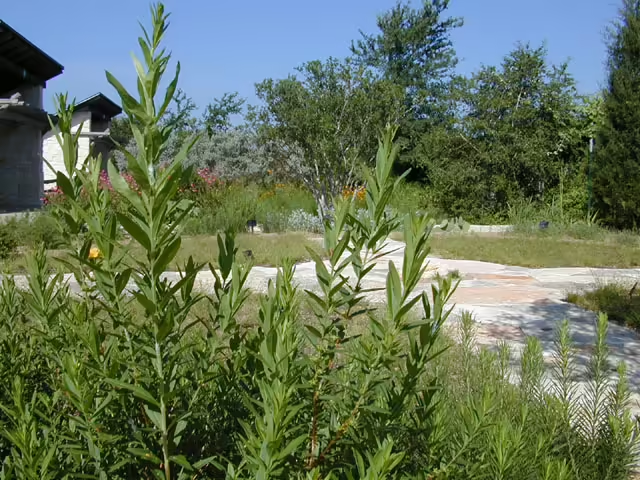
Blooms March-October. A spreading shrub, with narrow, willow-like leaves and reddish stems. The five-petaled yellow flowers drop their petals soon after the flowers open. The fruits is a dry, rounded, 4-celled capsule containing very tiny seeds.
Previous Scientific Name(s): Nesaea salicifolia
Material Treatment Method Collection References
Softwood Cutting Dip the cut end in rooting hormone powder. Place the cutting in a small container filled with well-draining soil, and water it thoroughly. Cover the container with a plastic bag to create a mini greenhouse and keep the cutting in a warm, bright location. Check the soil moisture level frequently and mist the cutting occasionally to keep it hydrated. After a few weeks, the cutting should form roots, and new growth will appear. Take softwood cuttings from the tips of healthy branches in the early summer. Cuttings should be about 4-6 inches long with a few sets of leaves at the top. Cut at a 45 degree angle. Remove the lower leaves. https://plantiary.com/plant/heimia-salicifolia_6969.html
Seed No Treatment Use fresh seeds in well-draining soil and maintain consistent moisture without waterlogging. The substrate should be rich and fertile to support the initial stages of growth. A warm, sheltered spot promotes optimal germination and early seedling development. Alternatively, seeds can be sown in warm soil after the last frost. Seeds can be collected from the plant when the flower turns into a capsule and the seeds are dark brown. 1 ) https://www.picturethisai.com/care/propagate/Heimia_salicifolia.html 2) https://www.botanikks.com/plants/heimia-salicifolia/588178/1
Clump division Division Plant each division in a pot with well-draining soil and keep it moist. Place the pot in a bright but indirect light area and wait for new growth to appear. Carefully remove the plant from its pot and separate the root ball into smaller sections. Each section should have a healthy crown and roots attached to it. https://www.botanikks.com/plants/heimia-salicifolia/588178/1

About the Region

Fall Symposium 2025 Logo - Teach for the Future

Salado, the location of our Fall 2025 Symposium, lies at the intersection of two ecoregions: the Edwards Plateau (Limestone Cut Plain) and Blackland Prairie (Northern Blackland Prairie).

The Edwards Plateau area is also called the Hill Country; however, this general term covers a much larger area extending farther north. Spring-fed creeks are found throughout the region; deep limestone canyons, rivers, and lakes (reservoirs) are common. Ashe juniper is perhaps the most common woody species found throughout the region. Additional woody species include various species of oak, with live oak (Quercus fusiformis) being the most common. Sycamores (Platanus occidentalis) and bald cypress (Taxodium distichum) border waterways. This area is well known for its spring wildflower displays, though they may be viewed in spring, late summer, and fall, as well. According to Texas Parks and Wildlife, average annual rainfall in the Edwards Plateau ranges from 15 to 34 inches.

The Blackland Prairie extends from the Red River south to San Antonio, bordered on the west by the Edwards Plateau and the Cross Timbers, and on the east by the Post Oak Savannah. Annual rainfall averages 30 to 40 inches, with higher averages to the east. This region is dominated by prairie species. The most common grass species include little bluestem (Schizachyrium scoparium) and Indian grass (Sorghastrum nutans) in the uplands and switchgrass (Panicum virgatum) in the riparian areas and drainages. Common herbaceous flowering plants include salvias, penstemons, and silphiums. This area has suffered greatly from overgrazing and agricultural use. Few intact areas remain, though many of the plants can be found along county roadsides throughout the region.

Our fall Symposium host chapter, the Tonkawa Chapter, includes both of these ecoregions.

Source: Wildflowers of Texas by Michael Eason