

White Four O'Clock

Mirabilis albida

Other common name(s):

Dwarf Four O'clock

Family:

Nyctaginaceae (Four-O'Clock Family)

Plant Ecoregion Distribution Map

This map uses data from the US EPA. EPA  servers have been offline frequently so maps may not display. We are working on a solution.

Chihuahuan Deserts, Cross Timbers, East Central Texas Plains, Edwards Plateau, Gulf Coast Prairies and Marshes, Texas Blackland Prairies, Western Gulf Coastal Plain
Chihuahuan Basins and Playas, Chihuahuan Desert Grasslands, Chihuahuan Montane Woodlands, Low Mountains and Bajadas, Stockton Plateau
Carbonate Cross Timbers, Eastern Cross Timbers, Grand Prairie, Limestone Cut Plain, Western Cross Timbers
Bastrop Lost Pines, Floodplains and Low Terraces2, Northern Post Oak Savanna, Northern Prairie Outliers, San Antonio Prairie, Southern Post Oak Savanna
Balcones Canyonlands, Edwards Plateau Woodland, Llano Uplift, Semiarid Edwards Plateau
Coastal Sand Plain, Lower Rio Grande Alluvial Floodplain, Lower Rio Grande Valley, Southern Subhumid Gulf Coastal Prairies
Floodplains and Low Terraces1, Northern Blackland Prairie, Southern Blackland Prairie
Flatwoods, Southern Tertiary Uplands

Plant Characteristics

Growth Form

Herbaceous

Height

1
to
3
ft.

Spread

1
to
3
ft.

Leaf Retention

Deciduous

Lifespan

Perennial

Habitat and Care Requirements

Soil Type(s)

Dry, Rocky, Sand

Light Requirement

Sun

Water Requirement

Low

Native Habitat

Grassland, Woodland Edge

Bloom and Attraction

Bloom Color

Pink, Purple, White

Bloom Season

Summer, Fall

Seasonal Interest

Flowers, Larval Host, Nectar, Pollen

Wildlife Benefit

Bees, Hummingbirds, Moths, Nectar Insects

Maintenance

Avoid overwatering. The soil should be allowed to dry out almost completely between waterings to prevent root rot. Good drainage is essential for the health of the plant. For a more compact form, prune in the early spring before new growth begins. WARNING: all parts of the plant are poisonous to humans and pets. Can be grown in containers. dry soils, Native habitat: meadows and hillsides, dry prairies, pastures, rocky bluffs, open wooded hillsides, sandhills and barrens.

Description

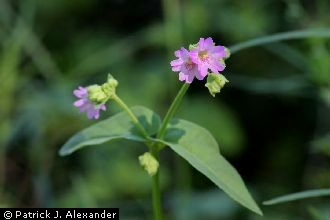
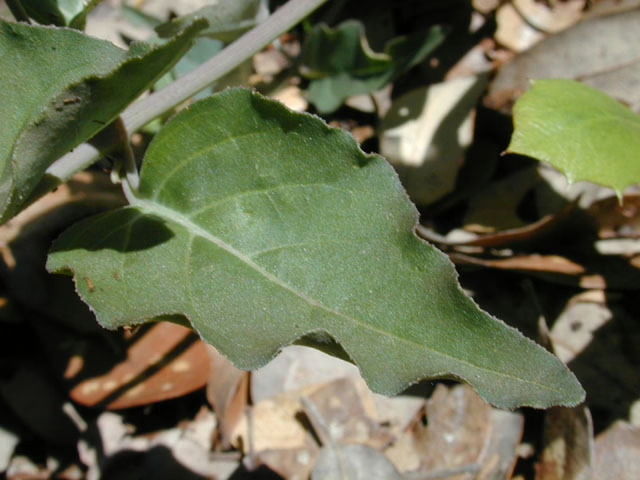
Blooms August-October. Stems are erect to sprawling. The upper stem and flowers are covered with thick, glandular hairs. Most leaves are in the lower part of the plant, lance- to narrowly egg-shaped, and hairy, with wavy edges. Tubular, 5-lobed flowers (petals lacking), grow in terminal branched panicles or occasionally solitary in leaf axils. The name of this plant describes its habit of flowers opening only in the late afternoon. The fruit is a brown, oval, dry seed, 5-angled, densely hairy. Larval host: Neoheliodines nyctaginella (moth), Leaf-footed Bug (Catorhintha mendica).
Previous Scientific Name(s): Allionia albida, Allionia bracteata, Allionia coahuilensis, Allionia grayana, Allionia pauciflora, Allionia pseudaggregata, Allionia rotata, Mirabilis albida var. lata, Mirabilis albida var. uniflora, Mirabilis coahuilensis, Mirabilis dumetorum, Mirabilis entricha, Mirabilis grayana, Mirabilis oblongifolia, Mirabilis pauciflora, Mirabilis pseudaggregata, Mirabilis rotata, Oxybaphus albidus, Oxybaphus coahuilensis, Oxybaphus pauciflorus, Oxybaphus pseudaggregatus, Oxybaphus rotatus
Material Treatment Method Collection References
Seed No Treatment You can either sow them directly in the garden or start them indoors for an earlier bloom. Sow the seeds in well-draining soil The best time to sow seeds is in the spring or early summer after the last frost. The pot or tray should be kept in a warm and sunny location, and the soil should be kept moist but not waterlogged. Germination can take up to two weeks. 1) https://www.botanikks.com/plants/mirabilis-albida-walt-heimerl/558967/1 2) https://earthone.io/plant/mirabilis%20albida?srsltid=AfmBOoqqnZw_ONtkCk2J74geDcBGyiifbTqj2i8Ie8wz_Ms2Ey9Lrd01
Stem Cutting Apply rooting hormone to the base of the cutting. Plant cutting in a well-draining potting mix, keeping the soil consistently moist but not waterlogged. A humidity dome or propagator will increase the chances of successful rooting. Using a bottom heat mat can also accelerate root development. The cutting should root within a few weeks. Take cuttings of approximately 4-6 inches in length, removing the lower leaves to prevent rot. 1) https://propagate.one/how-to-propagate-mirabilis-albida/ 2) https://earthone.io/plant/mirabilis%20albida?srsltid=AfmBOoqqnZw_ONtkCk2J74geDcBGyiifbTqj2i8Ie8wz_Ms2Ey9Lrd01 3) https://www.botanikks.com/plants/mirabilis-albida-walt-heimerl/558967/1
Clump Division The root ball should be carefully separated into several sections using a sharp, sterile knife. Each section should have several stems and a healthy root system. The sections can then be replanted in a well-draining soil mix and watered thoroughly. This method involves separating the plant into smaller sections and replanting them. The best time to divide the plant is in the spring or fall when the plant is not actively growing. 1) https://www.botanikks.com/plants/mirabilis-albida-walt-heimerl/558967/1

About the Region

2026 Fall Symposium Logo

This low-elevations region of Texas extends inland from the barrier islands, about 60 or so miles, and stretches from Brownsville to Louisiana. In total, it covers about 9.5 million acres, with a high point of 150 feet in elevation. More than 1000 species of plants can be found in this region. On the southern end, species more common in Mexico (such as Sabal mexicana) and Central America occur.

The barrier islands provide us with dune systems, and clay flats to the inland side, which have species found in these areas alone. Many plants here, such as Ipomoea pes-caprae (beach morning glory), can be found throughout tropical regions of the globe. I’ve encountered the same species on the beaches of Guam.

Once inland, vast marshes and wet prairies occur. Occasionally, oak (Quercus fusiformis) groves can be found. Common grasses include species of Bothriochloa, Paspalum, and Sporobolus; eastern gamagrass (Tripsacum dactyloides); and switchgrass (Panicum species). Many rivers and creeks cut through the Gulf Prairies, and along these riparian areas various species of trees, Sabal minor, and other plants adapted to clay soils can be found. Due to overgrazing, farming, and fire suppression, woody species such as mesquite (Prosopis glandulosa) and huisache (Acacia farnesiana), and invasive species such as chinaberry (Melia azedarach), Brazilian pepper (Schinus terebinthifolius), and Chinese tallow (Sapium sebiferum) have increased and displaced our native flora.

Source: Wildflowers of Texas by Michael Eason