
Yellow Passionflower

Passiflora lutea

Other common name(s):

Yellow Passion Vine, Yellow Passion-flower

Family:

Passifloraceae (Passion Flower Family)

Plant Ecoregion Distribution Map

This map uses data from the US EPA. EPA  servers have been offline frequently so maps may not display. We are working on a solution.

Cross Timbers, East Central Texas Plains, Edwards Plateau, Gulf Coast Prairies and Marshes, Texas Blackland Prairies, Western Gulf Coastal Plain
Eastern Cross Timbers, Grand Prairie
Floodplains and Low Terraces2, Northern Post Oak Savanna, San Antonio Prairie, Southern Post Oak Savanna
Balcones Canyonlands, Llano Uplift
Floodplains and Low Terraces4, Mid-Coast Barrier Islands and Coastal Marshes, Northern Humid Gulf Coastal Prairies, Texas-Louisiana Coastal Marshes
Floodplains and Low Terraces1, Northern Blackland Prairie
Flatwoods, Floodplains and Low Terraces3, Pleistocene Fluvial Terraces, Red River Bottomlands, Southern Tertiary Uplands, Tertiary Uplands

Plant Characteristics

Growth Form

Vine

Height

10
to
15
ft.

Spread

1
to
2
ft.

Leaf Retention

Deciduous

Lifespan

Perennial

Habitat and Care Requirements

Soil Type(s)

Limestone, Loam, Moist, Sand, Well Drained

Light Requirement

Part Shade

Water Requirement

Low

Native Habitat

Riparian, Woodland

Bloom and Attraction

Bloom Color

Green, Yellow

Bloom Season

Summer

Seasonal Interest

Fall Color, Fruit, Larval Host, Nectar, Pollen

Wildlife Benefit

Bees, Birds, Butterflies, Small Mammals

Maintenance

Does not spread quite as vigorously as other passionflowers. Growth can be controlled by trimming or pulling suckers in smaller spaces. It is happy in a container, will grow on a trellis or fence or sprawl on the ground in butterfly or pollinator garden. In cold areas, containers may need to be brought indoors over the winter. Leaves turn yellow in the fall. Native habitat: low, rocky, moist woods, thickets, bordering streams.

Description

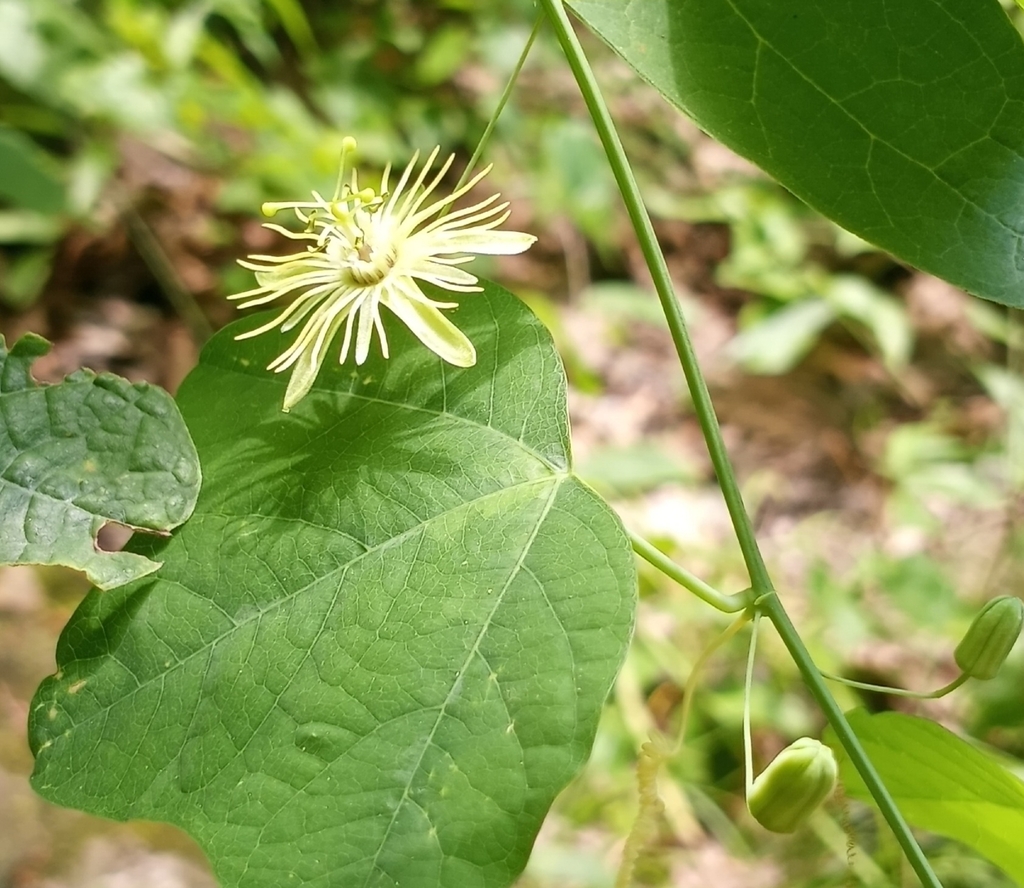
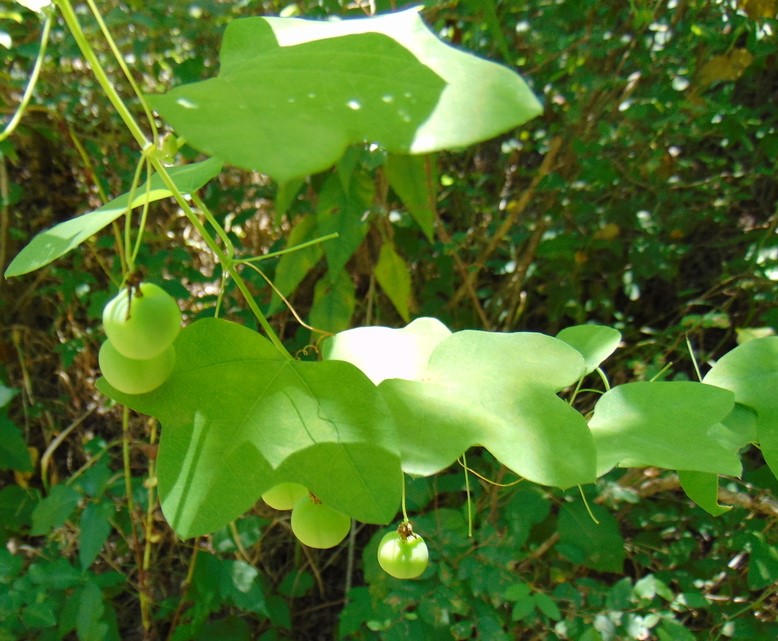
Blooms March-November. A climbing or trailing vine. The bright green leaves are wider than they are long and softly lobed in three parts. Attractive, small, greenish-yellow blooms are followed by purple or black berries. Larval host: Julia, Gulf Coast and Mexican Fritillary, Zebra and Crimson-Patch Longwing butterflies and Passion Flower Bee.
Previous Scientific Name(s): Passiflora lutea var. glabriflora
Material Treatment Method Collection References
Stem Cutting Remove the leaves from the lower half of each cutting, being careful not to damage the stem. This will help to prevent rot and will encourage root growth from the nodes. Dip end of stem in rooting hormone. Fill a clean pot with a well-draining potting mix, such as a blend of peat, perlite, and vermiculite or a commercial seed starting mix. Make a hole in the center of the potting mix with a pencil or your finger, and insert the bottom of the cutting, ensuring that at least one node is buried beneath the surface. Keep the cutting in a warm, humid environment until it establishes roots, covering with plastic if needed. Place the pot in an area that receives bright, indirect light. Avoid direct sunlight, as it can cause the cuttings to overheat under the plastic covering. After 4-6 weeks, gently tug on the cutting to check for resistance, which indicates rooting. You can also look for signs of growth, such as new leaves. After roots have developed, acclimate the cutting to the outside environment by gradually removing the plastic covering for a short period each day over a week. Then, transplant the cutting into a larger pot with fresh potting mix or into your garden after ensuring it is well-rooted and showing signs of growth. Spring or early summer, select a healthy yellow passionflower with new growth. Choose semi-ripe stems that have not yet become woody and take cuttings about 6-8 inches long, ensuring there are at least 2-3 nodes (where leaves attach) on each cutting. Use a sharp, sterile pair of pruners or scissors to make clean cuts. 1) https://earthone.io/plant/passiflora%20lutea 2) https://www.picturethisai.com/care/propagate/Passiflora_lutea.html
Seed Scarification Sow seeds after they've been soaked in water for 24 hours to enhance germination rates. For optimal growth, provide yellow passionflower with a trellis or support for climbing and ensure it's placed in a location with adequate sunlight and protection from harsh conditions. https://www.picturethisai.com/care/Passiflora_lutea.html

About the Region

2026 Fall Symposium Logo

This low-elevations region of Texas extends inland from the barrier islands, about 60 or so miles, and stretches from Brownsville to Louisiana. In total, it covers about 9.5 million acres, with a high point of 150 feet in elevation. More than 1000 species of plants can be found in this region. On the southern end, species more common in Mexico (such as Sabal mexicana) and Central America occur.

The barrier islands provide us with dune systems, and clay flats to the inland side, which have species found in these areas alone. Many plants here, such as Ipomoea pes-caprae (beach morning glory), can be found throughout tropical regions of the globe. I’ve encountered the same species on the beaches of Guam.

Once inland, vast marshes and wet prairies occur. Occasionally, oak (Quercus fusiformis) groves can be found. Common grasses include species of Bothriochloa, Paspalum, and Sporobolus; eastern gamagrass (Tripsacum dactyloides); and switchgrass (Panicum species). Many rivers and creeks cut through the Gulf Prairies, and along these riparian areas various species of trees, Sabal minor, and other plants adapted to clay soils can be found. Due to overgrazing, farming, and fire suppression, woody species such as mesquite (Prosopis glandulosa) and huisache (Acacia farnesiana), and invasive species such as chinaberry (Melia azedarach), Brazilian pepper (Schinus terebinthifolius), and Chinese tallow (Sapium sebiferum) have increased and displaced our native flora.

Source: Wildflowers of Texas by Michael Eason