
Seaside Goldenrod

Solidago sempervirens

Other common name(s):

Family:

Asteraceae (Aster Family)

Plant Ecoregion Distribution Map

This map uses data from the US EPA. EPA  servers have been offline frequently so maps may not display. We are working on a solution.

Gulf Coast Prairies and Marshes, Western Gulf Coastal Plain
Floodplains and Low Terraces4, Laguna Madre Barrier Island and Coastal Marshes, Lower Rio Grande Alluvial Floodplain, Lower Rio Grande Valley, Mid-Coast Barrier Islands and Coastal Marshes, Northern Humid Gulf Coastal Prairies, Southern Subhumid Gulf Coastal Prairies, Texas-Louisiana Coastal Marshes
Flatwoods

Plant Characteristics

Growth Form

Herbaceous

Height

2
to
8
ft.

Spread

1
to
2
ft.

Leaf Retention

Evergreen

Lifespan

Perennial

Habitat and Care Requirements

Soil Type(s)

Loam, Moist, Saline, Sand, Well Drained

Light Requirement

Sun

Water Requirement

Low, Medium

Native Habitat

Disturbed Areas, Grassland, Sand Dunes & Beaches, Wetland

Bloom and Attraction

Bloom Color

Yellow

Bloom Season

Summer, Fall

Seasonal Interest

Larval Host, Nectar, Pollen

Wildlife Benefit

Bees, Butterflies, Moths, Nectar Insects

Maintenance

Pinch the growing tips in June if a more compact plant is desired. Does not spread by rhizomes like other goldenrod. It is resistant to salt spray. Use in dune restoration, as wildlife habitat and in pollinator gardens. Leave stems throughout winter for wildlife. Native habitat: saline places along the coast, sand dunes, tidal marshes, grassland, disturbed sites.

Description

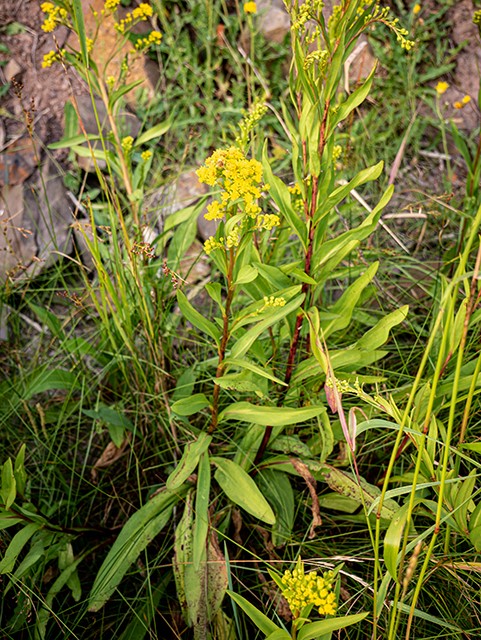
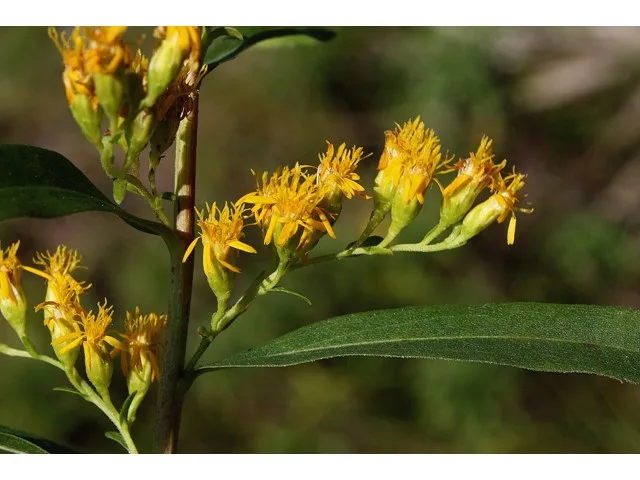
Blooms August-December. Produces a tight clump of narrow, evergreen basal leaves from which long, arching stalks grow. Leaves are somewhat succulent. Deep yellow flowers arranged in one-sided clusters. The fruit is a cypsela: a dry, one-seeded fruit, usually topped by pappus. Larval host: Wavy-lined Emerald (Synchlora aerata).
Material Treatment Method Collection References
Stem Cutting Remove the lower leaves from each cutting, leaving only the top few. This prevents excess moisture loss and encourages root development. Lightly dip the cut end of each stem in a rooting hormone. This enhances root growth and increases the success rate of propagation. Insert the prepared cuttings into a container filled with a well-draining, sterile potting mix. Ensure the cut end is well-covered by soil, and space the cuttings to allow for air circulation. Place the container in a location with indirect sunlight and maintain consistent moisture in the soil, without waterlogging. Covering the container with plastic can help retain humidity, but ensure there is ventilation to prevent mold. Choose healthy, non-flowering stems from a mature seaside goldenrod plant in early summer. Each cutting should be about 4-6 inches long, with several leaves. https://www.picturethisai.com/care/propagate/Solidago_sempervirens.html
Clump Division Segment established clumps, ensuring each section has ample roots and shoots for successful independent growth. Carefully separated divisions can be immediately replanted in suitable locations https://www.picturethisai.com/care/propagate/Solidago_sempervirens.html
Seed No Treatment Can be sown directly in the soil. These seeds need a winter or cold period to germinate - a minimum of 0-60 days below 40°F in moist soil (or sand or vermiculite). Sow outdoors in pots November throughFebruary.A great species for beginner seed-sowers. https://shop.wildseedproject.net/products/seaside-goldenrod-solidago-sempervirens-seeds?srsltid=AfmBOorjE_joRsPIiVUMt3XyMCgdTKMzqNZ-wUaVL-QK2T4TmrUNExp2

About the Region

2026 Fall Symposium Logo

This low-elevations region of Texas extends inland from the barrier islands, about 60 or so miles, and stretches from Brownsville to Louisiana. In total, it covers about 9.5 million acres, with a high point of 150 feet in elevation. More than 1000 species of plants can be found in this region. On the southern end, species more common in Mexico (such as Sabal mexicana) and Central America occur.

The barrier islands provide us with dune systems, and clay flats to the inland side, which have species found in these areas alone. Many plants here, such as Ipomoea pes-caprae (beach morning glory), can be found throughout tropical regions of the globe. I’ve encountered the same species on the beaches of Guam.

Once inland, vast marshes and wet prairies occur. Occasionally, oak (Quercus fusiformis) groves can be found. Common grasses include species of Bothriochloa, Paspalum, and Sporobolus; eastern gamagrass (Tripsacum dactyloides); and switchgrass (Panicum species). Many rivers and creeks cut through the Gulf Prairies, and along these riparian areas various species of trees, Sabal minor, and other plants adapted to clay soils can be found. Due to overgrazing, farming, and fire suppression, woody species such as mesquite (Prosopis glandulosa) and huisache (Acacia farnesiana), and invasive species such as chinaberry (Melia azedarach), Brazilian pepper (Schinus terebinthifolius), and Chinese tallow (Sapium sebiferum) have increased and displaced our native flora.

Source: Wildflowers of Texas by Michael Eason