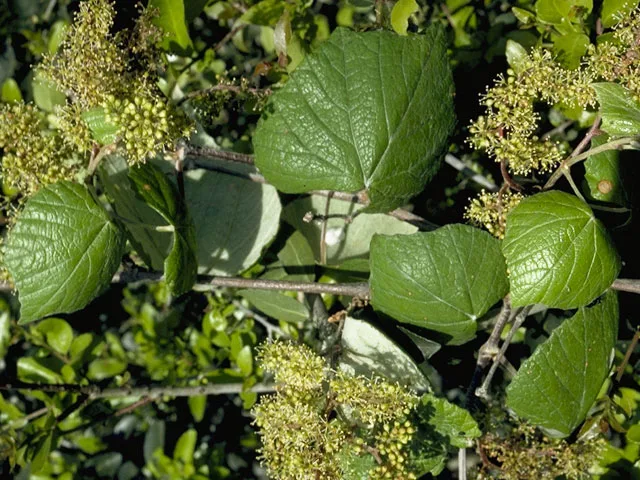


Mustang Grape

Vitis mustangensis

Other common name(s):

Family:

Vitaceae (Grape Family)

Plant Ecoregion Distribution Map

This map uses data from the US EPA. EPA  servers have been offline frequently so maps may not display. We are working on a solution.

Cross Timbers, East Central Texas Plains, Edwards Plateau, Gulf Coast Prairies and Marshes, Texas Blackland Prairies, Western Gulf Coastal Plain
Eastern Cross Timbers, Grand Prairie, Western Cross Timbers
Bastrop Lost Pines, Northern Post Oak Savanna, San Antonio Prairie, Southern Post Oak Savanna
Balcones Canyonlands, Edwards Plateau Woodland, Llano Uplift
Coastal Sand Plain, Floodplains and Low Terraces4, Laguna Madre Barrier Island and Coastal Marshes, Mid-Coast Barrier Islands and Coastal Marshes, Northern Humid Gulf Coastal Prairies, Southern Subhumid Gulf Coastal Prairies, Texas-Louisiana Coastal Marshes
Floodplains and Low Terraces1, Northern Blackland Prairie, Southern Blackland Prairie
Flatwoods, Floodplains and Low Terraces3, Southern Tertiary Uplands

Plant Characteristics

Growth Form

Vine

Height

1
to
2
ft.

Spread

30
to
50
ft.

Leaf Retention

Deciduous

Lifespan

Perennial

Habitat and Care Requirements

Soil Type(s)

Calcareous, Clay, Dry, Limestone, Loam, Sand, Well Drained

Light Requirement

Sun

Water Requirement

Medium

Native Habitat

Riparian, Woodland Edge

Bloom and Attraction

Bloom Color

Green, Yellow

Bloom Season

Spring, Summer

Seasonal Interest

Fruit

Wildlife Benefit

Birds, Small Mammals

Maintenance

Drought tolerant and low maintenance. Will climb over other plants, trees, and fences, and send out suckers. Give lots of room or prune to control growth and height as desired. Native habitat: woodland edge, opening, thicket, stream and river bank, fence row.

Description

Blooms April-June. A woody, high-climbing vine with young stems that are green and densely pubescent, while older vines have reddish-brown bark that exfoliates in long shreds. Leaves in two forms: one form unlobed or shallowly lobed, and the other form deeply lobed, with the latter less common and on rapidly growing shoots. Flowers are small and greenish-yellow in color, growing in clusters. The round, fleshy, dark purple fruit is produced only on female vines.
Previous Scientific Name(s): Vitis candicans, Vitis candicans var. diversa, Vitis mustangensis var. diversa
Material Treatment Method Collection References
Seed No Treatment best sown in a cold frame as soon as it is ripe[K]. Six weeks cold stratification improves the germination rate, and so stored seed is best sown in a cold frame as soon as it is obtained. Germination should take place in the first spring, but sometimes takes another 12 months. Prick out the seedlings into individual pots when they are large enough to handle and grow them on in a cold frame for their first winter. Plant out in early summer. https://pfaf.org/user/Plant.aspx?LatinName=Vitis+mustangensis#:~:text=Plant%20Propagation,Layering.
Softwood Cutting Take cuttings of mature wood of the current seasons growth, December/January in a frame. These cuttings can be of wood 15 - 30cm long or they can be of short sections of the stem about 5cm long with just one bud at the top of the section. In this case a thin, narrow strip of the bark about 3cm long is removed from the bottom half of the side of the stem. This will encourage callusing and the formation of roots. Due to the size of these cuttings they need to be kept in a more protected environment than the longer cuttings. Layering. https://pfaf.org/user/Plant.aspx?LatinName=Vitis+mustangensis#:~:text=Plant%20Propagation,Layering.
Stem Layering Layering can be done by bending a low-growing stem to the ground and covering it with soil until it roots. https://earthone.io/plant/vitis%20mustangensis
Stem Cutting Remove leaves from the lower half of the cutting to prevent excess moisture loss, leaving a few leaves at the top to support photosynthesis. It's advisable to dip the cut end in a rooting hormone to enhance root development. Fill a pot with a well-draining potting mix. Plant the cutting about 2-3 inches deep in the soil, ensuring at least one node is buried as roots will develop from these nodes. Water lightly to settle the soil around the cutting. Place the pot in a location that receives indirect light and maintains a consistent temperature. Keep the soil lightly moist but not waterlogged to prevent rot. Covering the pot with a plastic bag can create a greenhouse effect, encouraging humidity and warmth, which aids in rooting. After about 4-6 weeks, gently tug on the cutting. A slight resistance usually indicates that roots have begun to form. Once confirmed, you can gradually acclimate the cutting to less humid conditions before transplanting. Choose a healthy, disease-free cane from a mature mustang grape vine. The cutting should be about 6-8 inches long with at least 2-3 nodes. Make sure the cut is made just below a node using a clean, sharp tool to ensure a clean cut. https://www.picturethisai.com/care/propagate/Vitis_mustangensis.html

About the Region

2026 Fall Symposium Logo

This low-elevations region of Texas extends inland from the barrier islands, about 60 or so miles, and stretches from Brownsville to Louisiana. In total, it covers about 9.5 million acres, with a high point of 150 feet in elevation. More than 1000 species of plants can be found in this region. On the southern end, species more common in Mexico (such as Sabal mexicana) and Central America occur.

The barrier islands provide us with dune systems, and clay flats to the inland side, which have species found in these areas alone. Many plants here, such as Ipomoea pes-caprae (beach morning glory), can be found throughout tropical regions of the globe. I’ve encountered the same species on the beaches of Guam.

Once inland, vast marshes and wet prairies occur. Occasionally, oak (Quercus fusiformis) groves can be found. Common grasses include species of Bothriochloa, Paspalum, and Sporobolus; eastern gamagrass (Tripsacum dactyloides); and switchgrass (Panicum species). Many rivers and creeks cut through the Gulf Prairies, and along these riparian areas various species of trees, Sabal minor, and other plants adapted to clay soils can be found. Due to overgrazing, farming, and fire suppression, woody species such as mesquite (Prosopis glandulosa) and huisache (Acacia farnesiana), and invasive species such as chinaberry (Melia azedarach), Brazilian pepper (Schinus terebinthifolius), and Chinese tallow (Sapium sebiferum) have increased and displaced our native flora.

Source: Wildflowers of Texas by Michael Eason