Clear Lake Chapter

Plant of the Month: Coralbean

Presented by Keelen Fisher
February 8, 2021

Botanical name: Erythrina herbacea
Common names: Coralbean, Cherokee Bean, Red Cardinal
Family: Fabaceae (Pea)


[MUSIC—EASY AND FUN]

[Keelen] Hey guys! This is Keelen Fisher here. We’re going to go over the Plant of the Month for February, which is going to be the Coralbean plant, or in the scientific name Erythrina herbacea.

So, for its characteristics and details, the Coralbean or, in other words, Cherokee Bean and Red Cardinal, is a plant that belongs to the pea family. It’s a low, glossy-leaved and thorny shrub with many annual stems arising from the woody lower stem and perennial roots. The leaflets, they are long-petioled that are distinctly arrowhead-shaped.

Now, in continuation, after the Coralbean’s leaves fall off in the winter, upright spikes of showy, tubular flowers adorn the bare branches. The scarlet flower can grow about 12 inches long in spike-like clusters right on the upper portion of the stem. In addition, the plant’s leaves’ arrangement is alternate, with their bloom color being red, especially from March to November. And the leaves are three to five inches long and about three and a half to four inches wide, and they fall off in the winter and arise in the spring.

Now, for growing conditions and distribution, this plant prefers to be in dry sandy or clay-like soil in the sun or in an area is partly shaded. It is tolerant to the cold and requires medium water use. A couple tips: Trim the dead stem tips after new growth when they emerge in the spring. Also, the seeds are highly intoxic, or toxic, if ingested, so do be careful. When it comes to distribution, you’ll mainly see these plants in Alabama, Arkansas, Florida, Georgia, Louisiana, Mississippi, North Carolina, and Texas.

Propagation and benefits. The propagation material is seeds, and you can collect these seeds in the late summer to the early fall. When collected, fumigate them and store them in containers at room temperature. These plants and their seeds are try hummingbirds and can be used as nectar. These plants, however, can absorb toxic substances such as herbicides, pesticides, and pollutants from the water, air, and the soil, making them extremely toxic to humans.

For more references, resources, and information, please follow the links below. Thank you.

[MUSIC—AND THAT’S IT]

References

Related Posts

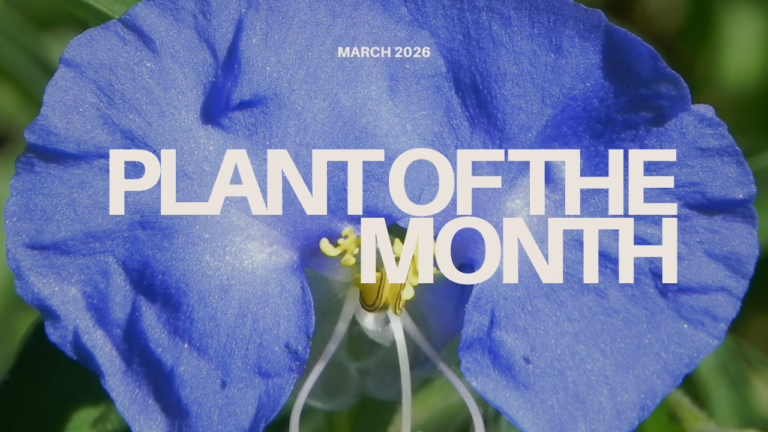
Clise up of Dayflower with text reading Plant of the Month

Plant of the Month: Dayflower

Our plant of the month for March 2026 has bright‑blue “butterfly wings.”
Botanical name: Commelina erecta
Common name(s): Dayflower, White Mouth Dayflower, Slender Dayflower, Widow’s Tears

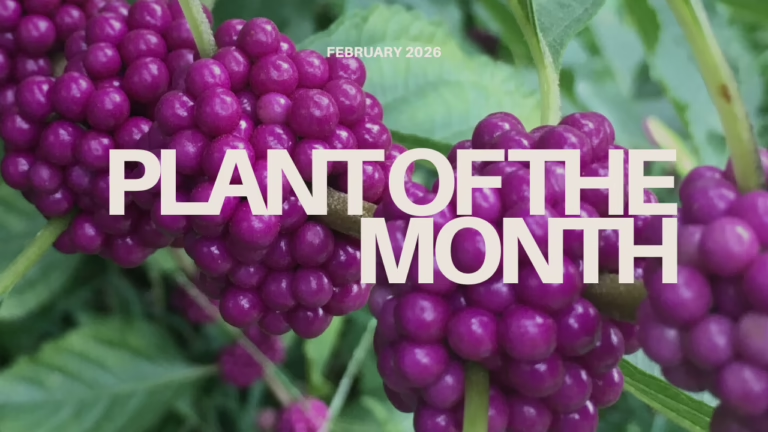
Clise up of American Beautyberry berry clusters with text reading Plant of the Month

Plant of the Month: American Beautyberry

Our plant of the month for February 2026 makes a wonderful jelly!
Botanical name: Callicarpa americana
Common name(s): French Mulberry, Sourbush, Bunchberry, Purple Beauty-berry

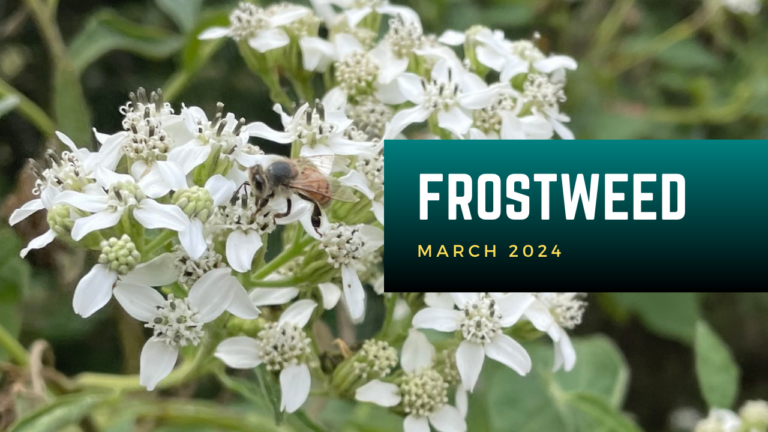
Frostweed

Plant of the Month: Frostweed

Our plant of the month for March 2024 is a little bit icy.
Botanical name: Verbesina virginica
Common name(s): Frostweed, White Crownbeard, Iceplant, Iceweed, Virginia Crownbeard, others

About the Region

2026 Fall Symposium Logo

This low-elevations region of Texas extends inland from the barrier islands, about 60 or so miles, and stretches from Brownsville to Louisiana. In total, it covers about 9.5 million acres, with a high point of 150 feet in elevation. More than 1000 species of plants can be found in this region. On the southern end, species more common in Mexico (such as Sabal mexicana) and Central America occur.

The barrier islands provide us with dune systems, and clay flats to the inland side, which have species found in these areas alone. Many plants here, such as Ipomoea pes-caprae (beach morning glory), can be found throughout tropical regions of the globe. I’ve encountered the same species on the beaches of Guam.

Once inland, vast marshes and wet prairies occur. Occasionally, oak (Quercus fusiformis) groves can be found. Common grasses include species of Bothriochloa, Paspalum, and Sporobolus; eastern gamagrass (Tripsacum dactyloides); and switchgrass (Panicum species). Many rivers and creeks cut through the Gulf Prairies, and along these riparian areas various species of trees, Sabal minor, and other plants adapted to clay soils can be found. Due to overgrazing, farming, and fire suppression, woody species such as mesquite (Prosopis glandulosa) and huisache (Acacia farnesiana), and invasive species such as chinaberry (Melia azedarach), Brazilian pepper (Schinus terebinthifolius), and Chinese tallow (Sapium sebiferum) have increased and displaced our native flora.

Source: Wildflowers of Texas by Michael Eason