Clear Lake Chapter

Plant of the Month: Flame-leaf Sumac

Presented by Andy Sipocz
August 10, 2020

Botanical name: Rhus copallinum var. lanceolata
Common name(s): Flame-leaf Sumac, Shining Sumac, Winged Sumac, Prairie Sumac
Family: Anacardiaceae (Sumac)


[MUSIC—EASY AND FUN]

[ANDY] I did want to note that the photographer’s name is down at the bottom of these photos. That’s who took these. I want to give them credit. So, I’m going to speak about Flame-leaf Sumac today. And the proper scientific name is Rhus copallinum. I state that because the taxonomy of this is very confusing. At some point it had been broken up into six different species, but currently there’s only two varieties recognized. And R. copallinum variety lanceolata is the one that’s found in Texas.

So, there are two varieties, but the one in Texas is lanceolata. It has many, many common names. If you go to purchase, typically you’ll see it listed as either Flame-leaf Sumac or Prairie Sumac or Winged Sumac or Shining Sumac, but also has many other names. You can purchase it from native plant nurseries, or you can grow it yourself. I was able to take a cutting off of FM 517 and it was very easy to grow from a plant I found there. But it is found throughout east Texas.

So, where does it grow? It likes sandy loam soils or loamy soils. Because of that, it’s not necessarily that common in the Houston area until you get up to the north side of town where you start to see pine trees growing. If you find pine trees, you’ll probably find this tree growing alongside of them. It does need full sunlight, so you’ll find it on the edges of forests or maybe on the edge of the creek. Although not in a flood plain because it is not flood tolerant. You also find it out in prairies. It is a prairie invader. So, for example, in Brazos Bend State Park this plant is quite common there, out in the prairies, out on the mima mounds and the little dunes that are found out in the prairie. In Texas, it does grow west to Austin up to Fort Worth and then all throughout east Texas and down south to around Victoria.

What does it look like? It’s a great plant it does look like a sumac, so it looks like a large bush or a small tree. It does live up to its name in that in the fall the leaves are exactly what you see here in the photo—bright red. Gorgeous. It’ll get to about 15 feet tall. It does form clumps that will sprout from rhizomes. So, it’ll spread vegetatively and form a nice dense clump. Generally, as long as it has a fairly well-drained soil it’s going to do well. It does need full sun. I think it should be planted in a raised bed otherwise, once it’s established, it may start to take over other areas out in your yard through root suckers.

So, everybody always asks, “Can you eat it?” You know, I don’t know. You can eat this. You can eat the berries. People do use the berries. They make a drink out of it, a lemonade-like drink. You steep it and then just like you would make a tea. Iced tea. I’ve never tried it. Maybe somebody has, but I hear it can be quite good.

Propagation. There are boy and girl sumacs. They both have flowers. However, the boys only have the male flowers the females only have the female flowers. The one I have in our yard flowered the first time this year, it turned out to be a boy. There’s no fruit on it. I was really disappointed. But if it is a female, it’ll have the clusters of red berries and they’ll hang on there for quite a while. And it’s really beautiful. If you want to grow it, you can grow it from cuttings or you can take the seeds and scarify them by putting them in like vinegar or some sort of a weak acid. Or you could very gently scarify them on a piece of fine sandpaper.

I guess that’s it. Thank you.

[MUSIC—AND THAT’S IT]

Related Posts

Plant of the month for August is Splitbeard Bluestem, Andropogon ternarius, and also called Feather Bluestem or Paintbrush Bluestem. It is a native. It's a warm season grass. It's a perennial. It's a bunchgrass. By warm season, it means that it's dormant in the winter and starts growing in the spring as the weather warms up. A bunchgrass tends to stay in a small circle or a bunch. The grass has numerous thin basal leaves, which usually stay about 12 or 15 inches tall, which makes it ideal in our home landscapes. It grows best in part shade to full sun. And this grass will be available at our plant sale on October 20 and 21. It prefers to grow in sand or well-drained soil, which we kind of struggle with here, but it does do well. It's shade tolerant and drought tolerant. I know the camera has a hard time focusing on those light hairy little seeds. The bloom time is from August to November. In late summer, it will send up its bloom stalk, which may be up to three feet tall. And, as the seeds on the long slender stalk mature, they'll split into two tiny stems about two inches long, each with seeds of fluffy white tufts. The seeds are wind distributed. The plants may be started from seed or another way is to dig your mature plant and with your shovels, cut it into maybe four sections, which then can be replanted in other places in your yard or shared with some of your neighbors. It's an easy plant to grow. Splitbeard can be found on the prairie with Little Bluestem and it's great when it's seen in the afternoon sun en masse; reminds me of snowflakes on the branches. And it can be used in a winter dried arrangement in the house. Native bees can use Splitbeard Bluestem for nesting materials. And until their bloom stalk is sent up, the narrow basal leaves are hard to distinguish from other bunchgrasses such as Sideoats Grama. And there it is. And you note how the seeds are all on one side, thus its name. We don't have any of this one for sale at our fall sale. Maybe we will in the spring, in April. But it was interesting, I thought, when I looked for Splitbeard Bluestem in the Wasowski book of Native Texas Plants these two bunchgrasses were on the same page. So, that is the story of the Sideoats Grama and the Splitbeard Bluestem.

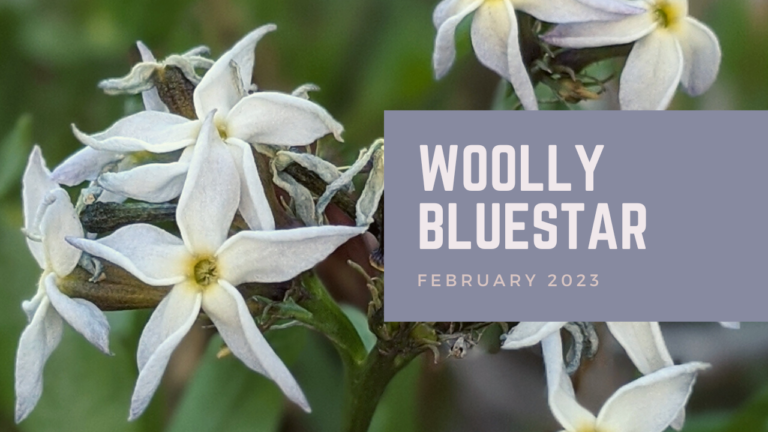
Plant of the Month: Woolly Bluestar

Our Plant of the Month for February 2023 is Amsonia tomentosa, commonly known as Woolly Bluestar, Woolly Amsonia, Small Leaved Amsonia, or Gray Amsonia.

Oyster Mushroom

Plant of the Month: Oyster Mushroom

Our plant of the month for January isn’t a plant at all, it’s a fungus!
Botanical name: Pleurotus ostreatus
Common name(s): Oyster Mushroom, Pearl Oyster Mushroom

About the Region

2026 Fall Symposium Logo

This low-elevations region of Texas extends inland from the barrier islands, about 60 or so miles, and stretches from Brownsville to Louisiana. In total, it covers about 9.5 million acres, with a high point of 150 feet in elevation. More than 1000 species of plants can be found in this region. On the southern end, species more common in Mexico (such as Sabal mexicana) and Central America occur.

The barrier islands provide us with dune systems, and clay flats to the inland side, which have species found in these areas alone. Many plants here, such as Ipomoea pes-caprae (beach morning glory), can be found throughout tropical regions of the globe. I’ve encountered the same species on the beaches of Guam.

Once inland, vast marshes and wet prairies occur. Occasionally, oak (Quercus fusiformis) groves can be found. Common grasses include species of Bothriochloa, Paspalum, and Sporobolus; eastern gamagrass (Tripsacum dactyloides); and switchgrass (Panicum species). Many rivers and creeks cut through the Gulf Prairies, and along these riparian areas various species of trees, Sabal minor, and other plants adapted to clay soils can be found. Due to overgrazing, farming, and fire suppression, woody species such as mesquite (Prosopis glandulosa) and huisache (Acacia farnesiana), and invasive species such as chinaberry (Melia azedarach), Brazilian pepper (Schinus terebinthifolius), and Chinese tallow (Sapium sebiferum) have increased and displaced our native flora.

Source: Wildflowers of Texas by Michael Eason