Clear Lake Chapter

Plant of the Month: Red Buckeye

Presented by Atalanda Cameron
March 8, 2021

Botanical name: Aesculus pavia
Common names: Red Buckeye, Scarlet Buckeye, Firecracker Plant
Family Hippocastanaceae (Horse-Chestnut)


[MUSIC—EASY AND FUN]

[ATALANDA] Hi, my name is Atalanda Cameron and today I’ll be talking to you about the Aesculus pavia, also known as the Red Buckeye.

Characteristics

This is a spring-flowering shrub with bright red flowers. These plants can grow up to 40 feet but are most commonly found around 15 feet tall. They spread out between 12 to 15 feet wide per plant and have large leaves that can grow up to six inches and are divided into five leaflets. They have smooth bark on the young branches and roughened bark on older branches. They are found on a variety of well-drained, usually acidic, woodland soils in the southeast, but are also tolerant of clay soils. Yellow-flowered hybrids known as flavescens grow beyond the central Edwards Plateau. The bloom time is between April to May.

Habitat and distribution

This is a map from iNaturalist, data collected from users all across the web. It shows the red-flowered Aesculus pavia. The species range extends from the east coast to the westernmost edge of the Edwards Plateau in Central Texas. The height ranges from 40 feet to 10 feet with the smaller ones being the farther west you go from the Mississippi Valley.

Propagation and growth

They’re found in nature most often as a plant of woodland edges where it can get morning sun and afternoon shade. They attract hummingbirds and tolerate clay soils relatively well. They prefer full sun to part shade, have a medium watering schedule. Moderate maintenance is required. They’re best grown in hedges, flowering trees, or in rain gardens, and they lose their leaves by the end of summer.

For more information, visit the Native Plant Society of Texas, Clear Lake Chapter.

Thank you!

[MUSIC—AND THAT’S IT]

Related Posts

Plant of the month for August is Splitbeard Bluestem, Andropogon ternarius, and also called Feather Bluestem or Paintbrush Bluestem. It is a native. It's a warm season grass. It's a perennial. It's a bunchgrass. By warm season, it means that it's dormant in the winter and starts growing in the spring as the weather warms up. A bunchgrass tends to stay in a small circle or a bunch. The grass has numerous thin basal leaves, which usually stay about 12 or 15 inches tall, which makes it ideal in our home landscapes. It grows best in part shade to full sun. And this grass will be available at our plant sale on October 20 and 21. It prefers to grow in sand or well-drained soil, which we kind of struggle with here, but it does do well. It's shade tolerant and drought tolerant. I know the camera has a hard time focusing on those light hairy little seeds. The bloom time is from August to November. In late summer, it will send up its bloom stalk, which may be up to three feet tall. And, as the seeds on the long slender stalk mature, they'll split into two tiny stems about two inches long, each with seeds of fluffy white tufts. The seeds are wind distributed. The plants may be started from seed or another way is to dig your mature plant and with your shovels, cut it into maybe four sections, which then can be replanted in other places in your yard or shared with some of your neighbors. It's an easy plant to grow. Splitbeard can be found on the prairie with Little Bluestem and it's great when it's seen in the afternoon sun en masse; reminds me of snowflakes on the branches. And it can be used in a winter dried arrangement in the house. Native bees can use Splitbeard Bluestem for nesting materials. And until their bloom stalk is sent up, the narrow basal leaves are hard to distinguish from other bunchgrasses such as Sideoats Grama. And there it is. And you note how the seeds are all on one side, thus its name. We don't have any of this one for sale at our fall sale. Maybe we will in the spring, in April. But it was interesting, I thought, when I looked for Splitbeard Bluestem in the Wasowski book of Native Texas Plants these two bunchgrasses were on the same page. So, that is the story of the Sideoats Grama and the Splitbeard Bluestem.

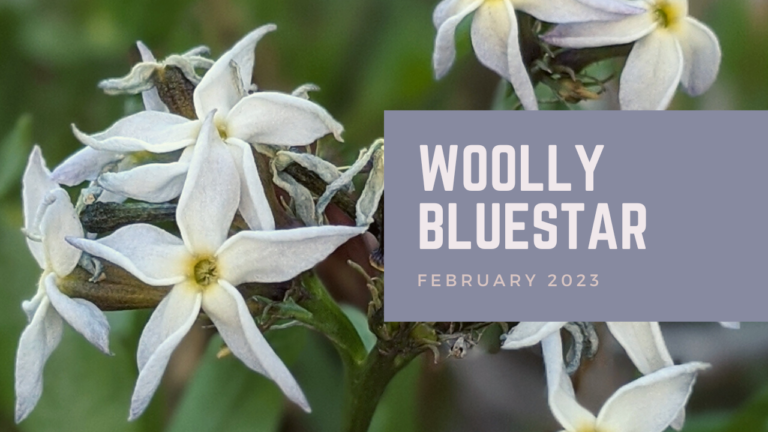
Plant of the Month: Woolly Bluestar

Our Plant of the Month for February 2023 is Amsonia tomentosa, commonly known as Woolly Bluestar, Woolly Amsonia, Small Leaved Amsonia, or Gray Amsonia.

Oyster Mushroom

Plant of the Month: Oyster Mushroom

Our plant of the month for January isn’t a plant at all, it’s a fungus!
Botanical name: Pleurotus ostreatus
Common name(s): Oyster Mushroom, Pearl Oyster Mushroom
About the Region

2026 Fall Symposium Logo

This low-elevations region of Texas extends inland from the barrier islands, about 60 or so miles, and stretches from Brownsville to Louisiana. In total, it covers about 9.5 million acres, with a high point of 150 feet in elevation. More than 1000 species of plants can be found in this region. On the southern end, species more common in Mexico (such as Sabal mexicana) and Central America occur.

The barrier islands provide us with dune systems, and clay flats to the inland side, which have species found in these areas alone. Many plants here, such as Ipomoea pes-caprae (beach morning glory), can be found throughout tropical regions of the globe. I’ve encountered the same species on the beaches of Guam.

Once inland, vast marshes and wet prairies occur. Occasionally, oak (Quercus fusiformis) groves can be found. Common grasses include species of Bothriochloa, Paspalum, and Sporobolus; eastern gamagrass (Tripsacum dactyloides); and switchgrass (Panicum species). Many rivers and creeks cut through the Gulf Prairies, and along these riparian areas various species of trees, Sabal minor, and other plants adapted to clay soils can be found. Due to overgrazing, farming, and fire suppression, woody species such as mesquite (Prosopis glandulosa) and huisache (Acacia farnesiana), and invasive species such as chinaberry (Melia azedarach), Brazilian pepper (Schinus terebinthifolius), and Chinese tallow (Sapium sebiferum) have increased and displaced our native flora.

Source: Wildflowers of Texas by Michael Eason
