Texas Native Plants Magazine

Latest Issues

Fall 2025 Member Magazine

President’s Message | Executive Update | Celebrating Leadership | Curb Appeal with a Cause | Grant Recipients | Autumn’s Perfect Pairing | Native Plant Database | Sustainable Landscaping | Winterizing Tips
Read More »

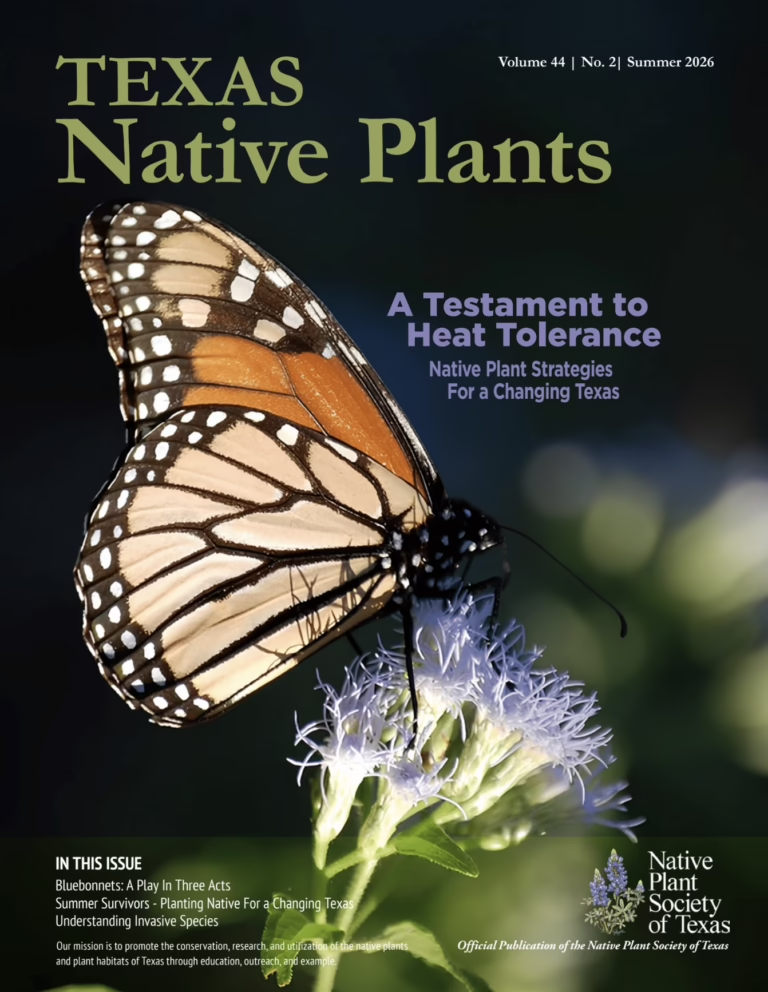
Summer 2025 Member Magazine

Executive Summary | Resilience in Bloom | Suburban Sanctuary | Texas-tough Summer Survivors | Where Salsa Meets Sage | A Rain Garden Grows | Member News | Smart Watering

Read More »

Distribution

  • Texas Native Plants is published quarterly and the digital version is distributed free to all Society members in current standing.
  • The digital version is also available in our library below.
  • Print versions are mailed at no cost to Society members in current standing who select to receive a print copy when they join/renew.
  • Libraries, educational institutions and other organizations may qualify to receive the publication for a $5 annual fee.
  • Contact the membership coordinator.
  • Many of our chapters publish their own newsletters and websites.
  • These have their own deadlines and guidelines. See list of chapters.

History

Since its founding the Society has provided a news periodical to its members. there have been a variety of names and formats. The Texas Wildfower Newsletter edited by Carroll Abbott served as the first newsletter. He advocated the formation of the Native Plant Society of Texas in his quarterly publication Texas Wildflower Newsletter. After the Society was created in 1980, a free subscription to Abbott’s newsletter was provided as a benefit to all members. His declining health eventually prompted Abbott to request that the Society start its own newsletter. Lean more about the Carroll Abbott story.

Beginning in 1983 our own official publication has documented the evolution of the native plant movement and the Native Plant Society of Texas. The publication has had several slightly different names and formats over the years. By 2005 it had evolved into a full-color glossy magazine.

The Native Plant Society of Texas encourages submission of articles, photos, pertinent news or other interesting information for publication.

  • Submit articles or written items as email attachments.
  • Send photos as email attachments in JPG, RAW or TIFF format.
  • Larger file size and best quality are preferable.
  • Contact the Editor for more information.
 

We reserve the right to edit all submissions for accuracy, relevance, length, grammar or for other reason. In matters of style our print publication generally follows the Chicago Manual of Style.

Unless prior arrangements with the editor are made, submissions may also appear on our website and linked on our social media pages. We do not accept outside advertising in any of our publications.

Publications Library

Click below to view issues by year/editor. Or visit our online archive.

  • Sort

1985 – Jan/Feb

Volume 3, No. 1
Editor: Manuel Flores
  • Native Texas Roses
  • Texas Snowbell
  • Solidago sp. (Goldenrods)
  • Interview: Benny Simpson

1984 – Nov/Dec

Volume 2, No. 6
Editor: Manuel Flores
  • Penstemon sp.
  • Tallgrass Prairies

1984 – Sep/Oct

Volume 2, No. 5
Editor: Manuel Flores
  • Carroll Abbott Memorial: 1926-1984
  • Sage Advice: Salvia sp.
  • Abronia macrocarpa
  • Texas First Botanist: Edwin James, Part II

1984 – Jul/Aug

Volume 2, No. 4
Editor: Manuel Flores
  • Hot Bloomers: Malvaceae species
  • Population Documentation: Paronychia sp.
  • Native Prairies of North Texas
  • Texas First Botanist: Edwin James

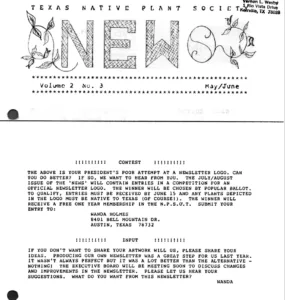
1984 – May/June

Volume 2, No. 3
Editor: Manuel Flores
  • Preservation of Texas Natural Areas

1984 – Mar/Apr

Volume 2, No. 2
Editor: Jim Hunt
  • Leonhardt Prairie Field Trip
  • Ft. Richardson Wildflower Field Day

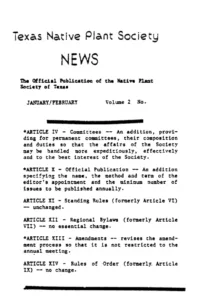
1984 – Jan/Feb

Volume 2, No. 1
Editor: Jim Hunt
  • Proposed Bylaws

1983 – Nov/Dec

Volume 1, No. 4
Editor: Jim Hunt
  • Native vegetation of North Central Texas
  • Aquilegia canadensis

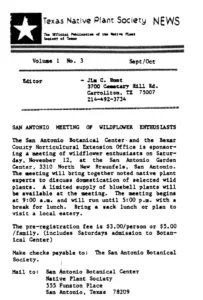
1983 – Sept/Oct

Volume 1, No. 3
Editor: Jim Hunt
  • Lonicera sempervirens

1983 – Jul/Aug

Volume 1, No. 2
Editor: Jim Hunt
  • Berberis swaseyi
  • Berberis trifoliolata
  • Asclepias tuberosa
  • Cultivation of Rose Pavonia

1983 – May/June

Volume 1, No. 1
Editor: Jim Hunt
  • Cultivation of Rose Pavonia

About the Region

Fall Symposium 2025 Logo - Teach for the Future

Salado, the location of our Fall 2025 Symposium, lies at the intersection of two ecoregions: the Edwards Plateau (Limestone Cut Plain) and Blackland Prairie (Northern Blackland Prairie).

The Edwards Plateau area is also called the Hill Country; however, this general term covers a much larger area extending farther north. Spring-fed creeks are found throughout the region; deep limestone canyons, rivers, and lakes (reservoirs) are common. Ashe juniper is perhaps the most common woody species found throughout the region. Additional woody species include various species of oak, with live oak (Quercus fusiformis) being the most common. Sycamores (Platanus occidentalis) and bald cypress (Taxodium distichum) border waterways. This area is well known for its spring wildflower displays, though they may be viewed in spring, late summer, and fall, as well. According to Texas Parks and Wildlife, average annual rainfall in the Edwards Plateau ranges from 15 to 34 inches.

The Blackland Prairie extends from the Red River south to San Antonio, bordered on the west by the Edwards Plateau and the Cross Timbers, and on the east by the Post Oak Savannah. Annual rainfall averages 30 to 40 inches, with higher averages to the east. This region is dominated by prairie species. The most common grass species include little bluestem (Schizachyrium scoparium) and Indian grass (Sorghastrum nutans) in the uplands and switchgrass (Panicum virgatum) in the riparian areas and drainages. Common herbaceous flowering plants include salvias, penstemons, and silphiums. This area has suffered greatly from overgrazing and agricultural use. Few intact areas remain, though many of the plants can be found along county roadsides throughout the region.

Our fall Symposium host chapter, the Tonkawa Chapter, includes both of these ecoregions.

Source: Wildflowers of Texas by Michael Eason