2025 Spring Symposium Speakers

The Native Plant Society of Texas is pleased to welcome our 2024 Spring Symposium Speakers:

Christopher Brown Phot

Christopher Brown, Author

Christopher Brown is the author of A Natural History of Empty Lots: Field Notes from Urban Edgelands, Back Alleys and Other Wild Places, and of the novels Tropic of Kansas (a nominee for the John W. Campbell Award), Rule of Capture, and Failed State (a nominee for the Philip K. Dick Award). He lives in Austin, where he also practices law.

Jennifer Bristol Photo

Jennifer Bristol, Author, Birder

Jennifer L. Bristol is a passionate advocate for birds and conservation in Texas, with a deep commitment to connecting people, especially youth, with nature. She is the author of Parking Lot Birding: A Fun Guide to Discovering Birds in Texas and Cemetery Birding: An Unexpected Guide to Discovering Birds in Texas, as well as the co-author with her father, George Bristol, on Texas State Parks: The First 100 Years 1923-2023. As the executive director of the Victor Emanuel Young Naturalist Camp Scholarship Fund, Jennifer ensures underserved youth have the opportunity to attend birding camps and experience the natural world.

Previously, she served as the director of the Texas Children in Nature Network at the Texas Parks and Wildlife Department, where she spearheaded initiatives to strengthen the connection between children, families, and nature. Her work earned her accolades like the Westcave Outdoor Discovery Center’s Enduring Dedication Award and the Phil Hardburger Park Conservancy’s Nature Hero Award.

A deep believer in giving service, she volunteers for the City of Austin’s Environmental Commission and Downtown Commission, as well as the Travis County Bond Citizen Advisory Board. On the Environmental Commission, she championed the Bird-Friendly Building Design resolution, promoting safer building practices for birds.

A dedicated community leader and avid birder, Jennifer resides in Austin with her husband and five energetic dogs. Through her work and writing, she continues to inspire others to embrace the beauty and importance of the natural world.

 
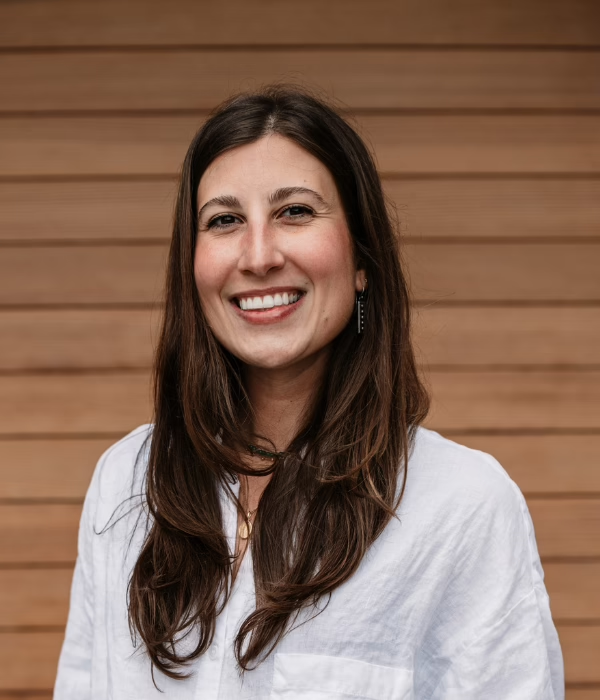
Julie Fineman Photo

Julie Fineman

President, Friends of the Warren Ferris Cemetery, 501C3

Founder, Constellation of Living Memorials

Member, Urban Land Institute Community Development Council 

After 30 years as an award-winning Hollywood photographer, Julie’s photographic legacy is now housed in the permanent collection of the Academy of Motion Picture Arts & Sciences Library. Subsequently, she re-envisioned her life’s focus through a year’s internship on an organic farm in upstate New York. She now advocates for wildlife conservation through multiple programs that she has developed.
Since moving to Dallas in 2017, Julie has studied the native ecosystems of Texas and the native plants that thrive in the Blackland Prairie environment. In 2019, she became a master gardener and Texas master naturalist, awakening her to the importance of Blackland Prairie restoration. That awareness became the foundation for restoring the neglected historic Warren Ferris family cemetery in Dallas’ Forest Hills neighborhood. Julie has guided the rewilding of the cemetery’s landscape, organizing volunteers to clear invasive species, plant indigenous species, and expand biodiversity.

To sustain this work, Julie formed The Friends of the Warren Ferris Cemetery, a 501c3, garnering public & private support and expanding outreach. She produced a 7-part documentary on Warren Ferris and the re-establishment of a native wildlife habitat within Dallas, which was donated to the Dallas County Public Library System. The FWFC has partnered with the Dallas Pioneers Association, the Texas Conservation Alliance, the Dallas Discovery Gardens, the North Texas Master Gardeners Association, and the Native Plant Society of Texas.

After five years, the result of the cemetery is a peaceful, contemplative setting, rekindling the neighborhood’s appreciation of its historic past, restoring biodiversity, and honoring the pioneers buried there. FWFC has earned a Preservation Dallas Achievement Award and is designated as a Certified Wildlife Habitat and Monarch Waystation.

Julie’s new initiatives for the FWFC include the Constellation of Living Memorials Program, which guides other neglected cemeteries in Indigenous landscape restoration and cultural archeological researc

Corrin Breeding

Corrin Breeding

Corrin J. Breeding is CEO/President of JBCG and has a background in horticulture, landscape architecture, land & property development and project management. After working for many successful landscaping, construction and land development companies he decided to pursue his entrepreneurial goals. Corrin has a passion for holistic design and construction practices that blend the natural and built environment. His knowledge of architecture, landscape architecture, construction and property development practices allow him to drive professional teams to create spaces that are aesthetically pleasing and financially feasible.

Corrin received his undergraduate degree in Landscape Design & Construction and first master’s degree in Landscape Architecture from the University of Tennessee, Knoxville and second master’s degree in Land & Property Development from Texas A&M University.

Jackson-Breeding Consultant Group (JBCG):

The history of Jackson-Breeding Consultant Group (JBCG) encompasses the legacy of two Georgia families that owned businesses in the construction, architecture and landscaping industries. The vision for JBCG began in 2016 as a small firm that assists municipalities, companies and individual clients with meeting their project needs. The main services offered by JBCG includes project management, providing professional drawings needed to move projects forward, and assembling a team of professionals to accomplish small to large scale tasks. JBCG has been involved in projects of various scales in the Southeast, Southwest and Midwest territories of the US.

Matthew Orwatt

Matthew Orwat, agriculture and natural resources, Dallas County. Orwat, of Fort Worth, earned his bachelor’s at the University of Texas at Arlington and his master’s in horticulture at Texas A&M. He worked with the rose breeding and genetics program and was a teaching assistant. He completed an internship with AgriLife Extension in Tarrant and Denton counties before starting his career as an Extension agent with the University of Florida IFAS Extension in Washington County. Growing fruit trees and vegetables with his father and helping his grandfather in his orchard and pecan grove helped him develop a love for growing vegetables, fruits and roses. Orwat said there are many untapped niche markets for small farms in urban areas, and he aims to help enterprising agricultural entrepreneurs find those and develop sustainable urban crop production through the outreach of AgriLife Extension

Andrea Delong-Amaya

Andrea DeLong-Amaya (ahn-DRAY-ah di-LONG ah-MY-ah)
Director of Horticulture, Lady Bird Johnson Wildflower Center

Andrea DeLong-Amaya oversees the Lady Bird Johnson Wildflower Center’s gardens and nursery programs and is passionate about sharing the value of native plants in planned landscapes. She’s been a staff member since 1998 and has over 30 years of experience with Texas native plants in horticulture, ecology and garden design.

She teaches classes in native plant horticulture and has contributed numerous gardening articles to publications such as Taunton’s Fine Gardening, Rodale’s Organic Gardening, American Public Gardens Association’s Public Garden, Neil Sperry’s Gardens and e-Gardens, Texas Gardener and Wildflower (the Center’s member magazine). Keep an eye out for her upcoming book, Texas Native Plant Primer (Timber Press), in March of 2025.

DeLong-Amaya has appeared numerous times on Central Texas Gardener, PBS’s long-running television program, and was a two-time guest on WNYC’s Science Friday. Jennifer Jewell featured Andrea’s work in her 2020 book, “The Earth in Her Hands: 75 Extraordinary Women Working in the World of Plants,” and interviewed DeLong-Amaya on the podcast Cultivating Place.
The Scott Arboretum of Swarthmore College will be honoring DeLong-Amaya with the prestigious 2025 Scott Garden & Horticulture Award in March 2025.

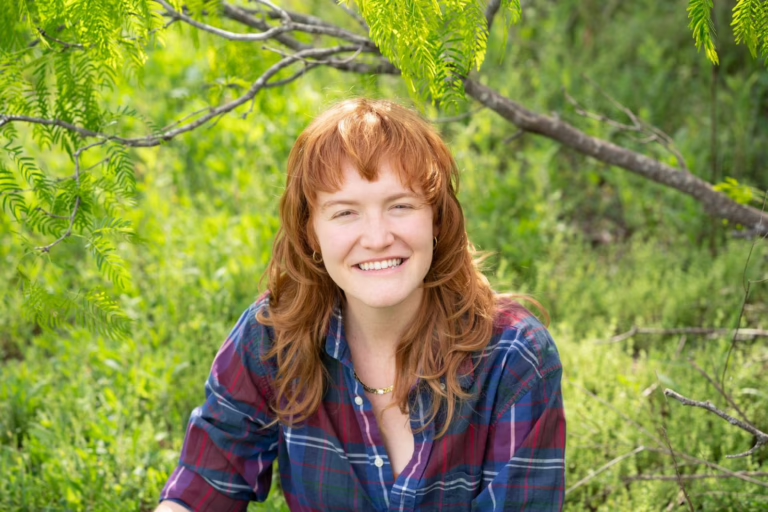
Chali Simpson Photo

Chali Simpson

Chali Simpson is a PhD student in the Forest Carbon Ecology Lab at Texas A&M University, specializing in carbon dynamics, grassland ecology, and sustainable grazing management. Their research focuses on quantifying soil carbon sequestration in Adaptive Multi-Paddock grazing systems compared to continuous grazing in northern Texas. By integrating field-based carbon flux measurements, ¹³C isotope analysis, eddy covariance data, and the Temporally Integrative Mass Balance Carbon Allocation (TIMBCA) model, they assess soil carbon inputs and outputs to determine the role of AMP grazing in enhancing soil carbon retention and mitigating climate change.

Wizzie Brown

Wizzie Brown is a Senior Extension Program Specialist- IPM with Texas A&M AgriLife Extension Service for 22. She works to educate others about insects and integrated pest management and hopefully succeeds in teaching that insects have their place in our world. Wizzie is a Board-Certified Entomologist specializing in urban and structural pest management, but also covers landscapes, gardens, native pollinators, insect identification as well as other topics. She received her Bachelor of Science in entomology from Ohio State University and a Master of Science in entomology from Texas A&M University.

About the Region

Fall Symposium 2025 Logo - Teach for the Future

Salado, the location of our Fall 2025 Symposium, lies at the intersection of two ecoregions: the Edwards Plateau (Limestone Cut Plain) and Blackland Prairie (Northern Blackland Prairie).

The Edwards Plateau area is also called the Hill Country; however, this general term covers a much larger area extending farther north. Spring-fed creeks are found throughout the region; deep limestone canyons, rivers, and lakes (reservoirs) are common. Ashe juniper is perhaps the most common woody species found throughout the region. Additional woody species include various species of oak, with live oak (Quercus fusiformis) being the most common. Sycamores (Platanus occidentalis) and bald cypress (Taxodium distichum) border waterways. This area is well known for its spring wildflower displays, though they may be viewed in spring, late summer, and fall, as well. According to Texas Parks and Wildlife, average annual rainfall in the Edwards Plateau ranges from 15 to 34 inches.

The Blackland Prairie extends from the Red River south to San Antonio, bordered on the west by the Edwards Plateau and the Cross Timbers, and on the east by the Post Oak Savannah. Annual rainfall averages 30 to 40 inches, with higher averages to the east. This region is dominated by prairie species. The most common grass species include little bluestem (Schizachyrium scoparium) and Indian grass (Sorghastrum nutans) in the uplands and switchgrass (Panicum virgatum) in the riparian areas and drainages. Common herbaceous flowering plants include salvias, penstemons, and silphiums. This area has suffered greatly from overgrazing and agricultural use. Few intact areas remain, though many of the plants can be found along county roadsides throughout the region.

Our fall Symposium host chapter, the Tonkawa Chapter, includes both of these ecoregions.

Source: Wildflowers of Texas by Michael Eason