NICE! Plant of the Month
(Capsicum annuum var. aviculare)
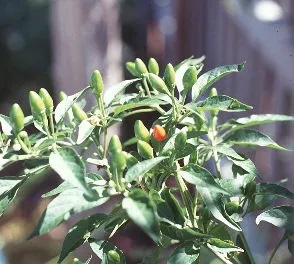
Description:
Chile Pequin is the native chile pepper from which many edible chilies have been derived. The natural range extends from tropical America through the southernmost tip of Texas north to Waco, east to Florida and west to Arizona. In the Hill Country, Chile Pequin is deciduous and rarely reaches over two – three feet tall. It may freeze to the ground during a severe winter, but it comes back from the root the following spring. Further south it may be evergreen and grow 5’ or more tall. It usually occurs as a woody, thin understory shrub with thin small leaves. It blooms a small inconspicuous white flower continuously and produces a profusion of small, very hot peanut sized edible red peppers. May spread some from seed, but it is not invasive.
Deer Resistance:
Chile Pequin is deer-resistant. However, young plants may be susceptible to damage where deer pressure is high.
Planting Sites:
Chili Pequin adapts to a wide variety of soil types and either moist or very dry conditions. It can grow in sand, loam, caliche, or limestone soils. Plants grown in the shade will be thin while those grown with a little sun exposure produce a thicker branching structure.
Planting Instructions:
Dig a hole at least two times wider than, but the same depth as the root ball in the nursery container. Sides of the hole should be irregular, not smooth. Remove plant from container, taking care to support the root ball. Loosen exterior roots gently with fingers. If the plant is root-bound, the outer roots may be cut in several places if they cannot be loosened by hand. Lift the plant by the root ball and place it in the hole. Backfill using soil that was dug from the hole. Do not add any soil to the top of the root ball, but a thin layer of compost may be spread over the soil surface. Gently firm the soil with hands, but do not tamp. Place 3-4 inches of mulch over the bare soil and root ball around the plant, but not touching the base of the plant.
Watering Instructions:
Water in well after planting to settle soil around roots. An organic-based root stimulator may be used following instructions on the product label. Water deeply a couple of times a week for 2-4 weeks after planting, then every 7-10 days, as needed, during the first growing season. Check moisture an inch or two into soil at the edge of the rootball to determine soil moisture. Skip a watering after a rainfall of ½ to 1 inch. Maintain this watering schedule until the first fall. Reduce watering during fall and winter. In a “normal” year, no watering may be necessary during fall and winter, but during a dry period, monthly watering may be needed. From the second spring and thereafter, water monthly only in periods of drought.
NICE! Tip:
Chile Pequin is an excellent xeriscape plant. Use it to produce a woodsy looking ground cover under large trees or as an accent shrublet in partial sun locations. If grown in a semi-sunny location, Chile Pequin may be sheared to produce a dense compact shrub that will be covered with bright red peppers. Save some peppers to use for seasoning, but be very cautious!
Look for the NICE! Plant of the Month signs and information sheets on your next visit to a participating Boerne nursery. And thank you for supporting native plants by using them in your landscapes.