

Collin County’s Bountiful Native Beans
This month we are taking a trip back in time to The Coneflower Courier, our chapter’s paper newsletter from 1994 – 2001. Below is a fascinating article from the April 1995 edition on Collin County’s surprising variety of native plants in the Bean / Pea (Fabaceae) family. The article was written by Harold E. Laughlin, Ph.D., who at the time was the Wildlife Sanctuary Directory of the Heard Natural Science Museum in McKinney. We hope you enjoy.
Many of my favorite Blackland prairie plants are members of the Fabaceae, the bean family (or pea family or legume family). One of them is every Texan’s favorite, the Bluebonnet (Lupinus texensis). However, we really do not have many naturally occurring bluebonnets in Collin County, so I will pass over them with only this mention. It does seem that most of our beans have flowers of blue, lavender, or pink.
Ground Plum
Probably the earliest occurring one is the Ground Plum (Astragalus crassicarpus). This pretty prairie pea grows in well-drained prairies and gravelly outcrops in most of the relict prairies of the county. It may begin blooming in early March, and continue until mid-April. When growing out in the sun, uninhibited by surrounding taller plants, it makes a mound of compound leaves about 8 – 10 inches tall and 12 – 14 inches across.
In full bloom it is crowned with light pink or magenta clusters of flowers. It is, of course, not a plum – it gets its name from seed pods (peas), which when ripe are about the size and shape of a small plum, with purple blush developing on the side receiving sunlight. These pods are edible, as are most pea pods, and are often eaten by mice, ground squirrels, and no doubt many other animals (I have sampled them, and they are not bad!).
Milk Vetch
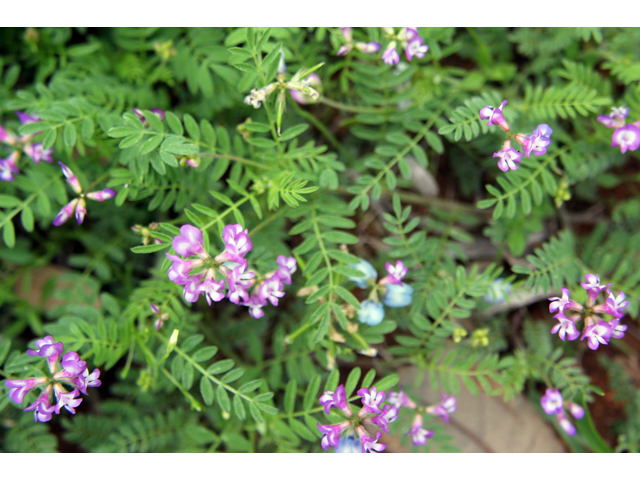
A very close relative, Milk Vetch (Astragalus nuttallianus), grows in about the same places and begins about 2 – 4 weeks later than the Ground Plum. Its flowers are very light blue or lavender and are a bit smaller and not as robust as those of their congeners. Its pods are drawn out at the ends and not at all like the plums. (I have never tried to eat one, but they do not look as if I would like them.)
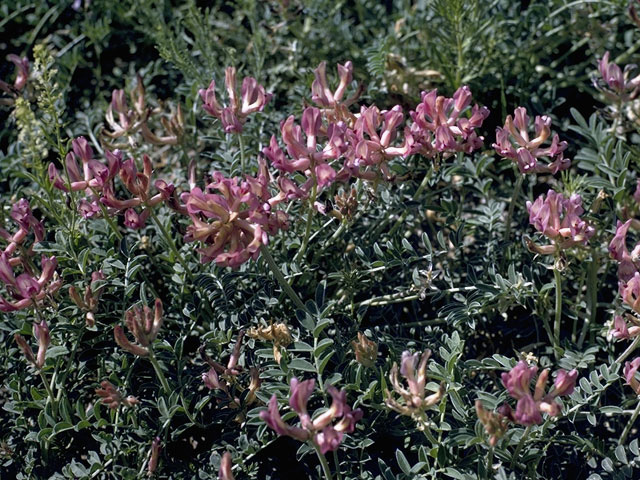
Another inhabitant of the limestone outcrops is the Wooly Loco Weed (Astragalus mollissimus). Yes, this is the plant which was the bane of early ranchers and farmers because of the toxic nature of the plant to livestock. Correll and Johnston say, “Because of its abundance and wide distribution it is probably the most destructive of all the known loco weeds.” How ironic that such an onerous creation should be so beautiful! Several flowering stalks per plant rise straight up out of a cluster of compound grayish-green leaves. At the top of each 10 – 15 inch stem is a raceme of pea-type florets in a range of colors from pink to lavender to purple to magenta, and occasionally white.
Wooly Loco Weed
Our county checklist includes 23 species of beans. There are the many varieties of Prairie Clovers with their funny heads which look more like coneflowers than legumes, the Sensitive Brier (Mimosa microphylla) with its shy-to-the-touch leaflets, and many more.
Blue False Indigo
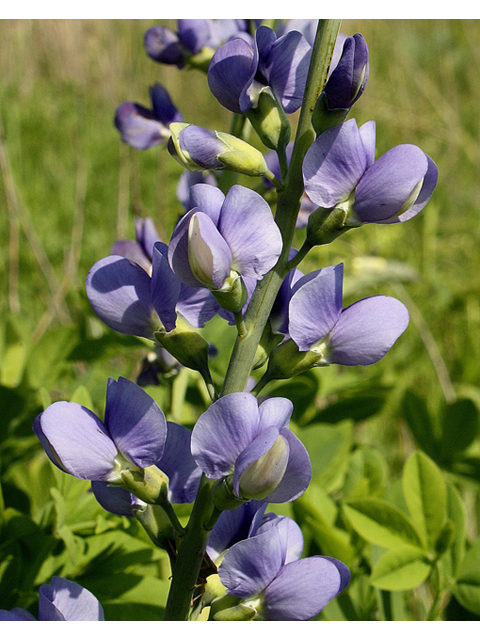
But arguably the most spectacular is the Blue False Indigo (Baptisia australis). Some have likened this handsome plant to a jumbo-size Bluebonnet. The flowering stalks may reach two feet or more in height, with the dark blue or violet blossoms occupying up to 6 inches of the top. The blossoms are about the same shape as those of Bluebonnets, but do not have the white faces.
The Blue False Indigo grows in deep but well-drained prairie soil, out in the sunshine. They are perennials but die back in winter, leaving a woody skeleton which eventually disintegrates. The young sprouts in early spring look for all the world like Asparagus and are tempting to put to a taste test. However, you would not want to cut one as it would damage the plant. (I did try it once – take my word for it – forget it.)

Ecologically, legumes are good for the soil and thus for all the prairie plants and other parts of the ecosystem. Microbes in the root nodules help fix nitrogen for use by other plants to make an important part of plant nutrients. It is uniquely fortunate that such environmentally important creations are also so beautiful.
