Kerrville Chapter

Hill Country Resources

Resources Compiled by Local Heroes

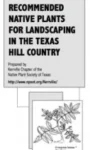
Recommended Native Plants for Landscaping in the Texas Hill Country

The plants in the pamphlet “Native Plants for Landscaping in the Texas Hill Country” were initially selected by members of the Kerrville Native Plant Society to provide a list of common and deer resistant plants that can be used for landscaping in the Kerrville and surrounding areas.  Extremely handy and well-organized little booklet.  Available for a suggested $2 donation at the Gift Shop of the Riverside Nature Center, at chapter meetings and at public outreach events

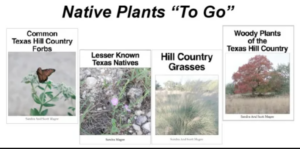
Native Plants “To Go” is a series of free downloadable books available as pdf files or for tablets and smartphones.  Created by our very own Past President Sandra Magee and her husband Scott.

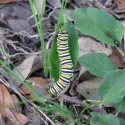
“Butterfly Larval Plants” is a compliation by Barbara Lowenthal and Sandra Magee.  The plants listed are native to the Texas Hill Country and the Edwards Plateau.  References used to make this spreadsheet are Butterfly Gardening for the South by Geyata Ajiivsgi and Texas A&M’s Checklist of Vascular Plants of Texas.

Thanks to Riverside Nature Center for these great informational documents.

 Gleaner’s Handbook” contains identification keys to native plant families, common forbs and wildflower seeds in Kerr County and surrounding counties.  It also includes pressed flower guidelines, success with wildflower seed collection and other useful information about native plants. PDF – 71 pages.
 
Wildflowers of Kerr County” is a checklist for the wildflower enthusiast.  Just as birders have life lists of bird sightings, this list can be used in the same way.  PDF – 21 pages.
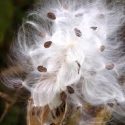
milkweed seed

“Identification of Milkweeds in Texas” is a great resource developed by Texas Parks and Wildlife in conjunction with the Lady Bird Johnson Wildflower Center.  It has many useful color photographs as well as key identification characteristics and range maps for the many different milkweed species found in Texas.

“Carroll Abbott’s Texas Wildflower Newsletter” was written between 1976 and 1984 by Carroll Abbott, one of the founders and NPSOT and a Kerrville resident.  These interesting newsletters contain information that is still valuable today, written in an entertaining and informal style by Mr. Abbott and other contributors.


These books by Jim Stanley are a great addition to the library of any landowner in the Texas Hill Country.

Jim is a member of our local NPSOT chapter and a graduate of one of the first classes of Texas Master Naturalists (TMN).  Jim has volunteered countless hours of land management consulting as a TMN and also at Riverside Nature Center

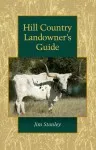
Hill Country Landowner’s Guide

This invaluable book charts a practical course for understanding and handling a variety of problems that both new and established landowners in the Texas Hill Country will confront-from brush control, grazing and overpopulation of deer to erosion, fire and management of exotic animals and plants.
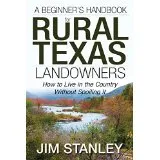
A Beginner’s Handbook for Rural Texas Landowner’s

The subtitle spells it out: “How to Live in the Country Without Spoiling It.” This book is the perfect introduction for small landowners wanting to be good stewards of their piece of the Hill Country.  As the title says, it’s a place to begin and a perfect lead-in to Stanley’s earlier book (above) which contains more specifics.

Also available at Riverside Nature Center.
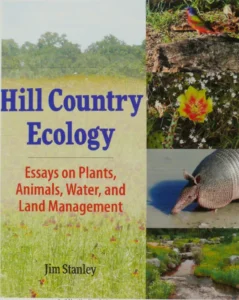
Hill Country Ecology: Essays on Plants, Animals, Water, and Land Management

This is a compilation of essays published in the Kerrville Daily Times.  In this book, Dr. Stanley, a knowledgeable naturalist of Hill Country issues, addresses a wide range of topics of interest and concern to residents of the Texas Hill Country.

Also available at Riverside Nature Center.
About the Region

Fall Symposium 2025 Logo - Teach for the Future

Salado, the location of our Fall 2025 Symposium, lies at the intersection of two ecoregions: the Edwards Plateau (Limestone Cut Plain) and Blackland Prairie (Northern Blackland Prairie).

The Edwards Plateau area is also called the Hill Country; however, this general term covers a much larger area extending farther north. Spring-fed creeks are found throughout the region; deep limestone canyons, rivers, and lakes (reservoirs) are common. Ashe juniper is perhaps the most common woody species found throughout the region. Additional woody species include various species of oak, with live oak (Quercus fusiformis) being the most common. Sycamores (Platanus occidentalis) and bald cypress (Taxodium distichum) border waterways. This area is well known for its spring wildflower displays, though they may be viewed in spring, late summer, and fall, as well. According to Texas Parks and Wildlife, average annual rainfall in the Edwards Plateau ranges from 15 to 34 inches.

The Blackland Prairie extends from the Red River south to San Antonio, bordered on the west by the Edwards Plateau and the Cross Timbers, and on the east by the Post Oak Savannah. Annual rainfall averages 30 to 40 inches, with higher averages to the east. This region is dominated by prairie species. The most common grass species include little bluestem (Schizachyrium scoparium) and Indian grass (Sorghastrum nutans) in the uplands and switchgrass (Panicum virgatum) in the riparian areas and drainages. Common herbaceous flowering plants include salvias, penstemons, and silphiums. This area has suffered greatly from overgrazing and agricultural use. Few intact areas remain, though many of the plants can be found along county roadsides throughout the region.

Our fall Symposium host chapter, the Tonkawa Chapter, includes both of these ecoregions.

Source: Wildflowers of Texas by Michael Eason