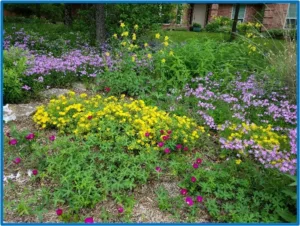
Serving all of Tarrant County, the North Central Chapter has over 450 members. Our chapter maintains several demonstration gardens filled with Texas native plants. The gardens are open to the public, showcase native plant landscapes, promote conservation, and are valuable local greenspaces. You may even encounter some of our members working in the gardens on our monthly volunteer days.
Our monthly meetings feature a variety of speakers and take place on the second Thursday of the month. Held at the Fort Worth Botanic Garden in the Rose Room and live-streamed via Zoom, the public is welcome to join us either in person or online. There are no monthly meetings in January and July, and our annual Holiday Party is held in December.
Visit our online Bonfire shop to purchase t-shirts, hats, and other merchandise featuring our chapter logo. NPSOT State also has a shop on Bonfire, as well as yard signs and books for sale.
The mission of the Native Plant Society of Texas is to promote conservation, research and utilization of native plants and plant habitats of Texas through education, outreach, and example.
Inspirations
Nature is an open book for those who care to read. Each grass covered hillside is a page on which is written the history of the past, the condition of the present, and predictions of the future. ~John Earnest Weaver
A true conservationist is a man who knows that the world is not given by his fathers, but borrowed from his children. ~John James Audubon
About the Region
This low-elevations region of Texas extends inland from the barrier islands, about 60 or so miles, and stretches from Brownsville to Louisiana. In total, it covers about 9.5 million acres, with a high point of 150 feet in elevation. More than 1000 species of plants can be found in this region. On the southern end, species more common in Mexico (such as Sabal mexicana) and Central America occur.
The barrier islands provide us with dune systems, and clay flats to the inland side, which have species found in these areas alone. Many plants here, such as Ipomoea pes-caprae (beach morning glory), can be found throughout tropical regions of the globe. I’ve encountered the same species on the beaches of Guam.
Once inland, vast marshes and wet prairies occur. Occasionally, oak (Quercus fusiformis) groves can be found. Common grasses include species of Bothriochloa, Paspalum, and Sporobolus; eastern gamagrass (Tripsacum dactyloides); and switchgrass (Panicum species). Many rivers and creeks cut through the Gulf Prairies, and along these riparian areas various species of trees, Sabal minor, and other plants adapted to clay soils can be found. Due to overgrazing, farming, and fire suppression, woody species such as mesquite (Prosopis glandulosa) and huisache (Acacia farnesiana), and invasive species such as chinaberry (Melia azedarach), Brazilian pepper (Schinus terebinthifolius), and Chinese tallow (Sapium sebiferum) have increased and displaced our native flora.