We are excited to welcome Brenda Fest as our February speaker.
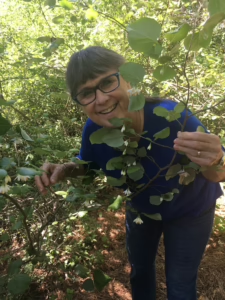 Brenda is an active member of NPSOT-Boerne chapter and an instructor for NPSOT Boerne’s Native Landscape Certification Program (NLCP). In addition, she also is an active volunteer for the Hill Country Master Naturalist Chapter, and a certified Texas Master Naturalist.
She has always enjoyed gardening with native plants that attract butterflies and support our natural ecosystem.
Brenda’s presentation, “Botany Basics – An Introduction to Plant Families”, will give a brief overview about the variety of plants in the plant kingdom. It will discuss how plants are arranged into plant families. A hands-on dissection of flower parts and practice handout will be included. Knowing the basics of plant families is helpful when identifying and understanding native plants.
Brenda grew up in San Antonio, moved to Austin, and earned her degree in Botany as well as her Master’s and Ph.D. in Science Education at the University of Texas, Austin. She taught science at various high schools in Texas and was a science learning specialist at the University of Texas Learning Center. She and her husband, Gary, moved to Pipe Creek, Texas in 2003 and Brenda taught biology and aquatic science at Clark High school in San Antonio until she retired in 2014.
About NPSOT Boerne Meetings: Join us for our monthly chapter meetings. You do not need to be a member to attend. We meet the first Tuesday of each month.
Our meetings start with a social time at 6:00pm. Announcements will begin at 6:45pm, followed by the presentation. For the social time, please bring any snacks/appetizers/desserts that you would like to share.
Volunteers are needed to come early and/or stay late to help with set-up and clean-up.
Meeting Location: Hunke Hall, 33 Herff Farm Road, Boerne
We hope to see you there!