San Antonio Chapter

Gardening Tips, Hints and Hacks July 2023

If you’ve been gardening for any amount of time, you have probably discovered practical gardening practices that work for you here in Central Texas.  We’d love for you to share them with us!  In coming newsletters, we’ll select and share one or two submissions.  Please help us make this new monthly feature a success by sending your submissions to sanantonio@npsot.org.  Be sure to include your name, fully describe the gardening tip, and possibly include an illustrative photo.

Time To Prune Your Native Perennials

Early summer is the time to prune! So many plants are growing VERY well right now from all our rain this spring. And as much as I don’t mind things growing a bit wild, even I’m like WOWSERS. It’s time to get pruning! 

Plants benefit from being trimmed, even if they have flowers. They’re just going to give you more flowers and be more bushy, healthier, and prettier. 

Some plants that are fall bloomers (like Frostweed) should get a heavy prune so they aren’t too tall and become top heavy with their blooms. Here’s a list of things you should be pruning now.

  • Frostweed: cut by a least 1/2 of whatever its height is currently is. (I cut mine back to 8”)
  • Tall Goldenrod: Cut 1/2 way its current height.
  • Turk’s Cap : Cut 1/4-1/2 its current height. (I cut back to 8”)
  • Maximilian Sunflowers: Cut by 1/2.
  • Autumn Sage: 1/4 trim all around
  • Texas Fall Aster: Cut back 1/4 and long and leggy stems.
  • Mistflowers: 1/2 their current height.
  • Flame Acanthus: anything leggy (or to your desired height/width)
  • ALL NON-NATIVE MILKWEED: This mimics our native milkweed going dormant for summer and will grow back with OE clean leaves/flowers for Fall migration.


(Submitted by Drake White of The Nectar Bar)
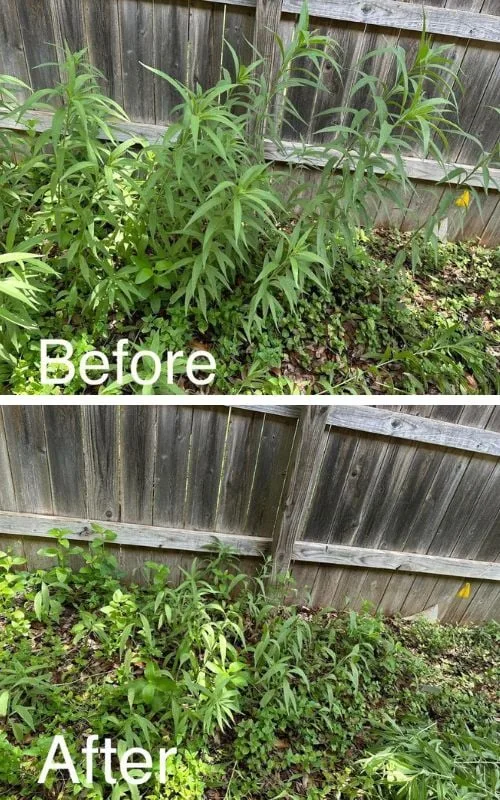
Photo by Drake White

About the Region

Fall Symposium 2025 Logo - Teach for the Future

Salado, the location of our Fall 2025 Symposium, lies at the intersection of two ecoregions: the Edwards Plateau (Limestone Cut Plain) and Blackland Prairie (Northern Blackland Prairie).

The Edwards Plateau area is also called the Hill Country; however, this general term covers a much larger area extending farther north. Spring-fed creeks are found throughout the region; deep limestone canyons, rivers, and lakes (reservoirs) are common. Ashe juniper is perhaps the most common woody species found throughout the region. Additional woody species include various species of oak, with live oak (Quercus fusiformis) being the most common. Sycamores (Platanus occidentalis) and bald cypress (Taxodium distichum) border waterways. This area is well known for its spring wildflower displays, though they may be viewed in spring, late summer, and fall, as well. According to Texas Parks and Wildlife, average annual rainfall in the Edwards Plateau ranges from 15 to 34 inches.

The Blackland Prairie extends from the Red River south to San Antonio, bordered on the west by the Edwards Plateau and the Cross Timbers, and on the east by the Post Oak Savannah. Annual rainfall averages 30 to 40 inches, with higher averages to the east. This region is dominated by prairie species. The most common grass species include little bluestem (Schizachyrium scoparium) and Indian grass (Sorghastrum nutans) in the uplands and switchgrass (Panicum virgatum) in the riparian areas and drainages. Common herbaceous flowering plants include salvias, penstemons, and silphiums. This area has suffered greatly from overgrazing and agricultural use. Few intact areas remain, though many of the plants can be found along county roadsides throughout the region.

Our fall Symposium host chapter, the Tonkawa Chapter, includes both of these ecoregions.

Source: Wildflowers of Texas by Michael Eason