Hairy Leafcup – Supporting Pollinators in the Shade
If you are seeking a native North Central Texas perennial that is pollinator-friendly, a conversation piece, space-eater, and adaptable to varying degrees of shade, the Hairy Leafcup (Smallanthus uvedalius) should be on your radar. Though big in stature, this relatively little-known, but fascinating plant warrants strong consideration in your native landscape.
Big and Beautiful
Below are a few of the intriguing aspects of the Hairy Leafcup, also commonly known as Yellow Leafcup:
- For a perennial that can be 4 – 10’ tall, the irony of its botanical name stems from American botanist John Kunkel Small.
- Smallanthus uvedalius is the only plant in its genus native to North America.
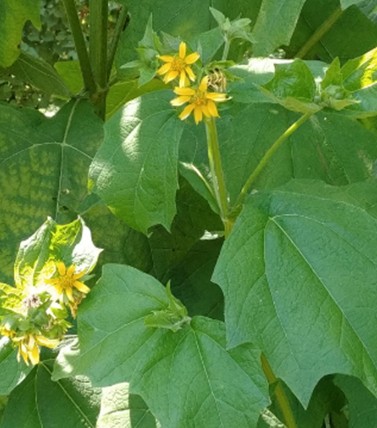
- With its large leaves, some reaching nearly 12” long and 8” wide, it is also known commonly as “Bear’s Foot”.
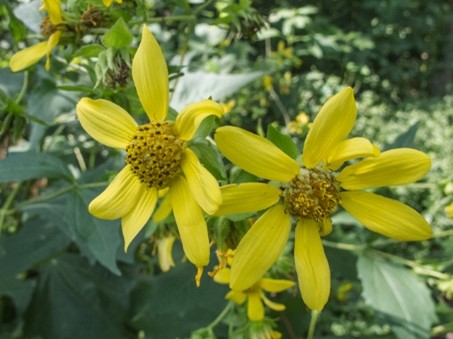
- Incongruously for a perennial of its size, its flowers are only 2” wide. But they make up for their small size with an abundance of flowers, often several hundred on an individual plant.
- In the late 19th century into the early 20th century, commercial extracts from its leaves were used for a variety of ailments, including the popular Brooks’ Bears-Foot ointment.
- The opposing leaves around the stem form a small “cup”, thus the common name. The other part of the common name is from the fine hairs on the top and bottom of the leaf surface.
Range and Habitat
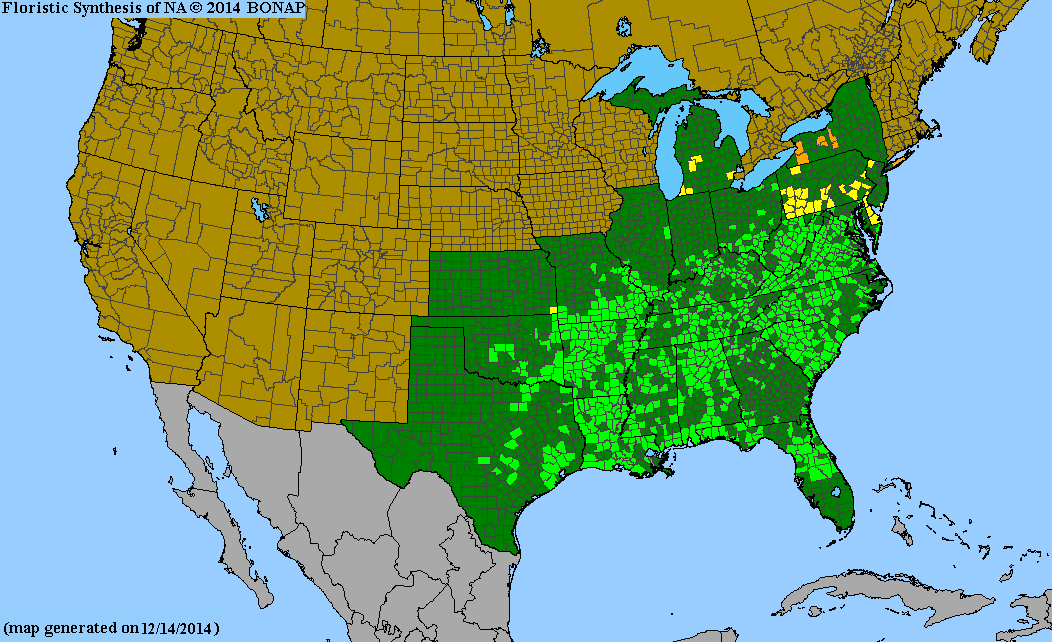
Smallanthus uvedalius range covers much of the southeastern U.S., extending to the eastern half of Texas – see graphic from the Biota of North America Program (BONAP). Though it prefers moister soil, it can tolerate drier conditions, and can prosper in partial shade to full sun.
Pollinator’s Partner
Hairy Leafcup is a member of the Aster (Sunflower) family. As such, it is an excellent nectar and pollen plant, popular with many species of bees and wasps. Flowering typically occurs from July to September. Their bountiful flower heads are crowded together in tight clusters.
How to Use in Your Landscape
Hairy Leafcup can make a “wow” statement in your landscape with its stature and abundance of flowers. Plus, it is easy to grow, adaptable to a variety of conditions, and despite its size, is not aggressive. The key is location and pairing. Placing along a back border, fence, or in a naturalized meadow or woodland will accentuate its positives without infringing and overshadowing its neighbors.
Pairing Hairy Leafcup with native plants that are also tall or in a large mass provides a natural and balanced setting. Some potential native partners include:
- Frostweed (Verbesina virginica) – Tall, insect-friendly plant provides mountains of blooms and is a good sturdy neighbor for Smallanthus uvedalius.
- Cardinal Flower (Lobelia cardinalis) – Bright red flowers of this reliable and up to 6’ tall perennial provides both the stature and contrast to highlight both plants.
- Coralberry (Symphoricarpos orbiculatus) – Sturdy shrub provides a counterpoint and mass, including berries, to be a great complementary native.
- Buttonbush (Cephalanthus occidentalis) – Multi-stemmed shade-loving shrub that can grow to 6-12’ with small white flowers.
Lastly, experts recommend not cutting the plant down after the growing season ends, as our native bees will over-winter in the hollow stems.
Availability
The biggest challenge with Smallanthus uvedalius is finding specimens. The best approach is through local native plant sales in the spring or fall, since finding at local nurseries is challenging.
Despite the challenge of procuring, going big with a Hairy Leafcup is well worth any extra effort. Its unique combination of attributes will provide your landscape and our ecosystem with a bounty of benefits.