

The Honey Locust (Gleditsia triacanthos) is a living ecological anachronism. It evolved with traits that were in response to a partnership with extinct species. As a result, this fascinating and resilient native North Central Texas tree is renowned for its unique characteristics.
Formidable Defenses – The Thorny Side of Honey Locusts
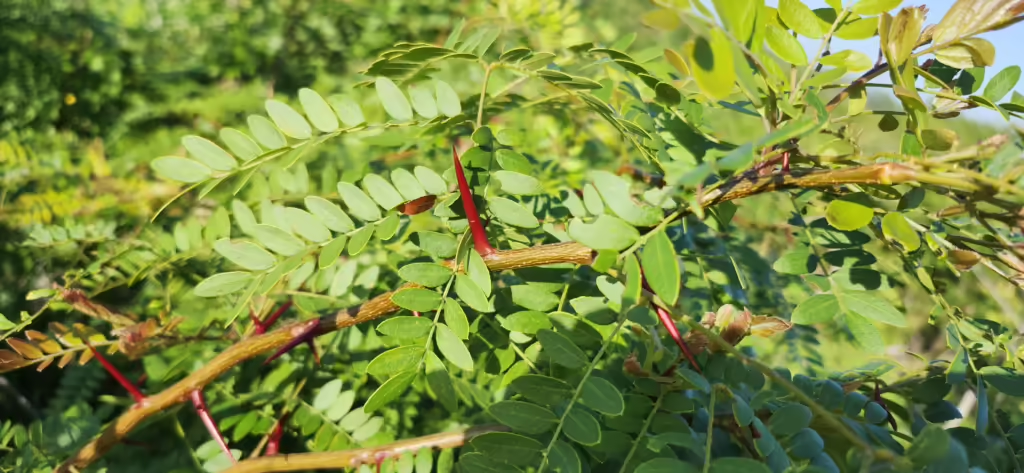
The most striking feature of the Honey Locust is the formidable reddish-brown thorns on its trunk and lower branches. These sharp spines, which often emerge in groups of three, can grow up to eight inches long. As they mature, the upper reaches of the tree are thornless. Because of their daunting thorns, especially on the lower portions of the trunk, the Honey Locust is not typically used or recommended for urban or suburban landscapes.
Honey Locust also stands out with an eye-catching bark that transforms with age. Young trees’ bark starts smooth and gray. As the tree develops, the bark takes on a unique pattern of furrows and ridges. Adding to the visual interest, the bark of mature trees often has a reddish-brown hue.
A Living Fossil: The Honey Locust’s Evolutionary Journey
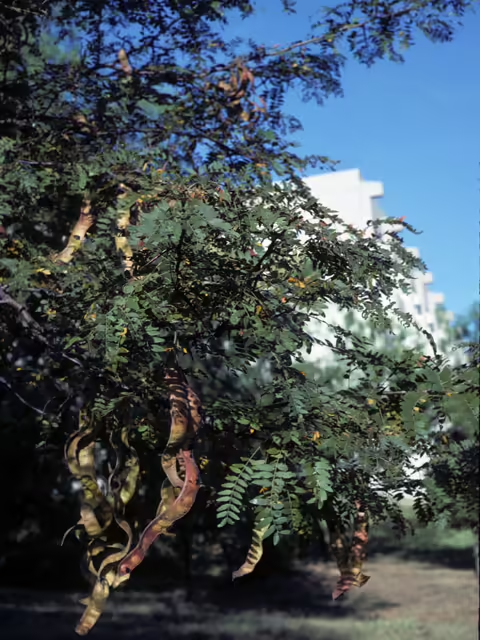
Honey Locusts evolved with enormous herbivores, such as Mastodons and Mammoths, that once roamed North America. According to author Connie Barlow in her book, “The Ghosts of Evolution: Nonsensical Fruit, Missing Partners, and Ecological Anachronisms,” these animals ate the seed pods whole and, through their digestion, widely distributed the seeds. These herbivores became extinct about 13,000 years ago, removing a critical element from the Honey Locust and also our native Bois D’arc (Maclura pomifera) life cycle. Now, the Honey Locust seed pods are not consumed whole by any indigenous animals in its native range.
Additionally, Honey Locusts are typically found in floodplains, a result of water distributing the seeds. Without the large herbivores, there are limited means to disperse the seeds into the uplands. Barlow also explains that the hard coating of the seed pod prevents germination unless they are damaged, such as through the digestive tract of a Mastodon. Finally, she posits, “Why waste energy manufacturing a sweet, protein-rich pulp unless that pulp is meant to attract an animal?” Some animals, like deer and squirrels, occasionally eat the seeds, but with their small size and varied diet, they play a minor role in seed dispersal.
Native Range
North Central Texas is part of the approximate westernmost limit of the tree’s native range, which runs north to Iowa and across to Western Pennsylvania and diagonally southwest along the western edge of the Appalachian Mountains to the Gulf Coast. After the extinction of the megafauna, humans played a significant role in the tree’s distribution. Native American tribes valued the Honey Locust for its sweet pods and medicinal properties, leading to cultivation. The tree has been spread throughout much of the United States. Generally, Honey Locust is only a minor component of natural forest stands.
Honey Locust – Beyond the Obvious

Honey Locust’s unique characteristics extend beyond their observable attributes. Below are some more uncommon features that add to its intrigue:
- A peculiar trait of the tree is its phenotypic plasticity. The Honey Locust can exhibit significant variations in leaf shape, size, and thorn development depending on environmental conditions.
- The tree’s adaptability allows it to thrive in a wide range of habitats and to be highly resistant to pests and diseases. Plus, it is typically more tolerant of – salt, drought, heat, and high PH – than other hardwoods.
- Young Honey Locust trees typically have bipinnately compound leaves, with leaflets arranged on secondary stalks along the central stalk. However, as the tree matures, its leaves simplify, becoming pinnately compound with leaflets directly attached to the main stalk.
- Though it is in the Fabaceae (Pea) family, Honey Locust is not a nitrogen fixer. However, botanists disagree on whether the tree uses a mechanism that is not yet fully understood.
Lastly, we have focused on the wild native species of Honey Locust, but there are thornless cultivars available, such as Gleditsia triacanthos var. inermis, that have been developed and are planted to minimize the risk of injury in urban environments.
The Honey Locust’s evolutionary path reveals a story of resilience and adaptation. It is a botanical marvel with its imposing thorns, intricate foliage, and sweet seed pods. This remarkable tree, a living ecological anachronism, adds to the uniqueness of our North Texas biota.
