Collin County Chapter

Mistletoe – Our Enigmatic Native Semi-Parasitic Shrub

11 Fascinating Facts about Mistletoe in North Texas

You cannot escape mistletoe during the holidays; it is in songs, decorations, movies, and many other forms of popular culture. Of course, after the leaves fall, you cannot escape noticing it residing on many of our native deciduous trees in North Texas. This evergreen shrub, while a potential nuisance, is fascinating, and certainly our best-known obligate semi-parasitic plant.

North Texas’ Native Mistletoe Species
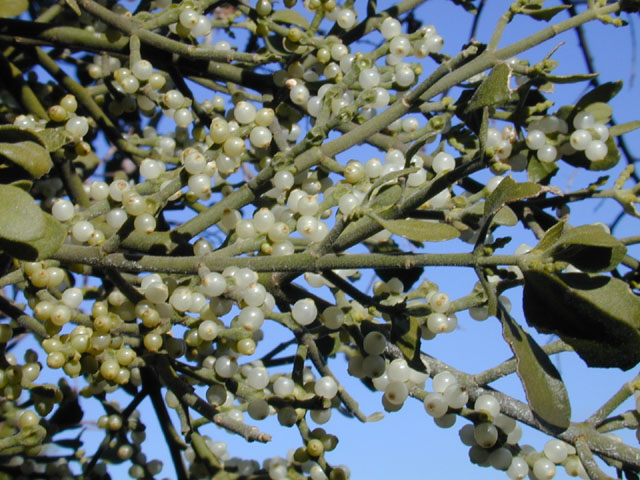
We have two native species of mistletoe in North Texas:

  • Oak Mistletoe (Phoradendron leucarpum) – native to most of the southeastern U.S., including the eastern half of Texas.
  • Christmas Mistletoe (Phoradendron tomentosum) – native to only Texas, Oklahoma, and Louisiana.

While we do not typically think of semi-parasites as native plants, they have existed in our ecosystem for thousands of years.

Fascinating Facts About Native North Texas Mistletoe
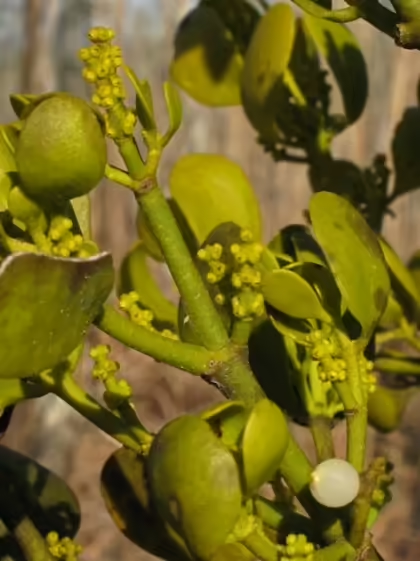
Photo Courtesy of the Wildflower Center and Alan Cressler; Phoradendron leucarpum (Oak Mistletoe)

Below we have compiled a short primer on our enigmatic native mistletoes here in North Texas:

  • Mistletoe is an obligate semi-parasitic (or hemi-parasitic) plant. In other words, it requires a host plant to germinate and complete its life cycle. While mistletoe’s leaves produce chlorophyll, it also must gather water and minerals from the host via its root system.
  • There are 40 species of mistletoe in the Viscaceae family in North America, according to the Wildflower Center. Of these species, 24 are in the Arceuthobium genus (dwarf mistletoe varieties), primarily located in the Western U.S. and Canada and utilize conifers as hosts. The remaining 16 are in the Phoradendron genus, including the two varieties native to North Texas.
  • The seeds are covered with a sticky substance readily eaten by birds such as cedar waxwings, bluebirds, mockingbirds, and cardinals. In addition, deer relish the leaves and will eat the entire plant if available.
  • Mistletoe’s life cycle typically begins when a seed is deposited by a bird on a tree’s limb. Because the seeds are sticky, they easily adhere to the limb and provide the time necessary to sink roots into the branch.
  • Mistletoe has a surprisingly long life. The germination and attachment to the host plant can take up to 1 year. Then in 2 – 3 years, as mistletoe’s specialized root system matures in the limb, it can produce another plant on the host. By 7 years, they typically reach hand-size, and in 20 years, they are about 3 feet in diameter.
  • Their longevity appears to be correlated to the lifespan of the host tree. Some have been reported to live for over 100 years.
  • The plant is dioecious, having only male or female flowers, with the female flowers producing seeds. On Tomentosum, the flowers on both males and females are greenish-yellow, and the seeds are white. While Leucarpum has yellow or white flowers and white seeds.
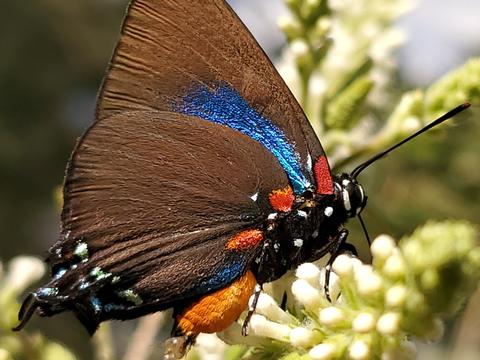
  • Photo courtesy of butterfliesandmoths.org; Great Purple Hairstreak
  • They typically attach to Sugar Hackberry (Celtis laevigata), Cedar Elm (Ulmus crassifolia), and Bois D’arc (Maclura pomifera) among a wide variety of native deciduous trees. Both types require exposure to the sun to flourish.
  • A variety of insects, including butterflies, wasps, bees, and ants, depend on both species for food from the leaves, seeds, nectar, and pollen.
  • Three species of hairstreak butterflies lay their eggs on the leaves. The Great Purple Hairstreak butterfly is the only butterfly in the United States that feeds on both of our North Texas mistletoe. When the caterpillars’ hatch, they eat the leaves. Once a butterfly, they feed on the mistletoe nectar.
  • Mistletoe is also important for our native bees, providing readily available nectar and pollen. It offers bees one of the first available pollen sources in the spring.
  • What to do If You Have Mistletoe on Your Trees?

    There is no simple answer to this question. But typically, if a tree is inundated with mistletoe, it is a measure of more underlying problems, such as diseases, root loss, insects, drought, or storm damage. These issues weaken the plant and make it more susceptible to the hemi-parasite. But typically, mistletoe alone will not kill a tree, just weaken it.

    Photo courtesy of NPSOT – Williamson County Chapter; Phoradendron tomentosum

    Removing the mistletoe, however, is not simple. You cannot just pull out the mistletoe, you have to cut off the branch starting a foot or so below the plant. This helps ensure capturing most of their root system to prevent the growth of another plant. If you do decide to remove, since they will likely be high up in the tree, we recommend hiring an arborist.

    Coexisting with a Semi-parasite

    No one is going to encourage the growth of mistletoe in their landscape. While it creates potential problems in the landscape, you need to consider it holistically and weigh these issues against mistletoe’s benefits to birds and insects in your local ecosystem. In the end, coexisting with the enigmatic mistletoe is likely inevitable, and your best approach to avoid having your trees overwhelmed is to create and maintain a healthy and diverse landscape filled with native plants.

    About the Region

    2026 Fall Symposium Logo

    This low-elevations region of Texas extends inland from the barrier islands, about 60 or so miles, and stretches from Brownsville to Louisiana. In total, it covers about 9.5 million acres, with a high point of 150 feet in elevation. More than 1000 species of plants can be found in this region. On the southern end, species more common in Mexico (such as Sabal mexicana) and Central America occur.

    The barrier islands provide us with dune systems, and clay flats to the inland side, which have species found in these areas alone. Many plants here, such as Ipomoea pes-caprae (beach morning glory), can be found throughout tropical regions of the globe. I’ve encountered the same species on the beaches of Guam.

    Once inland, vast marshes and wet prairies occur. Occasionally, oak (Quercus fusiformis) groves can be found. Common grasses include species of Bothriochloa, Paspalum, and Sporobolus; eastern gamagrass (Tripsacum dactyloides); and switchgrass (Panicum species). Many rivers and creeks cut through the Gulf Prairies, and along these riparian areas various species of trees, Sabal minor, and other plants adapted to clay soils can be found. Due to overgrazing, farming, and fire suppression, woody species such as mesquite (Prosopis glandulosa) and huisache (Acacia farnesiana), and invasive species such as chinaberry (Melia azedarach), Brazilian pepper (Schinus terebinthifolius), and Chinese tallow (Sapium sebiferum) have increased and displaced our native flora.

    Source: Wildflowers of Texas by Michael Eason