

If you have lived in North Central Texas for any time, you know that frequent and dramatic weather changes are inevitable. For any plant, this presents many challenges – floods, droughts, record heat, freezing temperatures – and that can just be one week in March. Okay, that was a slight overstatement; nonetheless, our weather extremes can make your landscaping efforts a great challenge.
Native Plants and the Weather
But we have readily available a group of plants with built-in defenses that can enable them to flourish despite our irrepressible weather – plants native to our area. These plants have evolved over eons to adapt to all that mother nature can throw at them.
We are one big state, so just because a plant is native to Texas does not mean it is well-suited to North Central Texas. It may be native to east Texas and suited to the higher precipitation and more acidic soil of that region compared to the DFW area. Or it could be a more tropical-like plant native to south Texas and the gulf coast, therefore less tolerant of the colder weather in our region.
The Root of Their Adaptability
Adaptation often starts with the root systems of our native plants. These plant’s deep root system gives them a distinct advantage through the ability to seek out water when it is in short supply. Their depth also gives them protection from deep freezes and helps to hold the soil during deluges, plus improves the ground’s water-holding ability.
Prairie plants include highly adaptable grasses and other perennials. Below are some hardy grasses and perennials for our area:
- Englemann’s Daisy (Engelmannia pinnatifida)
- Little Bluestem (Schizachyrium scoparium)
- Prairie Verbena (Verbena bipinnatifida)
- Sideoats Grama (Bouteloua curtipendula)
Our native trees are likewise adapted over millennia to our conditions, toughening them to the vagaries of our weather. Natives are typically less susceptible to disease and pest problems, as they have built up defenses, and often the pest’s natural predators are likely to keep them in check. They are also much more beneficial to our local wildlife than exotics. Our native trees provide wildlife with nourishment, shelter, and nesting material. They are suited not only to our microclimate but also to our soil types. Below are some local native trees of note:
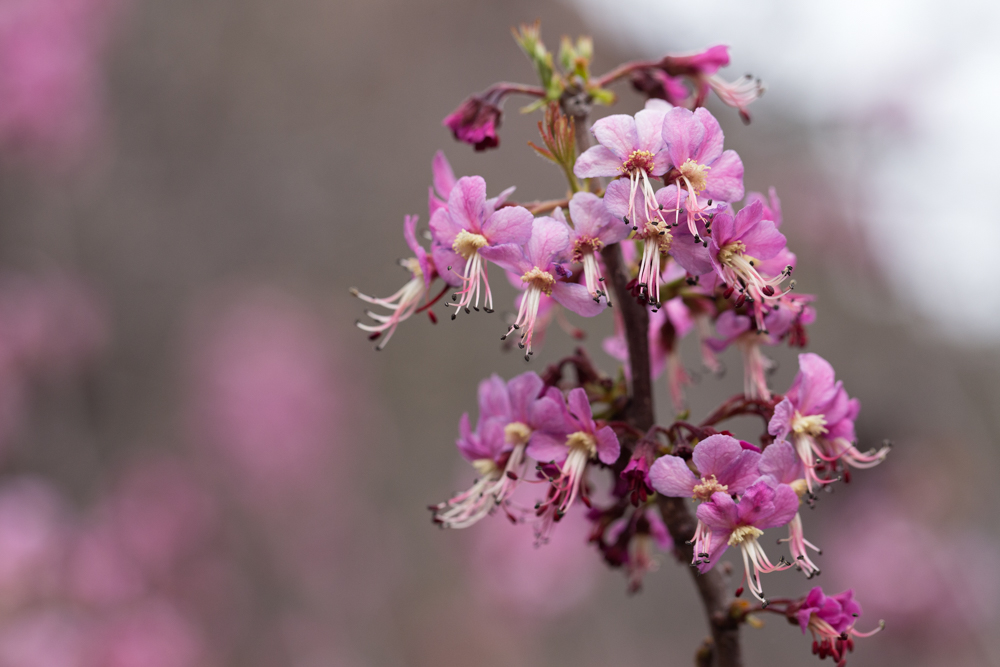
- Cedar Elm (Ulmus crassifolia)
- Mexican Buckeye (Ungnadia speciosa)
- Yaupon Holly (Ilex vomitoria)
Native shrubs, like the above plant types, have adapted to our environment over thousands of years to survive the elements. Some hardy native shrubs you may want to consider include:
- American Beautyberry (Callicarpa americana)
- Coralberry (Symphoricarpus orbiculatus)
- Fragrant Sumac (Rhus aromatic)
You can find more information on plants native to the DFW area in Sally Wasowski’s very helpful listing by plant type done exclusively for the Native Plant Society of Texas.
Don’t be Tempted by Non-Natives
Plants not native to our area can often survive for some time, but eventually, our weather extremes will make them succumb. Our February storm was the first time since the mid-1980s that we had temperatures around zero. Then as now, these low temperatures killed many of them.

Non-native plants can be a tempting choice due to their easy availability in many large nurseries and home improvement centers, fast-growth cycles, variety of colors, or unique foliage. Many of these plants are invasive in our area, like the Ligustrums (also known as Privets). They will quickly spread out of control and push out the native plants.
Avoid Zone Denial
A related problem, for both natives and non-natives, is an affliction known as “zone denial”. Which is rationalizing the planting of tropical or cold-sensitive plants, such as agaves or hibiscus, in our area. The USDA plant hardiness zones, while not perfect, give you solid guidance on a plant’s cold tolerance. However, remember there are other factors that go into a native plant’s suitability to a location, not just cold tolerance. But since it is in widespread usage, knowing our zone is a good starting place. North Central Texas is in zone 8a.
The old gardening adage of “right plant – right place” applies not only on the micro-level to the best location in your yard but also on a macro-level regarding the right plant for your ecosystem. With resources like our NICE (Natives Improve & Conserve Environments) plant of the season, the Native Plant Society of Texas has a variety of valuable material to help you choose the native plant that is right for our area and for your landscape.
