

A sidebar to our earlier article on bottomland hardwood forests. Long-time chapter member John Lingenfelder sent us a note about the potential for a vast amount of bottomland hardwood forests in east Texas to be inundated as part of a new reservoir. John is a member of the Texas Water Board Region C Planning Group.
Sulphur River Basin Reservoir Plans
The Sulphur River basin in the northeast corner of the state has an extensive network of bottomland hardwood forests. The Region C Group is studying the area due to the vast amount of water available throughout the basin. The group is seeking to quench the future water demands of Dallas – Fort Worth.
The Metroplex is expected to grow from its current population of nearly 8 million to 15 million by 2070. As a result, the water planning group and its constituencies are wrestling with how to best meet the expected water demands of the next half-century.
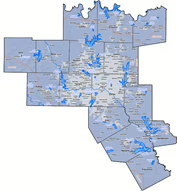
Texas is broken down into 16 water planning regions. The DFW area is part of Region C and includes about 25% of the state’s population. Sixteen counties are included in Region C (see nearby map).
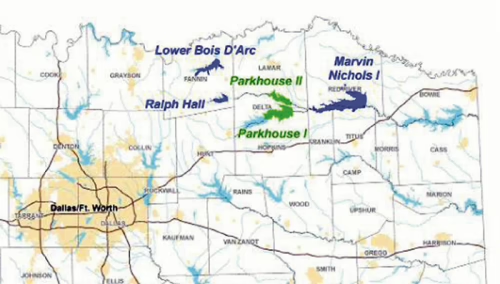
The current plan for Region C is for the Sulphur River basin to feed two new reservoirs. The first, Lake Ralph Hall is already under construction; work started in June of this year. Plans are for the lake to cover about 7,600 acres when completed in 2026. The reservoir is not expected to impact any bottomland hardwood forests.
Marvin Nichols Reservoir
More controversial is the proposed Marvin Nichols reservoir, which is still in the approval stage, and is by far the bigger of the planned reservoirs, in the range of 65,000 – 72,000 acres. If the Marvin Nichols reservoir is approved, over 30,000 acres of bottomland hardwood forests will be impacted. The state is moving fast to get the reservoir permits, so construction can begin in the next several decades (developing reservoirs involves truly long-term planning).
With a reservoir of that size, it will impact communities and livelihoods, in addition to wildlife and habitat. If the reservoir moves forward, the impact on the region’s ecosystem will be substantial. The financials are also eye-raising, with a $4.4 billion price tag.
Newest Reservoir – Bois D’Arc Lake
Another new North Texas reservoir, Bois D’Arc Lake in Fannin County, is nearing completion. Unlike the Marvin Nichols reservoir, it has a relatively low impact on bottomland forests, about 1,700 acres. Bois D’Arc is currently filling and will be the first major Texas reservoir in nearly 30 years. When completed next year, it will cover nearly 17,000 acres.
Native Plants Support Water Conservation
Unfortunately, the DFW area has the distinction of having the highest water usage rates in the state. There are many factors that go into water usage, but a major one is residential water usage. Compared to non-native plants, native plants require 80% less water. Therefore removing even parts of your non-native lawn grass, which requires significant amounts of water, you can help to reduce our dependence on additional reservoirs. Replacing non-natives with native plants will help to reduce your water bill and the region’s water needs. Below is a listing of a few drought-tolerant North Texas native plants that are hardy and readily available for purchase.
Trees
Shrubs
Groundcover
Perennials
Grasses
Lastly in our listing, for the adventurous, we have to include our North Texas native Low Prickly Pear (Opuntia humifusa) cactus – very drought tolerant. One caveat, native plants often require supplemental water in their first couple of years, but once their roots are established, additional watering is not usually needed.
Additional Information
For your reference, here is a link for additional information on water-wise native plant garden designs. Plus, the Lady Bird Johnson Wildflower Center provides a comprehensive listing of drought-tolerant native North Central Texas plants.
Including native plants in your landscape is a simple action you can take to reduce your and our region’s water needs. In combination with practical water conservation measures, it reduces the need for more reservoirs that often replace critical native habitats, such as the bottomland hardwood forests of northeast Texas.
