NICE! Plant of the Month
Juglans major
Family: Juglandaceae
Type: Medium sized, deciduous, edible nut bearing tree with chambered pith in shoots; related to Eastern Black Walnut, J. nigra and Little or Texas Walnut, J. microcarpa.
Natural Habitat: Found mostly near stream banks in Central Texas; ranges from Central Texas westward into Arizona and southward into northern Mexico commonly in riparian broadleaf forest communities; only walnut found growing naturally in a desert environment.
Growth: Moderate growth rate up to 40-60 feet with spreading crown.
Deer Resistance: No, like all trees, must be protected from browsing and rubbing for several years.
Wildlife: Utilized by a wide range of wildlife including mammals, squirrels and other rodents, various birds and insects; walnut tree communities have a high species richness of breeding birds.
Light Tolerance: Sun.
Flowers: Monoecious; male flowers are greenish, 2-3 in cylindrical catkins on leafless shoots from previous year; small, inconspicuous female flowers cluster at the tip of current year’s leafy shoots.
Fruit: or nut-like drupe, 1-1.5 inches in diameter with very hard shell growing inside bulky outer husk.
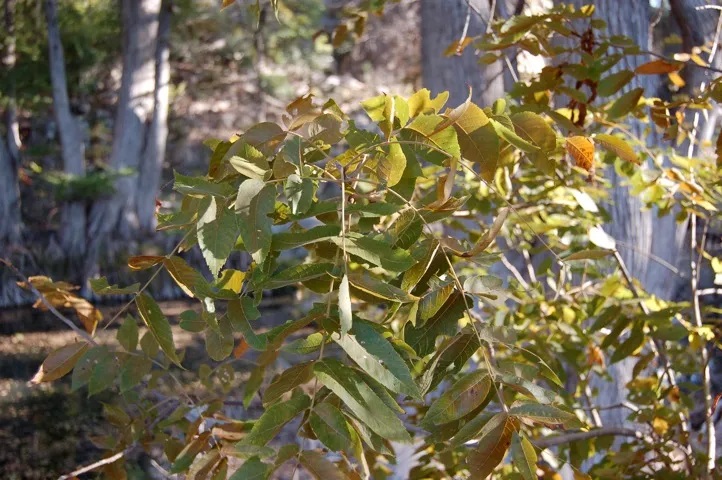
Leaves: Pinnately compound with 9-15 leaflets, leaves 7-13 inches long, leaflets narrowly lanceolate, yellow-green above, paler below.
Water Requirements: Drought tolerant once established; may require longer watering to establish.
Soil Requirements: Tolerates a range of conditions; due to its taproot grows best in deeper soils.
Planting Instructions: Space trees 20-30 feet apart or closer for a woodsy feel. Dig a hole at least two times wider than, but the same depth as the root ball in the nursery container. Sides of the hole should be irregular, not smooth. Remove plant from container, taking care to support the root ball. Loosen exterior roots gently with your fingers. If the plant is root-bound and cannot be loosened by hand, the outer roots may be cut in several places. Lift the plant by the root ball and place into the hole. Backfill hole, using soil dug from hole. Do not add any soil to the top of the root ball. Gently firm the soil with your hands, but do not tamp it down. Place 2-3 inches of mulch over the bare soil around planting and the root ball but not touching the base of the plant.
Watering Instructions: Water deeply after planting to settle soil around roots. Then water every 7-10 days, or more often as needed, during the first growing season. Before watering, check for soil moisture at a depth of an inch or two at the edge of the root ball. Skip a watering after a rainfall of 1 or more inches. Maintain this watering schedule until the first fall. Reduce watering during the cool fall and winter months. In a “normal” year, no watering may be necessary during the fall and winter, but during a dry period, monthly watering will be needed. Second Spring and thereafter: Water 1-2 times monthly only during periods of drought. Once established, which may take 2-4 years, natives will survive with little supplemental irrigation if rainfall averages around 30 inches/yr.
NICE! Tip: Due to its hardness, tight grain, and color walnut wood is prized for furniture, gun stocks and carving. Shells are used in many manufacturing and industrial processes. Husk makes a mordant free fabric dye. Juglone, secreted from roots and released by decaying leaves, is reportedly inhibitory or toxic to certain plants like tomatoes & apples. Plant Arizona Black Walnut to give the wildlife in your area a real treat while you enjoy the shade!
Look for the NICE! Plant of the Month signs and information sheets on your next visit to a participating Boerne nursery. And thank you for supporting native plants by using them in your landscapes.