Presented by Martha Richeson
June 14, 2021
Botanical name: Alophia drummondii
Common names: Propeller Flower, Purple Pleat-leaf, Pinewoods Lily, Pleatleaf Iris
Family: Iridaceae (Iris)
[MUS—EASY AND FUN]
[Martha] I hope all of you are as smitten with the beauty of this flower as I was when I first saw it. In 2019, I was at the Deer Park Prairie. We were doing a seed collecting foray and someone had showed this to Tom Solomon. He came over and got me and I looked at it, and my first thought was this is an exotic plant hiding here in Deer Park Prairie kind of looks like an orchid, but it was not an orchid.
So, I went home to do a little research on this plant. This research that you’re looking at on the screen is just from a couple of weeks ago, so it’s fairly current from iNaturalist. You can see in the upper left-hand corner the distribution in Texas is basically the eastern third of Texas. And then in the larger view you can see Dallas, Houston, Austin and San Antonio. And you can see the distribution around those large cities. I didn’t enlarge Harris County. You see it’s fairly empty. There were only four or five sightings of this Alophia drummondii in Harris County. Several were in the Deer Park Prairie. And then later, Carter Clay took me to an easement behind Walmart on Spencer Highway in Pasadena. And then there has been a report it’s been on the easement behind Home Depot on El Dorado, and then there is another sighting on the west bank of what is now [Lake] Mark Kramer, previously called Mud Lake. Really not very many, but there are some in our area.
And this again from iNaturalist. The time of the year is right now. It was about three years ago to the week that I first saw this plant. And you see from its graph, the big time is in May and June, so this is their season.
You may see some similarities to a plant that you’re familiar with—the Prairie Nymph or Herbertia lahue. You look at these plants and you see fairly quickly that they each have three large and three small [outer parts]. We call these tepals. But they’re in threes. You kind of say, hmm, what else is in threes? You think about irises and tulips and members of the monocot group. So, on the left is the Propeller Flower or it’s also called Pinewood Lily, Purple Pleat-leaf or Pleatleaf Iris, is what I call it. And the Herbertia also is known as a Prairie Nymph. Taxonomically, when you look these up it’s all over the map. The Prairie Nymph has sometimes been called Alophia. It’s very confusing when you start to look these up, but they are two distinct plants. I will call them cousins. And if you will notice, both of them have these club-like seed heads, so that’s a very distinguishing mark on both of those plants.
When you look at this flower when it’s completely open, there’s three large and three small tepals. The large ones are mostly just lined and the small ones have this intricate pattern with the purple, the yellow and the rust color. As you see, they’re all aiming down toward the center of the flower. I would love to see what the bees see with their ultraviolet colors and how this plant actually looks to the pollinators when they come.
You would step right on this plant if you didn’t know it was there. It is only about 12 to 18 inches tall and it would never fill out your flower garden. It’s a very unassuming vegetation and it doesn’t last all year. It disappears. You better know where it is and you better look for it when it omes up. In the top right picture, the word propeller plant comes from the fact that as you view this from a side view, the stem bends at 90 degrees right behind the flower so that the tepals, or the face of the flower, is perpendicular to the ground, as opposed to the Prairie Nymph [where] the flower is parallel to the ground.
Because I like to plant seeds, I was just so excited when I finally found a plant that had a seed head on it. If you look at the picture on the left, you can tell it’s rather lumpy-looking on the outside. As they get lighter green and lumpy, I have found that those seeds are viable. On the right hand picture you can see a green club of seeds, and then you can see the one in the forefront where it’s kind of getting lighter and turning a little yellow, which is a little bit more mature. And then in the back, the two brown ones, the lid or the opening has popped open and you see all these nice brown seeds in three little seed packets in these clubs.
So I, of course, had to try to grow some, and they germinate pretty well. This was a picture, again taken just a couple of weeks ago, of some seeds that were planted in January of 2021. They were just planted in a little cupcake container. This is about the size they have gotten between January of this year and June of this year.
When I have seeds and plants, I try not to keep all my eggs in one basket. And I try to experiment a little bit to see what they like and what they don’t like. On the left, these were seeds from 2020 that in August I kind of separated out and put them each in a tall cell container. And then they immediately disappeared, so I guess they kind of tend to go dormant in the late summer. But then they came out this year, but they don’t look the best. So, on the little photo on the right, the left-hand pot are 2020 seedlings that I kind of separated and put them in a rather light, a very well draining pottery pot, and then a lot of light soil. And they’re okay but they’re not super strong looking. Whereas in the black pot on the right, those are 2019 seedlings. I got tired of separating them so I just dumped a bunch of them in the black pot and they seem very happy. The ones in the 2019 pot, the black one, have just bloomed this year. So, it seems to take about two years before they get to the bloom stage. These are in the iris family, they’re not orchids even though they look exotic like orchids, but they’re in the iris family. And they have a tiny little bulb down at the bottom. These little plants, they like to live with friends rather than just by themselves, it appears. And if you would like to share some of these plants, I’d be glad to share with you, but I need to extract some work from you first. And you could help me with lateral transfers and then you could take a few with you.
Thank you. These are the resources that I used. The pictures were by permission. That’s it.
[MUS—AND THAT’S IT]
Related Posts
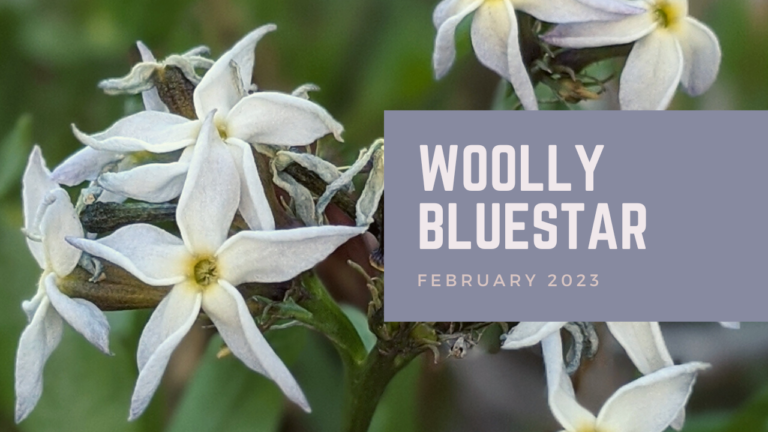
Plant of the Month: Woolly Bluestar
Our Plant of the Month for February 2023 is Amsonia tomentosa, commonly known as Woolly Bluestar, Woolly Amsonia, Small Leaved Amsonia, or Gray Amsonia.
Plant of the Month: Oyster Mushroom
Our plant of the month for January isn’t a plant at all, it’s a fungus!
Botanical name: Pleurotus ostreatus
Common name(s): Oyster Mushroom, Pearl Oyster Mushroom
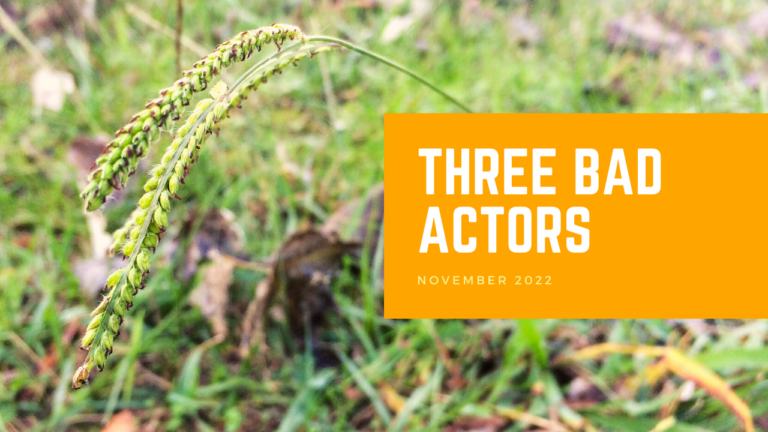
Spotlight on Invasives: Three Bad Actors
Spotlight on Invasives: Johnsongrass (Sorghum halepense), Southern Crabgrass (Digitaria ciliaris), and Dallisgrass (Paspalum dilatatum)