Presented by Jordan Lucas
March 13, 2023
Botanical name: Morus microphylla
Common name(s): Texas Mulberry
Family: Moraceae
[MUSIC—EASY AND FUN]
[Jordan] Hey everybody. Welcome to the plant of the month presentation. This month, we’re going to be talking about the Texas Mulberry tree. This tree is native to our area, but we’ll talk a little bit about that in just a second.
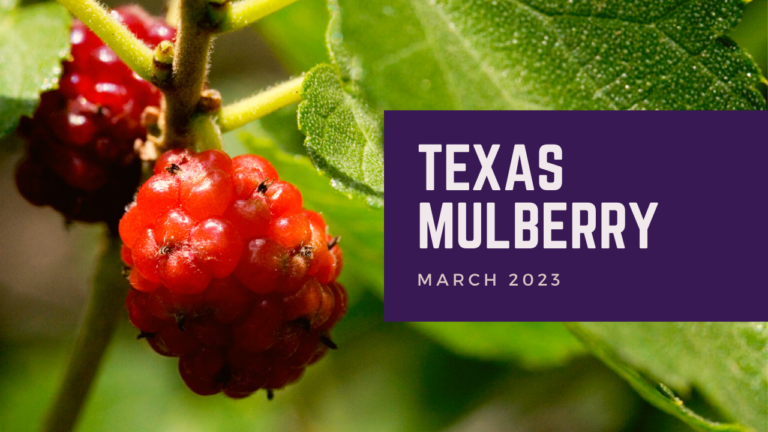
Some characteristics of this tree are that it is a deciduous tree, so it’ll lose its leaves in the winter. But don’t worry about it because it is a perennial, so you’ll be able to enjoy this tree and its fruit for years to come. It has a simple leaf, and the fruit type is going to be a berry that is black in color when fully matured and red while maturing. Once it’s black, it’s pretty sweet; you can even make pies and jam with it. The size gets up to about 25 feet tall, so it’s not the largest tree, but it’s a pretty good size.
The distribution of this species ranges from Texas to Arizona. It likes that South-Southwestern area because it does enjoy an arid climate. The further west you go, the less of a chance you’ll have of it being native and naturally occurring in those areas. But it continues to grow in those areas where it was introduced because it likes that arid weather and soil composition. It doesn’t need a ton of water because it likes drier soil, and it doesn’t necessarily enjoy full sun, so you’ll want to plant this in a partly shady area with some sun so that it’s able to photosynthesize and produce its fruit correctly.
The soil it likes is limestone-based, sandy, loamy, clay loam, things of that source, even up to igneous soil. This tree is going to be blooming from March to May, so kind of that late spring to early summer time of year, the colors are going to be red, green, and black as I mentioned before. It has unisexual flowers, meaning that the flowers either have a stamen or a pistil, not both, so it can’t self-pollinate. This is also known as having an incomplete flower, so this tree does require cross-pollination. It can be carried out by certain insects that are attracted to the tree.
Let’s talk a little bit about this species and birds. Some birds that are attracted to the Texas Mulberry tree include robins, cardinals, catbirds, crows, blue jays, and mockingbirds. The birds listed here eat berries and aid in the seed dispersal for this tree. So, the birds get some good food, and the tree gets seed dispersal so that it’s able to continue to reproduce. And it’s really great for all of you birders out there, and I know we’ve got quite a few.
Let’s talk about the Texas Mulberry tree and its relationship with mammals. The mammals attracted to this tree include foxes, raccoons, opossums, and squirrels. So, kind of those smaller forest-dwelling critters that are also going to be attracted to the sweet berry of this tree. The mammals that are attracted and do come to eat the fruit will also aid in seed dispersal.
Some potential parasites for this tree include the Fall Webworm, mealybugs, whiteflies, Glassy-winged Sharpshooters, and scales. The webworms only eat the ends of the trees at the end of the season, so they’re not a huge threat to the tree; it’s mostly cosmetic damage. But you can prune those ends of the tree if you’re that concerned about it. Mealybugs also feed on this tree. They are not in and of themselves a threat to the tree, but their excrements are. They excrete honeydew, which will reduce the growth of this tree, but there’s not much you can really do about mealybugs. Whiteflies also suck the juice out of the tree and excrete honeydew, but again, not much you can do to prevent whiteflies.
The Glassy-winged Sharpshooters are leafhoppers, so they eat the sap of the tree. They don’t necessarily cause damage, but once again, their excrement can. Their excrement can promote the growth of Xylella fastidiosa, which is a bacteria that is harmful to this tree. It’s a disease sort of like mulberry leaf scorch. Scales are going to eat the juices of the tree, and large infestations of them can cause wilting and yellowing of the leaves and bark cracking as well that will leak the sap out of the tree. You can avoid scales with adequate watering and pruning, and if you’re really in need of other preventative measures, you can introduce ladybugs to the tree in your garden, which will eat the scales and stave off that infestation.
Some other interesting facts I found while researching this tree are that mulberries were generally dedicated to Minerva, the goddess of wisdom, by the ancient Greeks, which I thought was kind of cool. In addition, the leaves of mulberry trees used to be used to fatten silkworms to boost the silk industry in America once they came over from Asia. So, not only are they great for their fruit, but they ended up boosting the silk industry as well.
That’s all I have for you guys today, but thank you so much for listening, and I hope you enjoyed it. Take care.
[MUSIC—AND THAT’S IT]