Collin County Chapter

Texas Arbor Day – November 1

Plant a North Texas Native Tree

“We make an immense mistake when we think of trees as solely an aesthetic member of a community. They cut pollution, they cool the air, they prevent erosion, they muffle sound, they produce oxygen. Then, after all that, they look good.” Dr. Richard Leakey

In Texas, we have our own Arbor Day, separate from the National Arbor Day – this year on November 1. It is held separately because early November is a better time to plant trees in Texas than the last Friday in April, when the National Arbor Day occurs. Other states have followed suit and hold their state’s recognition during the best tree planting time for their climate.

Learn More about Native North Texas Trees

Planting trees native to North Texas is one of the wisest activities you can take for your landscape and the benefit of our local ecosystem. According to an Arbor Day Foundation study, urban forestry activities in Texas result in the following benefits:

  • Creates 39,000 jobs
  • Adds $1.6 billion in yearly property values
  • Contributes $7.8 billion in community-wide environmental benefits

To help you decide on the right native tree for your landscape, below are some helpful links.

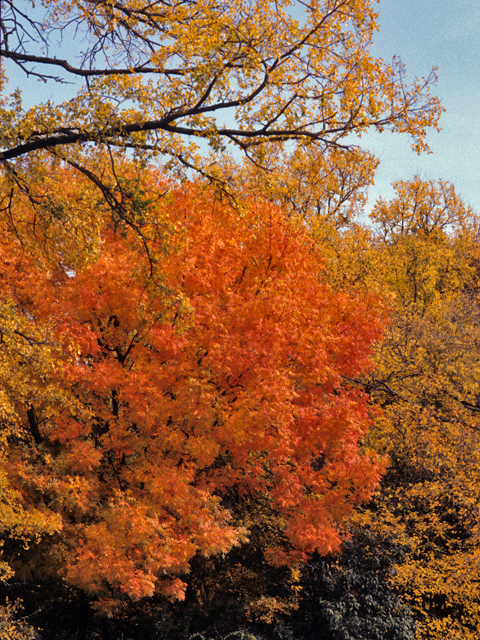
Photo courtesy of the Wildflower Center and Sally and Andy Wasowski; Prairie Flameleaf Sumac (Rhus lanceolata)

About the Region

2026 Fall Symposium Logo

This low-elevations region of Texas extends inland from the barrier islands, about 60 or so miles, and stretches from Brownsville to Louisiana. In total, it covers about 9.5 million acres, with a high point of 150 feet in elevation. More than 1000 species of plants can be found in this region. On the southern end, species more common in Mexico (such as Sabal mexicana) and Central America occur.

The barrier islands provide us with dune systems, and clay flats to the inland side, which have species found in these areas alone. Many plants here, such as Ipomoea pes-caprae (beach morning glory), can be found throughout tropical regions of the globe. I’ve encountered the same species on the beaches of Guam.

Once inland, vast marshes and wet prairies occur. Occasionally, oak (Quercus fusiformis) groves can be found. Common grasses include species of Bothriochloa, Paspalum, and Sporobolus; eastern gamagrass (Tripsacum dactyloides); and switchgrass (Panicum species). Many rivers and creeks cut through the Gulf Prairies, and along these riparian areas various species of trees, Sabal minor, and other plants adapted to clay soils can be found. Due to overgrazing, farming, and fire suppression, woody species such as mesquite (Prosopis glandulosa) and huisache (Acacia farnesiana), and invasive species such as chinaberry (Melia azedarach), Brazilian pepper (Schinus terebinthifolius), and Chinese tallow (Sapium sebiferum) have increased and displaced our native flora.

Source: Wildflowers of Texas by Michael Eason