

In our sprawling Metroplex, it can be hard to discern what was our “natural” landscape. With our mix of heavily developed land, artificial lakes, and small pockets of parks and nature preserves, it is challenging to see what was indigenous.
Upside-down Forests
So, what did our area look like before Europeans began settling the land? Prior to the arrival of Europeans, all of North Texas was part of 250+ million acres of tallgrass prairie, stretching from central Texas, running along the boundary of the Rockies, up to the Canadian plains, and east to Indiana.
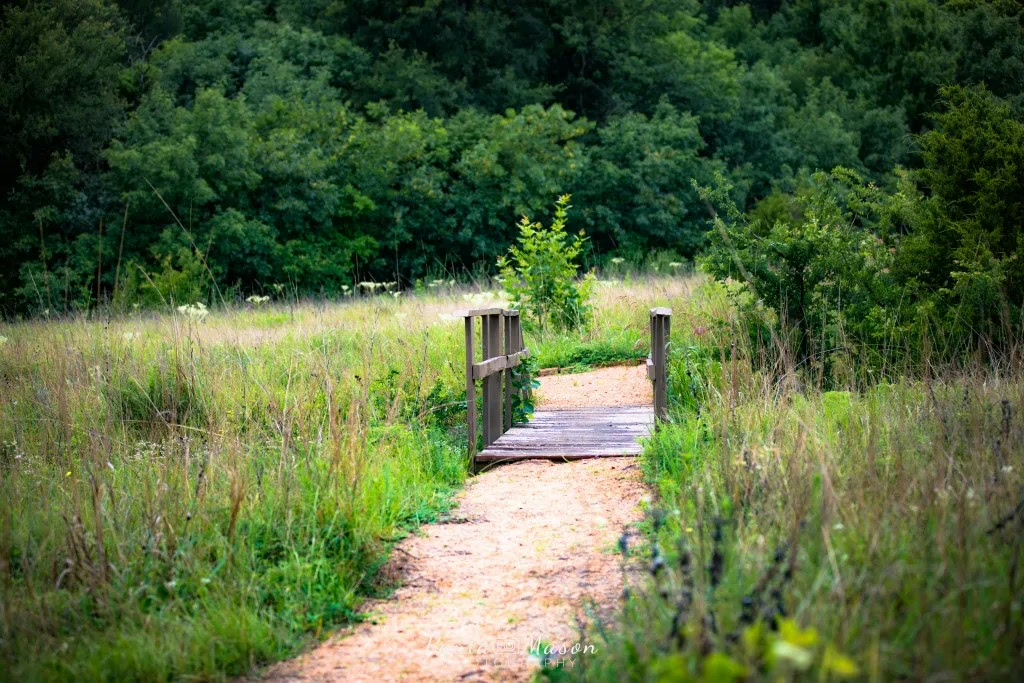
There was incredible diversity; the North American Prairie could have 250+ species of plants in a localized area. While more vertically challenged than forests, the native prairies have been termed “upside-down forests” for the grasses’ deep root systems. These extensive root systems allowed our native prairie plants to be drought resistant and adaptable to the vicissitudes of the weather.
Deep Topsoil – The Prairie’s Double-edged Sword
These deep root systems benefited from a deep layer of topsoil. The North American prairie began to form around 20 million years ago from sediment washed down from the Rockies and glaciers, along with windblown deposits of material into what was once a great inland sea.
This process created a rich layer of topsoil on top of the former seabed. A prairie can hold as much as 250 tons of topsoil per acre, compared to only 50 tons for a forest.
When Europeans arrived, they quickly utilized the soil’s richness for extensive farming throughout the region. However, the creation of our continent’s “breadbasket” has resulted in the near-extinction of the native prairie. Only about 0.5% of the native prairie remains, and it continues shrinking.
A Movement to Reverse the Decline
Starting in the 1930s, a movement began to reestablish native prairies due to the damage inflicted during the Dust Bowl era. This movement has continued across North America with a dual focus on restoring native prairies and preventing further loss of remnant portions of virgin prairies. While they are similar, there are essential differences between prairie restorations and remnants:
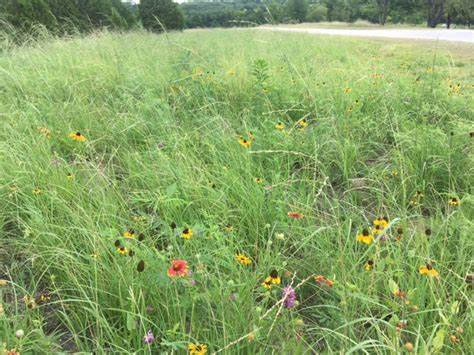
- Prairie restoration projects aim to convert a previously tilled or otherwise disturbed parcel of land back to near its pre-agriculture condition.
- Prairie remnants are a piece of land that has not been disturbed by agriculture or development and is still in or very close to its pristine condition.
Restorations attempt to turn back the clock on the land. But the reality is that the complexity of the North American prairie biome makes a complete transformation unrealistic, especially on heavily disturbed soil. This results in fewer species than a prairie remnant but still far more variety than cultivated land.
This problematic fact highlights the criticalness of preserving remnants, as restorations are not a replacement for saving virgin prairies and their unique characteristics. But restorations are vital, as they complement our few remaining remnants and help restore the beauty and healthier ecosystem of native prairies.
Prairie Remnants and Restorations in North Texas
Here in North Texas, we have a wide variety of prairie remnants along with many ongoing prairie restoration projects. Below are some notable local prairie remnants and restorations, listed by county.
- Collin County
- Blackland Prairie Raptor Center – On-going large prairie restoration (Lucas)
- Connemara Meadow Preserve— Prairie restoration on a 72-acre site (Allen)
- Heard Natural Science Museum & Wildlife Sanctuary— Prairie restorations throughout the 300-acre site (McKinney)
- Peters Prairie – Small prairie remnant (Farmersville)
- Dallas County
- Frankford Church and Cemetery— Small prairie remnant (Far North Dallas)
- Pemberton’s Big Spring— Prairie restorations on 42-acre site (Southeast Dallas)
- Tarrant County
- Blackland Prairie Park— Ten-acre prairie remnant (Arlington)
- Tandy Hills Natural Area— Prairie remnant encompassing 200 acres with a wide variety of flora (East Fort Worth)
- Outlying Counties
- Clymer Meadow Preserve – Covering 1,400 acres, one of the largest and most diverse remnants of virgin prairie in Texas (Hunt County – Celeste)
- Kachina Prairie— Thirty-acre remnant of original prairie (Ellis County – Ennis)
- Paul Matthews Prairie Preserve – One-hundred-acre remnant of pristine prairie, including deep gilgai impressions (Hunt County – Floyd)
For more information on other local prairie remnants and restorations, please see a more complete listing from the Blackland Chapter of the Native Prairie Association of Texas.
Lastly, prairie restoration projects do not need to include hundreds of acres to be valuable. Creating a native prairie in your yard is relatively just as important to our North Texas ecosystem. By taking this vital step, you help create awareness of native prairie plants, enrich your local fauna, beautify your neighborhood, and continue the movement to bring back our native prairies.
