Presented by Jerdel Delsol
March 9, 2026
Botanical name: Commelina erecta
Common name(s): Dayflower, White Mouth Dayflower, Slender Dayflower, Widow’s Tears
Family: Commelinaceae
[MUSIC—EASY AND FUN]
[Jerdel] All right, welcome to my plant of the month presentation. I’m talking about the Commelina erecta with its common name being the Dayflower. It is done by me, Jerdel Delsol.
Other names for this flower are the Slender Dayflower, Widow’s Tears, and White Mouth Dayflower. It is part of the Commelinaceae or spiderwort family. The Dayflower has soft, jointed hairy stems that may grow upright when supported by other plants. The plant has round-based minutely stiff-haired leaves that can grow 2 to 6 inches long with a width of 1 1/4 inch. If left alone, they tend to grow on the ground up to 3 ft long.
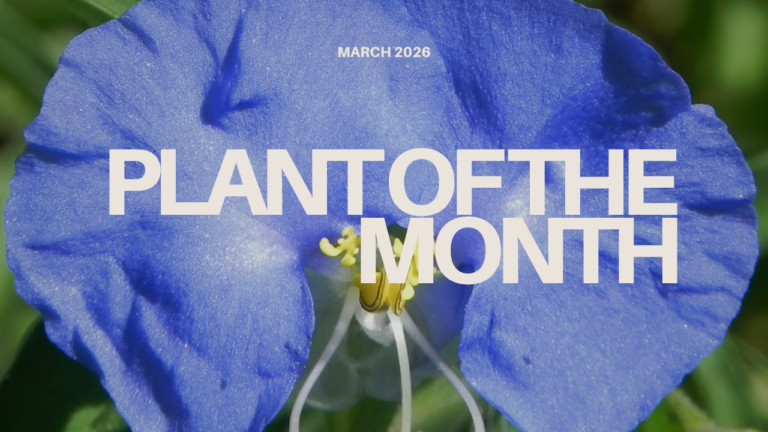
The ephemeral flower is about 1 inch across with two large blue ear-like petals and one white smaller petal. It has three steril stamens and one butterfly-haped one. They only bloom for a day, but each stem holds seven buds that bloom 3 to 4 days apart.
Characteristics of the flower is that the Commelina erecta tends to bloom from May until October.
It can be found all overUnited States preferring open part-shady areas. They also like sun; dry, sandy, or rocky soil; prairies, open woods, barrens, dunes, bluffs, outcrops, and even glades. It was also well suited for meadows and/or by wooded areas.
If you wanted to plant it, you could plant it from its seeds, which are found in the fruit containing two to three section capsules, each holding two brown seeds, or through transplanting it.
All right. Nice. Benefits of this flower is that it is a conspicuous flower, which means that it shows its bloom. It’s very bright and it’s good at attracting butterflies and bees for pollination. It’s also good for attracting birds such as Mourning Doves, Bobwhite Quail, and cardinals that eat and distribute the seeds. So, if you’re a bird watcher, this would be good. And deer tend to eat the foliage, making it good for foraging if you want foraging animals to pass by your property as well.
The Commelina erecta can also be consumed in salads and has been used as folk medicine to help with hemorrhages, rashes, sores, and infections.
And before I move on to the next slide, I’ll be talking about the invasive look-alike. And I want you to pay attention to, if you look right below the white flower, you see this thing. It’s called the spathe. It looks like a leaf. It has these hairy-like structures on them. And that’s a telltale sign that this version is a native plant, the Commelina erecta. All right, continuing.
The invasive look-alike, which is called the Commelina communis, is an Asiatic Dayflower. That’s also its scientific name. And as the name suggests, it’s from Southeast Asia.
It is present in all areas the native species is. So all throughout North America which reaches into Canada as well. They spread rapidly once one is planted and can take over an area if not handled.
The telltale sign is that the dayflower is invasive is if the seeds are dark brown to black color. If you remember native color plant is lighter and if the spathe is hairless. And if you look you can see that right where the flower is the spade is smooth and green, And if the yellow stamens have a maroon spot on them. The native plant is just yellow.
And thanks for listening to my presentation and hope you have a good day.
[MUSIC—AND THAT’S IT]