


Photo Courtesy of Lady Bird Johnson Wildflower Center and April Moore
Once again, we are taking a trip back in time to The Coneflower Courier, our chapter’s paper newsletter from 1994 – 2001. The below article from the October 1995 edition is on a plant with a unique name befitting its appearance. The plant is the Green Dragon (Arisaema dracontium), and just as the article had hoped, the plant is still growing deep in the shade of the Heard Natural Science Museum’s Sanctuary in McKinney.
The article was written by the always-enthusiastic Harold E. Laughlin, Ph.D., who at the time was the Wildlife Sanctuary Director of the Heard Museum. We hope you enjoy this fascinating and still relevant article.

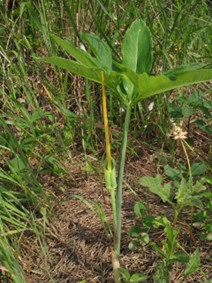
Most readers, seeing the above headline, will wonder what kind of a lizard, dinosaur, or other reptile I am talking about. You may be envisioning a large, green creature with a long, pointed, yellow tongue slinking through the woods or stalking across the prairie. Sorry to disappoint you, but it’s none of those. It is green, however, and it does have a long, yellow, pointed tongue-like structure rising out of a head-like, hooded base, and it does live in the woods. But it is a plant! A plant called Green Dragon (Arisaema dracontium). It is in the Arum family, which includes the similar Jack-in-the-Pulpit (A. triphyllum) of the eastern U.S., plus such familiar ornamental non-native plants as Anthurium, Philodendron, and Arum Lily.
What is a Green Dragon?
A Green Dragon plant is essentially a stalk, about 12 to 18 inches tall, with a single leaf at the top, and the leaf is divided into 3 to 9 leaflets spread out horizontally like an umbrella. From the side of the stalk of many mature plants comes another, smaller stalk topped by the “tongue” and “head” structures. These structures are the flowering parts of the plant. At the base of the tongue (technically a modified stem called the spadix), are two bands of knobby growths down inside the “hood” or head (a modified leaf called the spathe). The structures forming the lower band are female flowers, while those of the upper band are male flowers.
Some self-pollination does occur, but cross-pollination is also accomplished by insects. Arum family plants usually do not smell very good, so they are attractive not to butterflies or bees, but to…flies! The flies crawl down inside the spathe in search of what they think is something rotten down there. As they pass by the male flowers, they rub off a little pollen. Then when they enter the spathe of the next plant, they carry some of the last plant’s pollen to the female flowers.
If pollination is successful, each little bump-like flower produces a bright red berry containing 1 – 3 seeds. By the time the berries are mature, in mid-to-late August, the rest of the plant has dried and wilted, so all that remains is a yellowed stalk with a cluster of scarlet berries at the top.
The Long Lost Dragon

Back in the early days of the Heard Sanctuary, Green Dragon plants were fairly common on the east side of Hoot-owl Hill along the nature trail. In the museum’s slide collection, there are photos of Green Dragons taken in 1966, 1969, and 1974. Soon after that they began to disappear, probably by 1976. Despite diligent searching, none have been seen on the property for almost 20 years!
Then, early this past August (1995), I was doing some trail maintenance work around the Aquatic Laboratory at Bullfrog Pond, when my eye was caught by two red masses in a thicket on the back slope of the dam. I did a double take – could it be? I got down on my hands and knees to get under a tangle of vines and get closer. “Yes!” Two withered stalks, each with a bunch of scarlet berries. Obviously, the green plants had been hidden by the brush, but the fruit served as a beacon, calling my attention to the plants.
More Questions Than Answers
- Where have the Dragons been all this time?
- Why did they disappear from the original area on Hoot-owl Hill?
- Where did the ones at Bullfrog Pond come from?
The only obvious change in the Hoot-owl habitat is a maturing of the forest canopy, allowing less sunshine to reach the ground, and thinning the underbrush. But Arisaema plants are usually very happy in deep shade.
Curator Ken Steigman had theorized that the plants were pollinated by some insect which was preyed upon by fire ants, and indeed the Bullfrog Pond area has been treated extensively with LOGIC so that fire ants are well under control there. But when we found that flies are the pollinators, that blew that idea.
I have talked to a couple of botanist friends for advice about propagating Green Dragons. Both Bob O’Kennon of the Botanical Research Institute of Texas and Paul Cox of the San Antonio Botanical Center agreed that they should be easy to grow from seeds and should take no special care. O’Kennon said to just poke the berries in the ground, being sure to cover them as they are relished by birds (Aha! – perhaps that is how the got to Bullfrog Pond. But that does not tell us whence they came.)
I am planting some at the site where I found them, and some in the original area on Hoot-owl Hill. At Cox’s suggestion, I will also plant a few in pots in rich soil. Hopefully we will have a population of Green Dragons again.
The plants require at least three years to mature and produce spathe and spadix, though, so do not look for any yellow tongues for a while. Discovery of the “Dragons” return has been an exciting event, but the real excitement will come when we see if they are to become a permanent population.
