

Evergreen shrub with sharp-pointed leaves and fall berries
Provided courtesy of the Trinity Forks Chapter and Dr. Becca Dickstein
Description:
Agarita, Mahonia trifoliolata, is an evergreen, holly-like, native Texas shrub that grows 3-6 ft. tall 3-5 ft. wide. It has stiff, spreading branches holding gray-green to blue-gray sharp-pointed, thorny leaves. Agarita leaves are 2-4 inches long, separated into three narrow leaflets further divided into lobes that are tipped with sharp spines. In nature, Agarita is found on hillsides and wooded areas and can form thickets.
Flowers and Seeds:
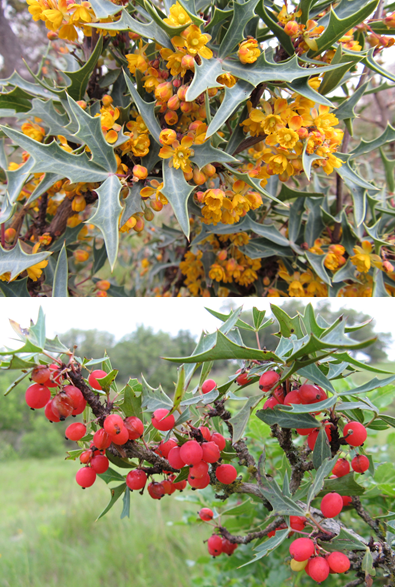
Agarita blooms in February to March each year with cheery, fragrant, yellow, half-inch flowers with six petals and sepals. These are followed by small green berries that ripen to bright red from May and feed the birds until June. The berries are edible.
Planting sites:
Agarita thrives in full sun to part shade. Full sun yields plants with the highest numbers of blooms and berries. The color of the foliage is also affected by sun exposure, with shadier conditions producing greener leaves and sunnier situations making grayer leaves. It is tolerant of most soil types as long as they are well-drained.
Watering Instructions:
Water Agarita when planting it or its seed. Once established, it is drought tolerant.
Comments:
Agarita looks great all year in several types of locations, as a stand-alone shrub or as a hedge. With its sharp leaves, it’s good as a barrier plant or security hedge. It is a wonderful substitute for non-native holly bushes, like Dwarf Burford Holly (Ilex cornuta). When working around Agarita, protective gloves are recommended to protect hands from the spines on the leaves. Dead fallen leaves on the ground are even sharper. Agarita’s mid- to late-winter blooms are a harbinger of spring and the edible berries that follow make a great-tasting jelly. However, those berries are hard to pick because of the sharp, scratching leaves. One tip for gathering the berries is to maneuver an open umbrella under an Agarita loaded with fruit and shake the bush until the berries fall into the umbrella.
Agarita berries are a favorite food for birds. Ground birds, like quail, and small animals use the plant for cover. Agarita is deer-resistant, probably because of the prickly leaves. Additionally, Agarita is tough, it survived the February 2021 winter freeze.
Thank you for using native plants in your landscapes. Look for the NICE Plant of the Season signs and information sheets on your next visit to a participating North Texas nursery.
