“How imperceptibly the first springing takes place!
No mortal is alert enough to be present at the first dawn of spring”.
Henry David Thoreau
Last month, we wrote about Golden Groundsel (Packera obovata) and how they are one of the first native flowers of the spring. Another hardy early riser among native Texas plants is the Blue-eyed Grass (Sisyrinchium). It has a graceful elegance with its understated flowers set against the bold green of the leaves.
For all their beauty, there is much more they can offer to your landscape. Blue-eyed Grasses have a prolonged blooming period with various shades of blue, white, and purple. Despite its name and appearance, it is not a grass, but in the Iris (Iridaceae) family. Nor does it have a blue “eye”, instead it is usually yellow.
Versatile and Beautiful
In nature, they show their versatility, depending on species, growing in prairies, hillsides, or woodland edges. Blue-eyed Grass flourishes in part to full sun here in North Central Texas. Plus, they are tolerant of a variety of soil types, but require good drainage. However, they are not aggressive, growing from a rhizome and forming a small seed sac.
All varieties have an evergreen grass-like mass with the stems rising just above the leaves in spring with their delicate flowers. The flowers are brightest during the morning to early afternoon, after which they tend to close. There is much similarity across the species, with the primary difference being the height and flower color, and to a lesser extent, the leaf shape.
Within the genus Sisyrinchium, there are a multitude of species, and often variations within an individual species. The Wildflower.org site lists 44 species native to the United States, 13 in Texas, and 4 in North Central Texas.
Below is a summary of our four varieties:
| Blue-eyed Grass Type | Flower Color | Height | Leaves | |
|---|---|---|---|---|
| White (Sisyrinchium albidum) | 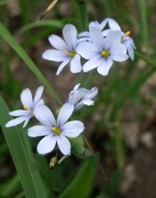 | White to Pale Blue | 8 - 15" | Wide, Light Green |
| Narrowleaf (Sisyrinchium angustifolium) | 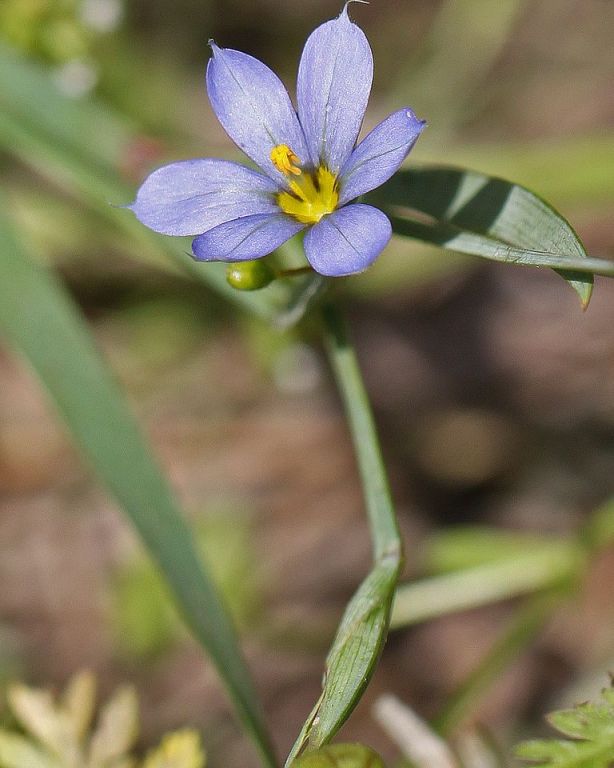 | Light Blue to Light Purple | 12 - 18" | Thin, Flat, Bright Green |
| Sword-leaf (Sisyrinchium chilense) | 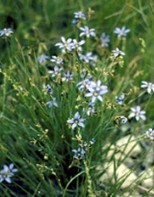 | Violet | 6 - 8" | Narrow, Medium Green |
| Roadside (Sisyrinchium langloisii) | 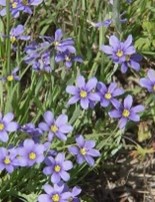 | Blue to Purple | 6 - 12" | Narrow, Light Green |
Photos courtesy of (top to bottom): U.S. Forest Service and Christopher D. Benda; Williamson County Chapter; Lady Bird Johnson Wildflower Center and W.D. & Dolphia Brandsford; Lady Bird Johnson Wildlife Center and Melody Lytle
Their early season flower provides bees with a handy pollen and nectar source before many other flowers are in bloom. While not the most popular of natives among birds, some songbirds will eat the seeds. Blue-eyed Grasses have no serious insect or disease problems.
Split and Split Again
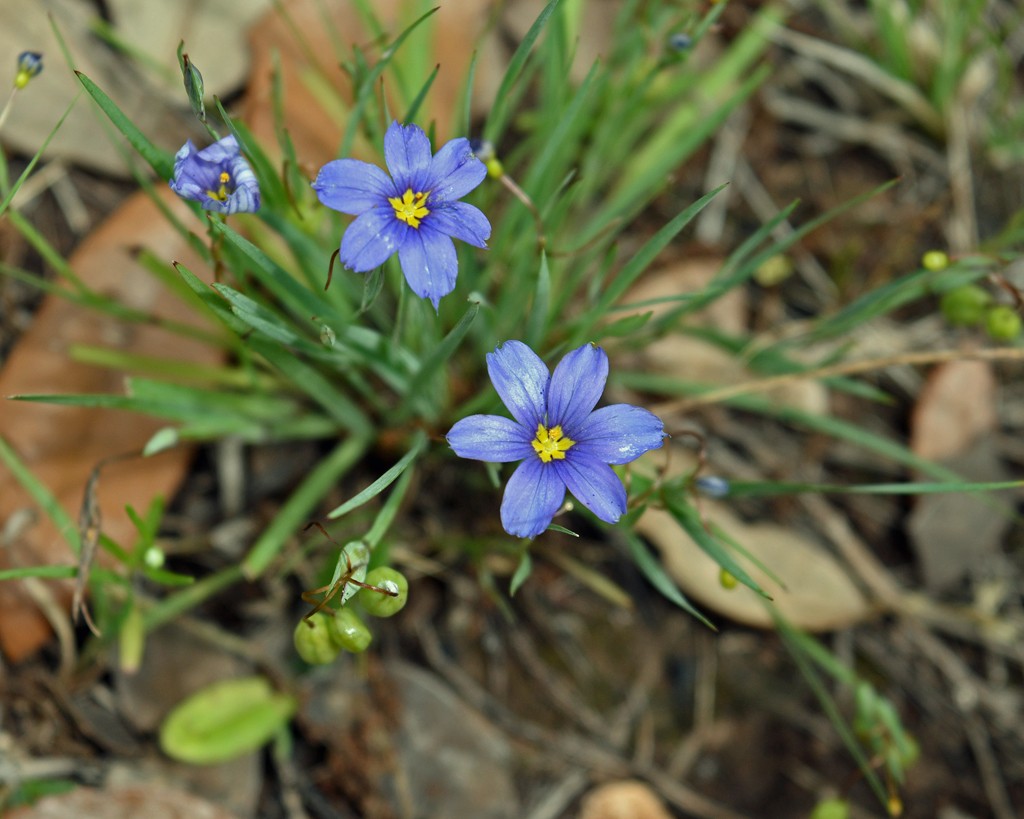
The most important requirement when growing Blue-eyed Grasses, like other Iris’, is splitting the rhizomes. Dividing every year or two results in more robust plants. Even after planting just a few, you can end up with a blanket of flowers in 2 – 3 years. Plus, they self-seed, and the seeds are easy to propagate.
With their small size, they are best situated in the front of borders or along paths. They can be utilized in both formal and informal areas. Plus, having the ability to self-sow, they are well suited to prairie and other natural landscapes. Possible companion plants include: (image)
- Butterfly Weed (Asclepias tuberosa)
- Downy Phlox (Phlox Pilosa)
- Little Bluestem (Schizachyrium scoparium)
- Side-oats Grama (Bouteloua curtipendula)
Whether you are a new or experienced native gardener in North Central Texas, you owe it to your garden to consider adding this understated beauty.