

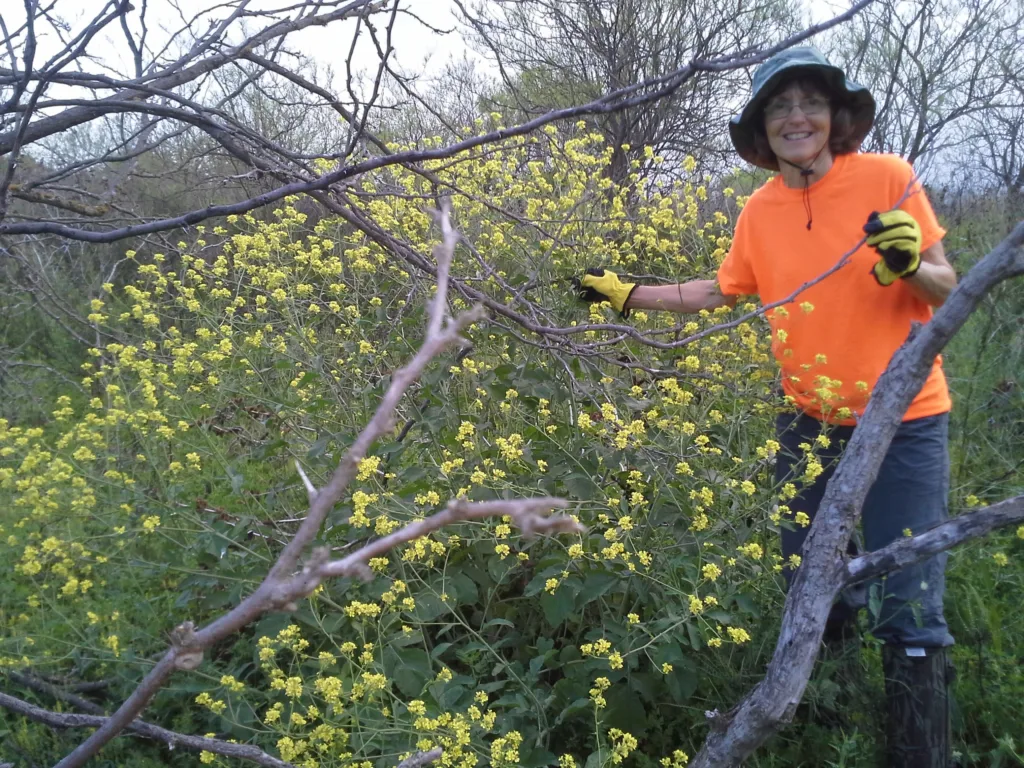
Cheryl Hamilton standing by a large bastard cabbage in full bloom.
“Non-native, invasive plants are destroying biodiversity and wreaking havoc in our backyards, neighborhoods, parks and preserves,” stated Cheryl Hamilton, co-founder of the Invaders of Texas Program, Balcones chapter. “These plants are causing economic and environmental harm or harm to human health. Invasive plants form monocultures, exacerbate allergies, alter fire regimes, reduce biodiversity and change the hydrologic flow of our rivers and streams.”
Hamilton shares her extensive knowledge about non-native, invasive plants and how to eradicate them at the next meeting of the Native Plant Society of Texas (NPSOT), Fredericksburg Chapter on Mar. 26 from 6:30-8 p.m. at St. Joseph’s Halle.
Her presentation will include:
- Descriptions of the most challenging invasive plants found in the Texas Hill Country,
- Strategies for management, including prevention, identification and eradication
- Removal of invasive plants and
- replacement with native plants as essential components to restoring the biodiversity of our public and private lands.
Hamilton has presented more than 100 invasive/native plant workshops at the local, state and national level since 2009. In 2015, she received a Presidential Lifetime Achievement Award for more than 4,000 hours with the Master Naturalist program.
“We’ll all be able to do better and help our area thrive when we stop planting non-natives and remove these invasive species from our properties,” noted Deborah Simmons, president of the Fredericksburg chapter of the Native Plant Society of Texas. “Johnsongrass, nandina and bastard cabbage are just some of the invasive plants that wreak havoc in our local ecosystem.”
Learn more. The public is invited to attend in person and via online streaming. The chapter holds its monthly meetings on the 4th Tuesday of the month at St. Joseph’s Halle (212 W. San Antonio St., Fredericksburg). There is a social time at 6:30 p.m. and the meeting starts at 7 p.m. More information is online at Facebook (@fbgtxnpsot), Instagram @npsot_fredericksburg_chapter, and https://npsot.org/chapters/fredericksburg/. Meetings are open to the public. The Chapter also holds members-only events such as the Spring and Fall native plant sales, and field trips.
