Fredericksburg Chapter

Community Outreach

Hi,  Please join our conversation and our monthly meeting. Our vision is restoring and protecting the native plant heritage of our Texas landscape. Do you have ideas or questions about using plants native to this ecosystem in your garden or landscape. We accomplish so much more when we are working as a group.
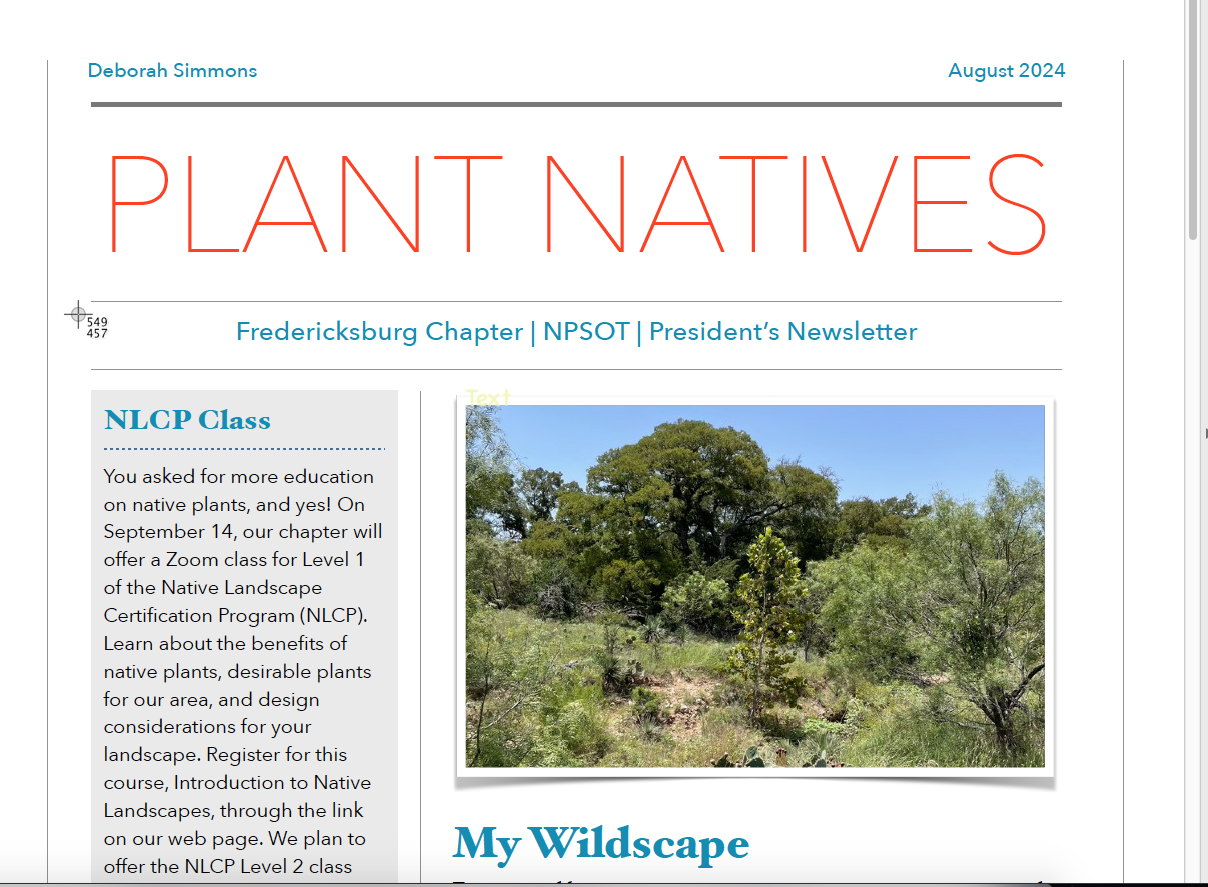


Sign Up to Receive the monthly Fredericksburg chapter Newsletter

 Plant Natives, the newsletter for the Fredericksburg chapter of NPSOT, provides information on upcoming activities as well as encouragement for your exploration of the native landscape of Texas. Community members are welcome to receive it.


NLCP  (Native Landscape Certification Program)

This statewide Native Plant Society of Texas educational program  encompasses a series of four classes for any gardeners or landscapers who are interested in promoting the use of native plants in private and public landscapes and in encouraging the conservation of our native ecology.  View ecoregions.  Each class is specifically developed for that individual ecoregion of the state. The Frederickburg chapter plans two classes a year – 1 spring; 1 fall – for the Edwards Plateau ecoregion.

Outreach at the Farmer’s market

            Volunteer:   Please join us.  Plant the Seeds of the Future!
 

Bill Lindemann Scholarship:

established as an annual scholarship by the Fredericksburg Chapter in November, 2021 to promote  the study and conservation of the native plants of the Texas ecosystem .


Calvin Nering 2025 recipient
Mercedes Burks 2024 recipient

About the Region

2026 Fall Symposium Logo

This low-elevations region of Texas extends inland from the barrier islands, about 60 or so miles, and stretches from Brownsville to Louisiana. In total, it covers about 9.5 million acres, with a high point of 150 feet in elevation. More than 1000 species of plants can be found in this region. On the southern end, species more common in Mexico (such as Sabal mexicana) and Central America occur.

The barrier islands provide us with dune systems, and clay flats to the inland side, which have species found in these areas alone. Many plants here, such as Ipomoea pes-caprae (beach morning glory), can be found throughout tropical regions of the globe. I’ve encountered the same species on the beaches of Guam.

Once inland, vast marshes and wet prairies occur. Occasionally, oak (Quercus fusiformis) groves can be found. Common grasses include species of Bothriochloa, Paspalum, and Sporobolus; eastern gamagrass (Tripsacum dactyloides); and switchgrass (Panicum species). Many rivers and creeks cut through the Gulf Prairies, and along these riparian areas various species of trees, Sabal minor, and other plants adapted to clay soils can be found. Due to overgrazing, farming, and fire suppression, woody species such as mesquite (Prosopis glandulosa) and huisache (Acacia farnesiana), and invasive species such as chinaberry (Melia azedarach), Brazilian pepper (Schinus terebinthifolius), and Chinese tallow (Sapium sebiferum) have increased and displaced our native flora.

Source: Wildflowers of Texas by Michael Eason