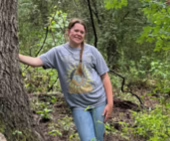
The Fredericksburg Chapter announced the “Bill Lindemann Scholarship” for the coming 2026-2027 academic year during the June chapter meeting. This year the scholarship was doubled to cover two exceptional candidates. A $2,500 scholarship has been awarded to Jen Wood, a senior at the University of North Texas graduating in 2027 with a degree in Ecology for Environmental Science, and to Autumn Webb, a junior at Texas A&M University studying Rangeland, Wildlife and Fisheries Management.
“Our chapter’s board was impressed with the leadership both students exhibited in the habitat and ecosystem restoration projects they have led as well as their commitment to continued careers promoting the restoration of healthy ecosystems,” noted Jonathan Watt, President of the Fredericksburg chapter of NPSOT.
“Thank ya’ll so much!! I’m so appreciative of this support,” Jen Wood said upon learning of her scholarship grant. “Upon completion of my undergraduate degree in Ecology for Environmental Science I aim to build a future career that will heavily involve habitat and ecosystem restoration projects. My goal is to work on endangered Texas prairie ecosystems, using rangeland management techniques to restore and conserve these invaluable habitats.”
Autumn Webb wrote in accepting the scholarship, “I am extremely honored to have been chosen for your chapter’s scholarship . . .and deeply appreciate your generosity and support. My future career goal is to work in wildlife and habitat management in Texas, where conservation decisions rely heavily upon the protection and restoration of native plant communities. My interest in Texas native plants is reflected through both my academic and field-based involvement as a student research assistant at the S.M. Tracy Herbarium in College Station and grows with the observation I have made.”
NPSOT Fredericksburg established the “Bill Lindemann Scholarship” in November 2021 to promote the study and conservation of native plants of the Texas ecosystem. This is the fourth year that the scholarship has been awarded. Scholarship applications are screened by the state NPSOT scholarship committee and finalists are forwarded to the chapter. Students may apply through the state organization for the 2027 scholarships February 1 through March 15, 2027
About the Region
This low-elevations region of Texas extends inland from the barrier islands, about 60 or so miles, and stretches from Brownsville to Louisiana. In total, it covers about 9.5 million acres, with a high point of 150 feet in elevation. More than 1000 species of plants can be found in this region. On the southern end, species more common in Mexico (such as Sabal mexicana) and Central America occur.
The barrier islands provide us with dune systems, and clay flats to the inland side, which have species found in these areas alone. Many plants here, such as Ipomoea pes-caprae (beach morning glory), can be found throughout tropical regions of the globe. I’ve encountered the same species on the beaches of Guam.
Once inland, vast marshes and wet prairies occur. Occasionally, oak (Quercus fusiformis) groves can be found. Common grasses include species of Bothriochloa, Paspalum, and Sporobolus; eastern gamagrass (Tripsacum dactyloides); and switchgrass (Panicum species). Many rivers and creeks cut through the Gulf Prairies, and along these riparian areas various species of trees, Sabal minor, and other plants adapted to clay soils can be found. Due to overgrazing, farming, and fire suppression, woody species such as mesquite (Prosopis glandulosa) and huisache (Acacia farnesiana), and invasive species such as chinaberry (Melia azedarach), Brazilian pepper (Schinus terebinthifolius), and Chinese tallow (Sapium sebiferum) have increased and displaced our native flora.