

Changing how Texans see their Native Landscapes
North Texas has been fortunate to have a number of remarkable botanists whose work continues to influence our landscapes today. Earlier, we featured a remembrance of Harold Laughlin. Another local botanist with far-reaching impact was Benny Simpson. He devoted his career to locating, studying, and sharing Texas native plants that could thrive in the state’s demanding conditions. Simpson also helped lay the foundation for the Native Plant Society of Texas (NPSOT), and its emphasis on education, conservation, and the practical use of native Texas species.
Early Years Shaped by Drought
Benny Jack Simpson was born in 1928 and grew up near Northfield, TX, about 120 miles southeast of Amarillo. His experience during the “Dust Bowl” of the 1930s and the preciousness of water, a constant of his early years, shaped his understanding of how land, weather, and plants are connected.
Initially, Simpson studied journalism at Texas Tech University before leaving to serve in the U.S. Marines near the end of World War II. Later, he was recalled to the military during the Korean War. Returning to Texas Tech, he earned a Bachelor of Science degree in Agronomy in 1954, specializing in Soil Management and Crop Production.
One Job – One Passion
Following college, Simpson began a 40+ year career at what would eventually become the Texas A&M AgriLife Research and Extension Center in Dallas. In the beginning, his responsibilities focused on agricultural research, including cotton root rot and crop management.
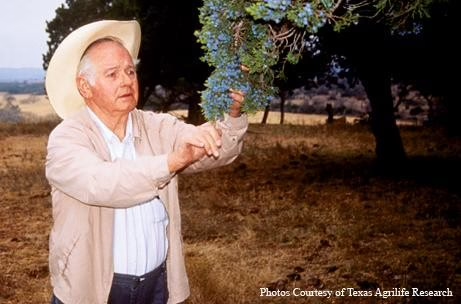
Simpson’s job title may have been Research Scientist, but he described himself as a “Plant Hunter”. In his free time, he traveled extensively through West Texas, the Trans-Pecos, the Hill Country, and other regions, searching for native trees and shrubs. He collected their seeds and cuttings, brought them back to the AgriLife Center, and evaluated them, sometimes for decades.
During the early years of his tenure, Texas A&M, like most universities and the broader horticultural community, had little interest in native plants. As a result, Simpson endured skepticism from colleagues and had to defend experimental plots that some considered of little value. But his research methodically demonstrated that native Texas plants could outperform many commonly used non-native species. With his passion and perseverance, he taught others how to see familiar plants in a new light, revealing beauty where others had seen only weeds and brush.
A Practical Vision for Native Plant Landscaping
Simpson focused especially on native trees and shrubs capable of tolerating heat, drought, cold snaps, and challenging soils. He helped bring multiple native species into broader use, including: Texas Sage (Leucophyllum frutescens), Desert Willow (Chilopsis linearis), False Indigo (Amorpha fruticosa), and Mountain Sage (Salvia regla).
His work was never about novelty, but practicality and suitability. It was a conviction rooted in his belief that Texas landscapes should reflect Texas ecology, not introduced plants from far-off places. That philosophy aligned perfectly with the values that would soon define NPSOT.
Helping Establish and Grow NPSOT
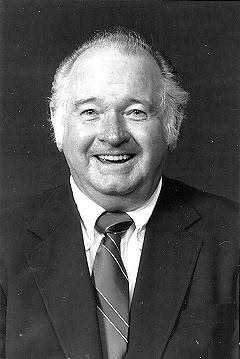
The Native Plant Society of Texas emerged in the early 1980s, beginning informally in the fall of 1980 and officially founded on April 25, 1981, at Texas Woman’s University in Denton. Simpson was a founding member of NPSOT and a close friend of NPSOT founder Carroll Abbott and others who recognized the need for a statewide organization dedicated to native plant education and conservation.
His leadership within NPSOT continued in many forms, including serving as president from 1993 to 1994, a time when native plant advocacy, particularly utilizing native trees and shrubs in landscapes, was still considered unconventional. Beyond his official role, he was a driving force in influencing many landscape designers, authors, and educators through talks, field trips, and personal connections. One example was Sally Wasowski, noted North Texas native plant author, who credited Simpson with changing her life after hearing him talk about the beauty and value of native plants.
A Living Legacy
During his career, Simpson studied more than 500 native plant species. The results of his work are still visible across North Texas:
- Many trees and shrubs at the Heard Museum’s Native Plant Garden in McKinney were donated by Simpson.
- The Benny Simpson Texas Native Plant Collection at the Texas Discovery Gardens in Dallas showcases dozens of species he studied and introduced.
- The Benny J. Simpson Ecopark at the Texas A&M AgriLife Research and Extension Center in Dallas continues his legacy of education and outreach.
He authored A Field Guide to Texas Trees, published in 1988, documenting 220 native tree species he personally observed in the wild. The book remains a common reference guide for both native plant enthusiasts and professionals.
Simpson died unexpectedly in December 1996 at the age of 68 following heart surgery. Within NPSOT, his name lives on through the Benny J. Simpson Fellows honor, which recognizes members whose exceptional service reflects the grassroots dedication that defined his life’s work. In 1997, NPSOT established the Benny J. Simpson Endowed Scholarship for Texas Tech students majoring in the Department of Plant and Soil Science with an emphasis in native plant research.
Reframing the Texas Landscape
Benny Simpson helped change how Texans perceive our native plants. At a time when native plant landscaping was rarely considered, he provided education and inspiration. As a founding member of NPSOT, he helped build an organization that continues to advance the ideas he championed. Every time a native Texas tree or shrub is planted, Simpson’s influence endures.
