Presented by Brenda Galvan
February 9, 2026
Botanical name: Callicarpa americana
Common name(s): French Mulberry, Sourbush, Bunchberry, Purple Beauty-berry
Family: Lamiaceae
[MUSIC—EASY AND FUN]
[Brenda] Hello everybody. My name is Brenda Galvan. I’m a student worker here at EIH. And for today’s plant of the month, I’ll be presenting American Beautyberry or Callicarpa americana.
Plant Characteristics
Beautyberry, also known as French Mulberry, Sourbush, Bunchberry, or Purple Beauty-berry, is a woody, deciduous perennial shrub that produces small purple round fruits from late summer to early fall.
Deciduous means that it sheds its leaves annually, and perennial means that it lives for many years, returning from its root system. And I mostly added that for myself, but good words to know.
In the late spring to early summer, you will see small flowers of violet, pink, or white that are arranged in clusters on the stems between the leaves. And the shrub is multi-stemmed with drooping branches and large green leaves that have opposite arrangement with saw-toothed margins, which you can see down here on the left. It is a member of the mint family and it is native to the central and southeastern United States extending from Texas and Oklahoma east to Maryland.
It stands about four to six feet tall and it spreads as well from four to six feet.
Callicarpa americana — Name and Usage
Beautyberry gets its name for its beautiful dense clusters of berries. Callos meaning beauty and carpos meaning fruit in Greek. It truly is a stunning plant.
The berries are edible and when eaten raw they have a zesty taste but they can be cooked up into a jam or jelly and like elderberry can be made into a light rose-colored wine.
Some Native American tribes relied on the American Beautyberry for medicinal purposes. Leaves and other parts of the plant were boiled for use in sweat baths to treat malaria, fevers, and rheumatism. The boiled roots were made into treatments for dizziness, stomach aches, and urine retention, while the bark from the stems and roots were made into concoctions for itchy skin.
In the old days, farmers would crush the leaves and place them under the harnesses of horses and mules to repel mosquitoes. They would also place them on themselves to repel mosquitoes and biting bugs.
And what’s pretty interesting is that agricultural research has actually been done on beautyberry and it actually found two compounds that are responsible for being an effective repellent.
Beautyberry is very beneficial to wildlife. The fruit is high in moisture content, and it is an important food source for more than 40 species of songbirds, including the American Robin, Brown Thrasher, Purple Finch, and Eastern Towhee. The droops of or clusters are eaten by armadillos, foxes, opossums, raccoons, and squirrels. White-tailed deer consume the fruit in the fall after the leaves drop. They will also eat the leaves in the summer when their preferred foods are not available.
Habitat and Growing Conditions
This plant is distributed throughout the southeastern United States from Texas and Oklahoma east all the way to Maryland. It also grows in the Caribbean and northern Mexico. So, it has a pretty good range. Beautyberry’s native habitat is open meadows, thickets, woodlands, margins of ponds, ditches, and streams.
American Beautyberry is found in woods particularly on moist areas under open pine canopies, thickets, right of ways, and fence rows. It is adapted to moist loam, sandy or shallow upland sites and has a wide pH range.
The shrub is considered a pioneer species and it is a characteristic of the midstages of plant succession. The plant is very tolerant of fire. However, it is intolerant of deep shade and declines in number when midstory vegetation is dense.
Propagation and Care
American Beautyberry prefers the soil of its natural forest floor habitat. A moist clay or sand enriched with organic matter. It thrives in full sun but may be grown in light shade.
Beautyberry needs minimal care once its roots are established and its seeds can survive several years in the soil bank.
American Beautyberry can be propagated by transplanting volunteer plants, softwood cutings, or by collecting the seeds. The seeds are easily gathered by picking up the mature fruit in the fall and planting them in the fall for spring germination.
So, why should we grow American Beautyberry? And it’s totally optional, right?
But here’s a couple of good points.
- It is a beautiful, vibrant addition to your garden.
- It is a fast growing native.
- It provides an ecological benefit for all types of wildlife, including birds, small mammals, deer, and various pollinators like bees and butterflies.
- We use it to make jams and wines, tea, insect repellent, and if you have the acquired taste buds, we eat it right off the branch.
- It is easily propagated and requires little maintenance, very drought tolerant.
- And it is also relatively disease and pestfree.
- And finally, it is beautiful year-round.
Did you count how many times I said beautyberry?
Here are my sources.
- Callicarpa americana – Native Plant Society of Texas
- Callicarpa americana (American Beautyberry, American Mulberry, Beautyberry, French Mulberry, Sour-bush) | North Carolina Extension Gardener Plant Toolbox
- American Beautyberry | Missouri Department of Conservation
- American Beautyberry (Callicarpa americana) Plant Fact Sheet
- All About American Beautyberry – Garden.org
- American Beautyberry (Callicarpa americana) – Urban Program Bexar County
- Beautyberry American
- American Beautyberry | Central Texas Gardener
- The Beauty of Beautyberry: 7 Reasons to Love This Native Shrub – Native Plant Society of Texas
- USDA Plants Database Plant Profile General
- Beautyberry leaf extract restores drug’s power to fight ‘superbug’
- So Charleston: Learn why locals have long planted the American beautyberry | Charleston SC | Charleston Magazine
- Photos of American Beautyberry (Callicarpa americana) · iNaturalist
Thank you.
[MUSIC—AND THAT’S IT]
Related Posts
Plant of the Month: Dayflower
Our plant of the month for March 2026 has bright‑blue “butterfly wings.”
Botanical name: Commelina erecta
Common name(s): Dayflower, White Mouth Dayflower, Slender Dayflower, Widow’s Tears
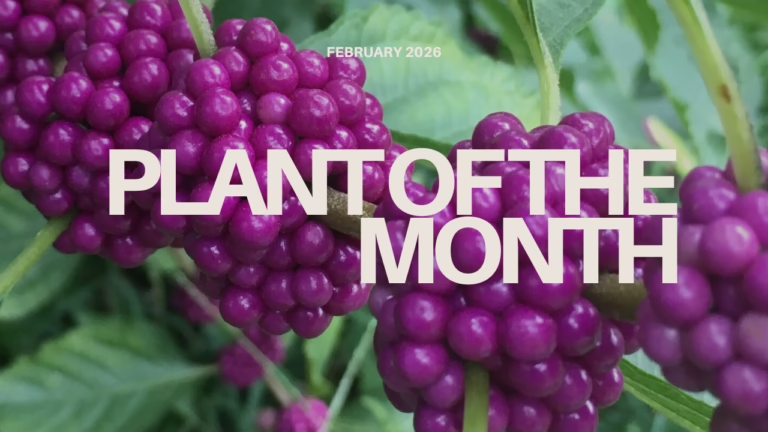
Plant of the Month: American Beautyberry
Our plant of the month for February 2026 makes a wonderful jelly!
Botanical name: Callicarpa americana
Common name(s): French Mulberry, Sourbush, Bunchberry, Purple Beauty-berry
Plant of the Month: Frostweed
Our plant of the month for March 2024 is a little bit icy.
Botanical name: Verbesina virginica
Common name(s): Frostweed, White Crownbeard, Iceplant, Iceweed, Virginia Crownbeard, others