Clear Lake Chapter

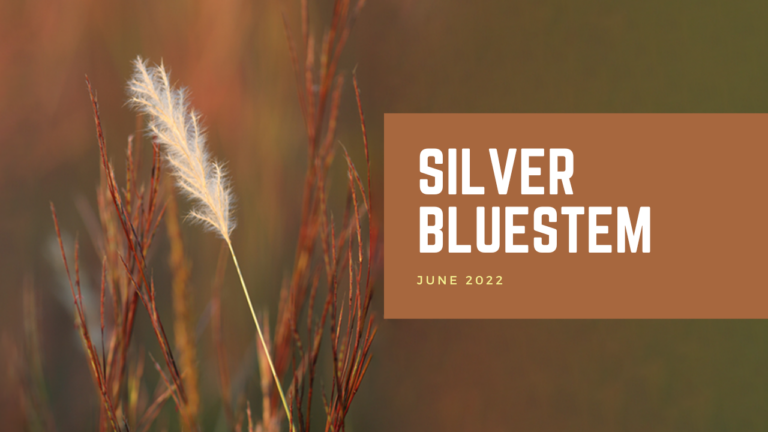
Plant of the Month: Silver Bluestem

Presented by Gabriella Bible
June 13, 2022

Botanical name: Bothriochloa laguroides
Common names: Silver Bluestem, Silver Beardgrass
Family: Poaceae (Grass)


[MUS—EASY AND FUN]

[GABRIELLA] Hello. My name is Gabriella Bible and I’ll be doing the Silver Bluestem today.

Another common name for the Silver Bluestem is Silver Beardgrass. It comes from the Poaceae family, the grass family, and is distributed along the southern region of the United States. I was able to get this chart from the USDA Plants website showing where it’s both native and introduced in the United States. The Silver Bluestem tends to grow in grasslands, prairies, roadsides, river bottoms, and woodland areas.

Plant Characteristics

Some plant characteristics of the Silver Bluestem would be that it’s a perennial, a grass, and produces white flowers. It blooms between May and November. The fruit type would be caryopsis, and I have some pictures of the seeds to the side. It has simple parallel, alternating leaves and can grow between one to three feet.

Growth Conditions

Some growth conditions would be that it is adapted to medium and coarse soil. It is drought tolerant and shade intolerant. And the minimum temperature that it can survive at is negative 23 degrees Fahrenheit.

And here are my resources. And that’s it. Thank you.

[MUS—AND THAT’S IT]

Resources

Related Posts

Texas Grasses

**ARCHIVED POST ** When choosing plants for your garden, don’t overlook Texas’ native grasses. Not only are they ecologically important, they can also provide texture
About the Region

2026 Fall Symposium Logo

This low-elevations region of Texas extends inland from the barrier islands, about 60 or so miles, and stretches from Brownsville to Louisiana. In total, it covers about 9.5 million acres, with a high point of 150 feet in elevation. More than 1000 species of plants can be found in this region. On the southern end, species more common in Mexico (such as Sabal mexicana) and Central America occur.

The barrier islands provide us with dune systems, and clay flats to the inland side, which have species found in these areas alone. Many plants here, such as Ipomoea pes-caprae (beach morning glory), can be found throughout tropical regions of the globe. I’ve encountered the same species on the beaches of Guam.

Once inland, vast marshes and wet prairies occur. Occasionally, oak (Quercus fusiformis) groves can be found. Common grasses include species of Bothriochloa, Paspalum, and Sporobolus; eastern gamagrass (Tripsacum dactyloides); and switchgrass (Panicum species). Many rivers and creeks cut through the Gulf Prairies, and along these riparian areas various species of trees, Sabal minor, and other plants adapted to clay soils can be found. Due to overgrazing, farming, and fire suppression, woody species such as mesquite (Prosopis glandulosa) and huisache (Acacia farnesiana), and invasive species such as chinaberry (Melia azedarach), Brazilian pepper (Schinus terebinthifolius), and Chinese tallow (Sapium sebiferum) have increased and displaced our native flora.

Source: Wildflowers of Texas by Michael Eason
