Presented by Rowena McDermid
February 14, 2022
Botanical name: Bouteloua curtipendula
Common name(s): Sideoats Grama
Family: Poaceae (Grass)
[MUS—EASY AND FUN]
[ROWENA] Our plant of the month is Sideoats Grama. It is a grass. As you can see it’s got these purple spikelets, which make it very attractive in the summer, and they fade to tan color in the winter. The binomial name is Bouteloua curtipendula. And it is actually Texas’s state grass and it’s a very useful grass. It’s great in the landscape. We planted it at EIH just about six, nine months ago. It has rapidly become one of my favorite plants in the garden. It does so well.
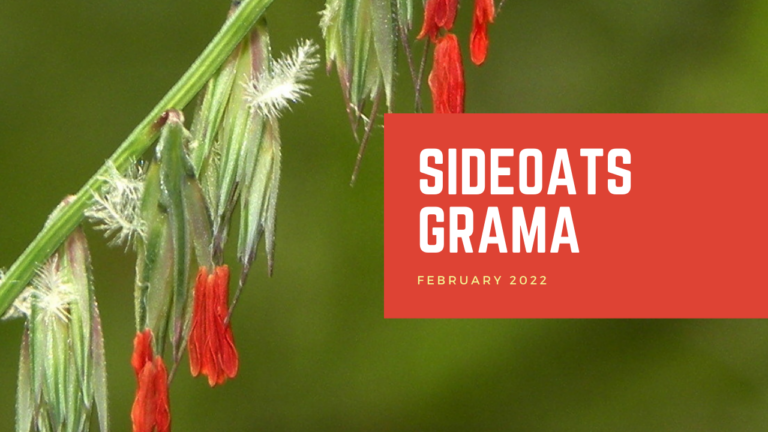
So, the characteristics… As you can see, well, it’s native across the US, the lower 48, and it is in Hawaii as well, but there it is an introduced species. It is a perennial, warm season grass, has purplish oat-like spikelets on one side of the stem, and they bleach to tan in the fall, as I’ve mentioned. Curtipendula, the second part of its binomial name, means short hanging, and this is where it gets its name from. As you can see here—this is in bloom at the moment—these orange bits underneath are actually their stamens. They are the pollen producing part of the grass. And those little feathery type filaments on either side sticking out horizontally those are the stigmas, the pollen accepting part of the grass. It’s nice because it doesn’t grow too tall, which is unusual for our Texas grasses. It only grows two to three feet high. And propagation is by seed or by root division.
To ID it, if it’s not in bloom, it’s fairly easy. They do after the seat has fallen end up with these zigzag stems as you can see in the picture on the left. And the leaves which are quite small very linear and they help the plant become heat and drought resistant but they’ve got these evenly spaced filaments or hairs at the bottom of the leaves and that’s how you tell what kind of plant it is.
It grows in medium textured, well-drained soils, but it’s tolerant to practically anything except the very loose sands and the very dense clays. The main thing it needs to be reasonably well drained. It probably won’t do well in our gumbo. It’s adapted to calcareous and modestly alkaline soils. So, even though it is native across Texas it is mostly seen up near the Edwards plateau in the Hill Country. We don’t see it so often down here, but it does grow in the area. It likes full sun but it can tolerate partial shade. It’s drought resistant. It’s heat resistant. And it’s cold resistant, so it’s your perfect plant.
And so finally i want to say that this is actually a very versatile grass. It grows well in dry and eroded conditions which is why it’s useful in erosion control and bank stabilization. It’s useful as a range grass because it’s very nutritious in the fall and in the summer and it’s also tasty in the winter. A lot of grasses don’t taste very good in the winter. So, livestock enjoys it, deer and elk will eat it, and turkeys too. For the wildlife in your garden: bird food, nesting material, and it is the host plant to at least two species of skipper butterfly. And as an ornamental plant, well, it doesn’t grow too tall so it looks very good in the garden. It spreads fairly easily so that it does cover an area quite nicely and keeps it weed free. And it mixes very well with spring wildflowers because again it doesn’t grow too tall.
Thank you very much.
[MUS—AND THAT’S IT]