Unveiling Beautyberry
So often, common names of native plants do no justice to their attributes. But American Beautyberry (Callicarpa americana) is an exception, as its name aptly reflects its vibrant, iridescent purple berries. Their berries are but one of many qualities of the plant that make it a great choice for your landscape.

Know Your Beautyberry: Native vs. Non-Natives
A word of caution regarding the plant, you may find in your plant shopping excursions several species that share the “beautyberry” name. But only Callicarpa americana is native to the United States. Other names you may see include “Purple Beautyberry” and “Japanese Beautyberry”. In comparison to our native species, the non-natives offer little ecological value and are considered potentially invasive.
The simplest identification tip is the location of the berries. For Callicarpa americana, the berries are wrapped tightly around the branches and close to the stems. The non-native variety’s berries develop slightly off the branch or have small stems that connect them to the branch. They also often appear only on the top of the stem and do not encircle it like our native species. The leaves are another point of distinction, as Callicarpa americana leaves are coarse-textured and 3 – 6 inches in length. The non-native species have smoother, smaller, and narrower leaves.
7 Reasons to include Beautyberry in your Landscape
Reason 1: Dazzling Display of Berries
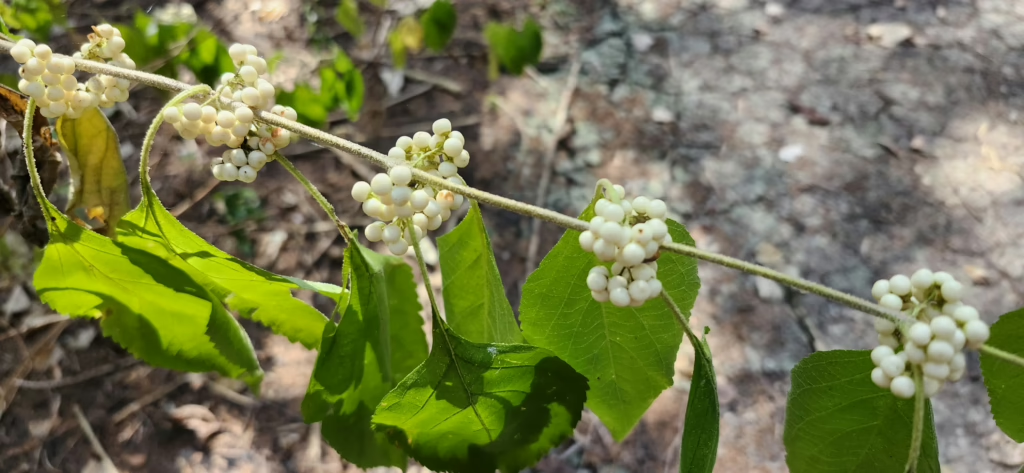
Although it has a variety of benefits for your landscape, the number one reason most people plant American Beautyberry is the berries. From late summer through fall and if conditions are right, into winter, the berries are the main draw. The abundant 1/3-inch-diameter magenta-purple or iridescent purple berries create a stunning display.
There are also relatively rare white and pink berry versions, Callicarpa americana var. Lactea, with similar characteristics, except for the berries’ color. The fruit’s color is controlled by a single recessive gene. These colors can occasionally be found in nurseries
Reason 2: A Feast for Wildlife
Beyond its aesthetics, Callicarpa americana offers a vital ecological benefit for local wildlife. Its berries are an important food source for more than forty species of birds, including Baltimore Orioles, Robins, Mockingbirds Brown Thrashers, and Tufted Titmice. Small mammals, including armadillos, foxes, opossums, raccoons, and squirrels, also enjoy the fruit.

Reason 3: Resilient Understory Workhorse
American Beautyberry has evolved over eons to flourish in the understory of moist woodlands, thickets, and bottomlands across the southeastern United States. These adaptations make it an excellent choice for those challenging partial shade areas in landscapes. With its natural niche, it is a top choice for an often-overlooked component of yards, the understory.

Reason 4: Low-Maintenance and Drought-Tolerant
For the busy gardener, American Beautyberry is an ideal choice. It is low-maintenance, and once established, it has strong drought tolerance. Additionally, the shrub is adaptable to a wide range of soil types and is typically resistant to pests and diseases.
Reason 5: A Hub for Pollinators
The blossoms are delicate yet effective in attracting various pollinators, including bees and butterflies. Beautyberry also serves as a larval host for some butterflies, such as the spring azure, offering sustenance for their entire life cycle. Their dual role as both a nectar source and a larval host enhances its ecological value and boosts insect populations.
Reason 6: Landscape Versatility
American Beautyberry’s natural grace and vibrant seasonal interest make it remarkably versatile in garden design. With its bright berries and long, arching branches, it can be used as a specimen plant. As mentioned earlier, as a natural understory shrub, it can be used in mass along woodland edges. Alternatively, you can utilize it as an informal hedge or screen in other areas of the landscape.
Reason 7: Four Seasons of Beauty
Beautyberry’s display evolves with the seasons, creating continuous interest in landscapes. In spring, the shrub unfurls its coarse, light-green leaves. Then, in late spring to early summer, it produces the small, light-pink and white flowers clustered in the leaf axils. Late summer and fall bring on the plant’s signature iridescent purple berries. As autumn progresses into winter and the foliage drops, the branches are often still adorned with the brilliant berry clusters. Few native shrubs can match this breadth of seasonal versatility.
A Beauty to Behold
American Beautyberry is not just another native garden shrub—it’s a “can’t miss” plant, beautifully suited to a variety of Texas landscapes. It is typically available at nurseries that specialize in native plants and at local native plant sales. Planting Beautyberry is about more than bright berries – you are planting with a purpose: to support pollinators, feed birds and mammals, and help restore the natural balance of your local ecosystem.