Fredericksburg Chapter

The Earth Beneath Our Earth

Tuesday, July 28, Andrew Pepper demonstrates which ground we stand on while planting and restoring vegetation native to the Edwards Plateau.

“The earth we plant in is a temporary veneer on an eroding hard rock surface that has been evolving over 35 million years. In Central Texas, rocks beneath the soil profile range in age from about a billion years (granite in the Llano uplift at Enchanted Rock) to 105 million years (the white limestone we see capping the mesas around Fredericksburg),” he stated.
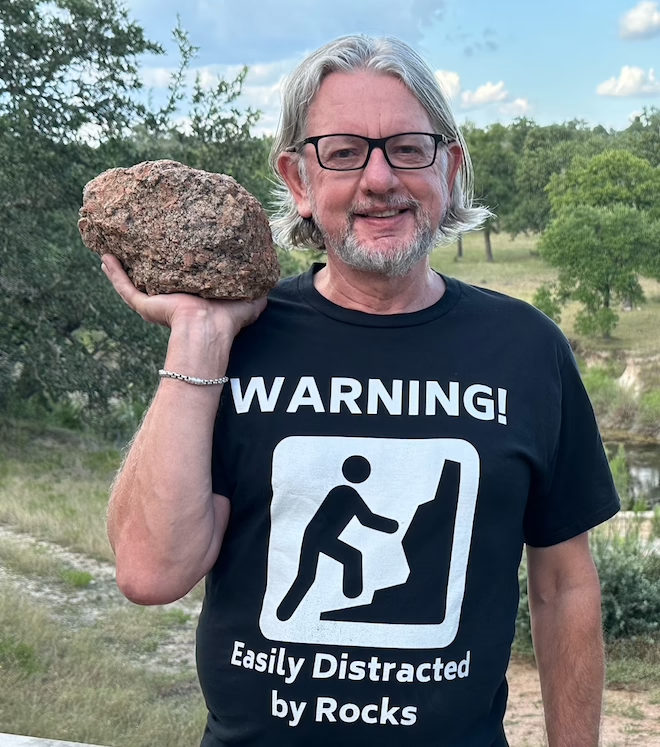
“In this talk I’ll show some local geologic maps and explain the geologic evolution using oil industry models of the Permian Basin whose eastern flank represents the earth beneath our Central Texas earth.”

This year, Andrew Pepper celebrates 45 years as a geologist, working in technical and leadership roles at BP, Hess and BHP petroleum companies. That bounced him all over the landscape. Currently, he is lucky enough to work from Fredericksburg where he runs a small global consultancy business with an enviable office window view of Ingrid’s garden and the creek beyond.

Come join us! Meetings are free and open to the public. The Fredericksburg chapter holds its monthly meetings on the 4th Tuesday of the month at St. Joseph’s Halle   (click link for a map) (212 W. San Antonio St., Fredericksburg)..

Come early at 6:30 pm to make new friends. The short chapter announcements  and program begin at 7:00. You may attend in person or via online streaming (https://www.youtube.com/@fredericksburgtexasnativeg4884).

More information is online at Facebook (@fbgtxnpsot), and Instagram(@npsot_fredericksburg_chapter)


About the Region

2026 Fall Symposium Logo

This low-elevations region of Texas extends inland from the barrier islands, about 60 or so miles, and stretches from Brownsville to Louisiana. In total, it covers about 9.5 million acres, with a high point of 150 feet in elevation. More than 1000 species of plants can be found in this region. On the southern end, species more common in Mexico (such as Sabal mexicana) and Central America occur.

The barrier islands provide us with dune systems, and clay flats to the inland side, which have species found in these areas alone. Many plants here, such as Ipomoea pes-caprae (beach morning glory), can be found throughout tropical regions of the globe. I’ve encountered the same species on the beaches of Guam.

Once inland, vast marshes and wet prairies occur. Occasionally, oak (Quercus fusiformis) groves can be found. Common grasses include species of Bothriochloa, Paspalum, and Sporobolus; eastern gamagrass (Tripsacum dactyloides); and switchgrass (Panicum species). Many rivers and creeks cut through the Gulf Prairies, and along these riparian areas various species of trees, Sabal minor, and other plants adapted to clay soils can be found. Due to overgrazing, farming, and fire suppression, woody species such as mesquite (Prosopis glandulosa) and huisache (Acacia farnesiana), and invasive species such as chinaberry (Melia azedarach), Brazilian pepper (Schinus terebinthifolius), and Chinese tallow (Sapium sebiferum) have increased and displaced our native flora.

Source: Wildflowers of Texas by Michael Eason